🧢 Beautiful ✨ Detailed πŸ’ Adorable

Adrian Pants Pattern

Adrian Pants Pattern
4.7β˜… Rating
5-7 Hours Time Needed
2.5K Made This
βœ‚οΈ

Intermediate Level

Ideal for those with basic crochet experience, featuring slightly more advanced stitches and techniques to expand your skills.

⏱️

Weekend Treat

Takes 5-7 hours, making it an enjoyable project to finish over a couple of days.

πŸ‘•

Casual Chic

Relaxed style with a modern twist, perfect for everyday wear while maintaining that handcrafted uniqueness.

About This Adrian Pants Pattern

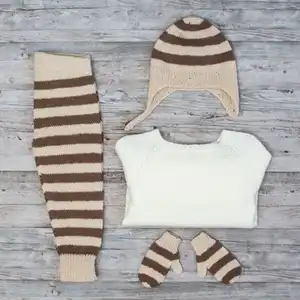
This pattern creates a pair of top-down knitted baby pants with pretty two-color stripes and an elastic waistband. It includes shaping for the back using German short rows and a gusset for a comfortable fit. The hem is folded and knitted down for a neat finish and a small gap is left to thread elastic.

Adrian Pants Pattern crochet pattern - detailed view of completed project

Available in multiple sizes from 6-12 months up to 7-8 years, with full yardage and needle recommendations. The pattern is worked in the round with a stripe pattern of 7 rounds per color and clear shaping instructions.

Why You'll Love This Adrian Pants Pattern

I absolutely love this pattern because it combines practical shaping with a playful striped design that kids adore. I enjoy how the German short rows add just the right amount of extra fabric in the back for a better fit. The knitted-down hem gives a clean, professional finish that holds the elastic securely. The gusset construction is clever and comfortable, making these pants stay put during active play. Working the striping keeps the project engaging and fun from start to finish.

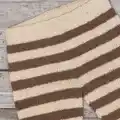
Adrian Pants Pattern step 1 - construction progress Adrian Pants Pattern step 2 - assembly progress Adrian Pants Pattern step 3 - details and accessories Adrian Pants Pattern step 4 - final assembly and finishing

Switch Things Up

I love customizing these pants with different color combinations; try alternating thin and wide stripes or using three colors instead of two.

I often change yarn weight and adjust needles to make a chunky winter version or a tiny keychain-sized sample for practice; just remember to recalc gauge.

I sometimes lengthen or shorten the legs to create shorts or full-length pants; measure on the child and add or subtract rounds accordingly.

For a softer waistband, use a narrower elastic or a stretchy ribbon and sew it in place securely through the knitted-down hem opening.

Try ribbing variations at the cuff such as 2x2 rib or folded double cuffs for a different look and extra warmth.

I like to add small decorative patches or elbow/knee reinforcements by darning with contrast yarn to make playful accents and improve durability.

Swap the knitted-down hem for a sewn-on fabric waistband if you prefer a different finish; you can also sew the hem down later as the pattern suggests.

Add a small button or toggles at the center front if you want a faux fly detail or to hide the elastic join.

Mix in a different stitch pattern like garter stitch or broken rib for the leg section to change texture and stretch properties.

I also recommend trying different finishing techniques such as blocking the pants lightly to even out stripes and improve drape before threading the elastic.

Common Mistakes & How to Fix Them

βœ— Not maintaining consistent gauge will change the finished size significantly; check your gauge and adjust needle size to match 24 sts = 10 cm before starting. βœ— Skipping placement of the marker at the start of the round can make the center front/back unclear; place markers (PM) as instructed to mark center front and the turning point. βœ— Working German short rows incorrectly can leave holes or uneven shaping; follow the DS (double st) instructions carefully and pick up both legs together when working the DS. βœ— Forgetting to leave a small gap when knitting the hem down prevents threading the elastic later; leave a small opening in the hem when joining cast-on edge to live sts. βœ— Increasing or decreasing with inconsistent tension around gusset increases can distort the fabric; make M1L and M1R neatly and keep even tension when working the gusset rounds.

Adrian Pants Pattern

Make cozy, striped Adrian pants knitted top-down with a neat folded hem and elastic waist. This pattern gives clear shaping with German short rows and a gusset for a comfortable fit. Perfect for babies and toddlers, the stripes add a playful, handcrafted look you will love.

Intermediate 5-7 Hours

Materials Needed for Adrian Pants Pattern

β€” Main Fabric

  • 01
    Sport weight yarn (recommended) - Color A: 190 (220) 260 (300) 350 meters / 210 (250) 290 (330) 390 yards depending on size
  • 02
    Sport weight yarn (recommended) - Color B: 140 (160) 180 (200) 220 meters / 160 (180) 200 (220) 240 yards depending on size
  • 03
    Suggested sample yarn: Wool4You Capella colors 260 and 264 (used on model)

β€” Tools Required

  • 01
    Circular needle 3 mm / US 2.5 : 40 cm / 16 inches
  • 02
    Circular needle 3.5 mm / US 4 : 40 cm and 60 cm / 16 and 24 inches
  • 03
    Double point needles (DPNs) for same sizes
  • 04
    Stitch markers (PM)
  • 05
    Stitch holder or scrap yarn
  • 06
    30 mm elastic, approx. length 46 (49) 52 (55) 58 cm / 18 (19.5) 20.5 (21.25) 22.75 inches
  • 07
    Tapestry/yarn needle for weaving in ends and threading elastic
  • 08
    Scissors

Progress Tracker

0% Complete

β€” Body :

Info :

With ndl 3 mm / US 2.5 and color A, CO 112 (119) 126 (133) 140 sts. PM, join to work in the rnd.

Info :

Work stst in the rnd until your work measures 3 (3) 3.5 (3.5) 3.5 cm / 1.25 (1.25) 1.5 (1.5) 1.5 inches. Next rnd: P all sts.

Info :

Then work sts in the rnd for another 3 (3) 3.5 (3.5) 3.5 cm / 1.25 (1.25) 1.5 (1.5) 1.5 inches.

Info :

Knit the hem down: The following rnd, fold your work at the purled rnd and knit the cast on edge together with the live sts, by working your ndl knitwise into the live st then into the associated CO st, and pull your yarn through both sts. Remember to leave a small gap to thread the elastic. Tip: If you find this too complicated, you can knit this rnd, and sew down the hem later. But knitting it down gives it a neater look, so give it a try!

Info :

Next rnd: With ndl 3.5 mm / US 4 work one rnd while inc as follows: *K7, INC1*. Repeat *-* to end of rnd. You have 128 (136) 144 (152) 160 sts on your ndl.

β€” Short rows :

Round 1 :

1. row (RS): K6 sts past M, turn work.

Round 2 :

2. row (WS): gsr, P6 sts past M, turn work.

Round 3 :

3. row (RS): gsr, K6 sts past last TP, turn work.

Round 4 :

4. row (WS): gsr, P6 sts past last TP, turn work.

Info :

Repeat row 3 and 4 until you've turned a total of seven times on each side of the M in the back.

Info :

Next, start the stripe pattern: 7 rnds of each color. Continue in the rnd with the stripe pattern until your work measures approx. 15 (16) 17 (18) 19 cm / 6 (6.25) 6.75 (7) 7.5 inches center front. PM center front.

β€” Gusset :

Round 1 :

1. rnd: M1R, K1, SM, K1, M1L.

Round 2 :

2. rnd: no inc. K all sts.

Round 3 :

3. rnd: M1R, K2, SM, K2, M1L.

Round 4 :

4. rnd: no inc. K all sts.

Round 5 :

5. rnd: M1R, K3, SM, K3, M1L.

Round 6 :

6. rnd: no inc. K all sts.

Round 7 :

7. rnd: M1R, K4, SM, K4, M1L

Info :

You have 144 (152) 160 (168) 176 sts on your ndl.

Info :

The pattern continues on the next page.

β€” German short rows :

Info :

When you've turned your work: wyif slip 1 st purlwise. Bring working yarn over the ndl to the back, pull tightly until the st falls to the back of the work and the 2 legs are on the ndl. These two legs are now referred to as a double st (DS) and are counted as one st.

Info :

If the next st is a purl st, bring working yarn under the right hand needle and get ready to purl as usual. If the next st is a knit st, keep working yarn on the back of work and k the next st as usual. When you get to the point of working the DS you either k or p it, depending on whether you're on the RS or WS. Remember that the DS is just 1 st, you work both legs at the same time.

β€” Legs :

Info :

Slip half of the sts, from M to M, on a st holder. You have 72 (76) 80 (84) 88 sts on your ndl.

Info :

PM and join to work the remaining sts in the rnd while you continue the stripe pattern. Leg dec: ssk, SM, k1, k2tog.

Info :

Work the leg dec every 2 (2) 2.5 (3) 3 cm / 0.75 (0.75) 1 (1.25) 1.25 inches, a total of 10 (11) 12 (13) 14 times. This should leave you with 52 (54) 56 (58) 60 sts on your ndl.

Info :

Continue working in the rnd until the leg measures 22 (27) 33 (39) 45 cm / 8.75 (10.75) 13 (15.5) 17.75 inches.

β€” Cuff :

Info :

With ndl 3 mm / US 2.5 and color A, K one rnd. Work 1x1 rib, i.e., K1, P1, until the rib measures approx. 6-10 cm / 2.5-4 inches. Bind off in pattern.

Info :

Knit the other leg the same way and weave in all ends.

Assembly Instructions

  • Knit the hem down by folding at the purled round and knitting the cast-on edge together with the live stitches, leaving a small gap to thread the elastic.
  • After completing the legs, slip half of the stitches from M to M onto a stitch holder and join the remaining stitches to continue the stripe pattern before shaping the leg decreases.
  • Thread the 30 mm elastic through the hem using a yarn needle, then join the elastic ends and secure with a few stitches, leaving it flat and even inside the hem.
  • Knit the second leg the same as the first, then weave in all ends securely and block gently if desired for a neater finish.
  • Place markers (PM) to mark the center front and turning point (TP) as instructed; these markers guide short rows and gusset increases for accurate assembly and fit.

Important Notes

  • πŸ’‘Use stitch markers to mark center front (PM) and any important points like turning points (TP) to keep track of shaping.
  • πŸ’‘Leave a small gap when knitting down the hem to allow you to thread the elastic later without unpicking stitches.
  • πŸ’‘Work German short rows exactly as described to avoid gaps; the double stitch (DS) counts as one stitch when you work both legs together.
  • πŸ’‘Check your gauge of 24 sts = 10 cm / 4 inches before starting; changing needle size may be necessary to match the gauge.
  • πŸ’‘Weave in ends as you go and secure the elastic with a few stitches to prevent twisting inside the hem.

These Adrian pants are a sweet and practical wardrobe staple for babies and toddlers, knitted top-down with comfy gusset shaping and playful stripes. They feature a neat knitted-down hem with elastic for a secure, adjustable waist. Make them in cozy sport yarn for a soft, wearable result that lasts. πŸ§ΆπŸ‘Ά

You ask,

we answer.

FAQs

What size will the finished piece be?

Garment hip circumference is approx: 53 (57) 60 (63) 67 cm / 20.75 (22.5) 23.5 (24.75) 26.5 inches for sizes 6-12 mo up to 7-8 yrs, as listed in the pattern.

Can I use different yarn weights for this pattern?

Yes, but this will affect the final size; the pattern uses sport weight yarn and a gauge of 24 sts = 10 cm, so adjust needle size accordingly to achieve the correct gauge.

Do I need to know German short rows and gusset shaping?

This pattern uses German short rows for back shaping and a simple gusset increase sequence; some experience with short rows and picking up DS will help, but instructions are provided.

How long does this project typically take to complete?

Most knitters finish this project in about 5-7 hours depending on experience, size chosen, and stripe complexity.