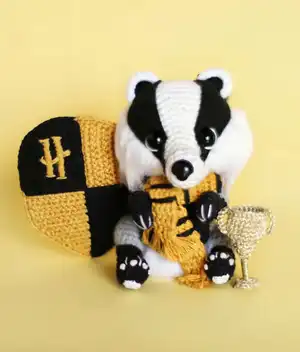
Create a charming Hufflepuff-inspired badger with this detailed crochet pattern. You will learn jacquard colorwork, work with fluffy yarn for realistic cheeks and tummy, and assemble a tiny mascot complete with a crest, scarf and trophy. This pattern includes step-by-step rounds, photos guidance and bonus accessories so you can finish a sweet collectible toy you'll love to display or gift.
Progress Tracker
0% Complete
— Head :
Round 1 :
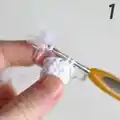
Yarn A: 6 loops, turning, 5sc (starting from the 2nd loop from the hook), 5sc (from the back of the chain) (10l)
Round 2 :
[4sc, inc]x2 (12l)
Info :
Next, you need to crochet the head of yarn A and yarn B at once alternately change the thread, but not cutting it to get fluffy cheeks. This technique is called jacquard. Color changing technique: when crocheting the last Yarn A sc, insert the hook into the loop, pull out the thread, crochet this sc to the end with Yarn B thread. Then the Yarn A thread is thrown forward, and the Yarn B working thread goes backwards. To change the thread back: when crocheting the last Yarn B sc, insert the hook into the loop, pull out the thread, crochet this sc to the end with the Yarn A thread. It's more convenience to move on only Yarn A, leave Yarn B where it ends and grab again when it necessary.
Round 6 :
inc (Yarn A); inc (Yarn B); [inc]x3 (Yarn A); inc (Yarn B), 6sc (Yarn A) (18l)
Round 7 :
2sc (Yarn A); 2sc (Yarn B); 6sc (Yarn A); 2sc (Yarn B), 6sc (Yarn A) (18l)
Round 8 :
sc, inc (Yarn A); sc, inc (Yarn B); [sc, inc]x3 (Yarn A); sc, inc (Yarn B), 6sc (Yarn A) (24l)
Round 9 :
3sc (Yarn A); 3sc (Yarn B); 9sc (Yarn A); 3sc (Yarn B), 6sc (Yarn A) (24l)
Round 10 :
2sc, inc (Yarn A); 2sc, inc (Yarn B); [2sc, inc]x3 (Yarn A); 2sc, inc (Yarn B), 6sc (Yarn A) (30l)
Round 11 :
4sc (Yarn A); 4sc (Yarn B); 12sc (Yarn A); 4sc (Yarn B), 6sc (Yarn A) (30l)
Round 12 :
3sc, inc (Yarn A); 3sc, inc (Yarn B); [3sc, inc]x3 (Yarn A); 3sc, inc (Yarn B), 6sc (Yarn A) (36l)
Round 13 :
5sc (Yarn A); 5sc (Yarn B); 15sc (Yarn A); 5sc (Yarn B), 6sc (Yarn A) (36l)
Round 14 :
4sc, inc (Yarn A); 4sc, inc (Yarn B); [4sc, inc]x3 (Yarn A); 4sc, inc (Yarn B), 6sc (Yarn A) (42l)
Round 15 :
5sc, inc (Yarn A); 5sc, inc (Yarn B); [5sc, inc]x3 (Yarn A); 5sc, inc (Yarn B), 6sc (Yarn A) (48l)
Round 16 :
6sc, inc (Yarn A); 6sc, inc (Yarn B); [6sc, inc]x3 (Yarn A); 6sc, inc (Yarn B), 6sc (Yarn A) (54l)
Round 17-19 :
8sc (Yarn A); 8sc (Yarn B); 24sc (Yarn A); 8sc (Yarn B), 6sc (Yarn A) (54l)
Round 20 :
6sc, dec (Yarn A); 6sc, dec (Yarn B); [6sc, dec]x3 (Yarn A); 6sc, dec (Yarn B), 6sc (Yarn A) (48l)
Info :
Comb the cheeks with the rug brush (see photos 7-9). Insert and fix the nose on the head (see photo 10). On the left is a picture that I used to make the spots around the eyes. Add brightness on the screen to maximum, enlarge or reduce the picture so that the size of the spots will be approx. 6 cm (2.4 inches) high. Attach a paper on it and circle the picture with a pencil. Then trace the paper onto the black felt and carefully cut out the spots with sharp scissors (see photo 11). Make x-shaped incisions and insert eyes there (see photo 12). Place safety eyes between the rounds 9 and 10 of the head (the distance between them is approx.imately 10 stitches) (see photos 13, 14). Sew black felt to the face with black threads. Using yarn needle to do around the eye 'loose stitch' of white mouline threads (see photos 15, 16). Separate one thread and fasten with a needle 'loose stitch' (see photos 17, 18). Press the eye to the embroidered line and fasten it.
Info :
Next cut the yarn B and continue crocheting with yarn A only!
Round 21 :
[6sc, dec]x6 (42l)
Round 22 :
[5sc, dec]x6 (36l)
Info :
Start stuffing the head with synthepus and continue crocheting.
Round 23 :
[4sc, dec]x6 (30l)
Info :
Insert cotter pin into shim (see photo 19). Place cotter pin with shim between the rounds 20 and 21 at the bottom of the head (see photo 20, 21).
Round 24 :
[3sc, dec]x6 (24l)
Round 25 :
[2sc, dec]x6 (18l)
Round 26 :
[sc, dec]x6 (12l)
Info :
Completely fill the head. Tip: Cut out a circle of white felt it should be a little larger than the resulting hole. Insert it into the hole in order to synthepus does not cling to the hook during closing the detail (see photos 22-24).
Info :
Trim the thread. Pass the thread through all the loops using a yarn needle. Tighten and secure.
— Ears :
Round 1 :
Yarn C 1: 2 loops, 6sc in 2nd loop from hook (amigurumi ring) (6l)
Round 3 :
[sc, inc]x6 (18l)
Info :
Change the thread to Yarn A. To get a beautiful line when changing color in the next round crochet the sc in this way - half of the sc with black thread, and the other half with white (Yarn C + Yarn A), see photo 25.
Round 4 :
18sc (Yarn C + Yarn A) (18l)
Info :
Next crochet with Yarn A only, cut the Yarn C leaving a long end for sewing! Remove the pin that marking the beginning of the round. Fold the resulting 18 loops in half and in the next round, crochet both halves together.
Round 5 :
1 loop, turning, 9 sl st (9l) (see photos 26, 27)
Info :
Cut and fix the thread. Sew the ears to the head, pre-fixing them with needles for cutting, in order to achieve perfect symmetry (see photos 28-30).
— Body :
Round 1 :
Yarn D 1: 2 loops, 8sc in 2nd loop from hook (amigurumi ring) (8l)
Round 3 :
[3sc, inc]x4 (20l) Change the thread to Yarn C.
Info :
To get a beautiful line when changing color in the next round crochet part of the sc in this way - half of the sc with grey thread, and the other half with black (Yarn D + Yarn C). Next, you need to crochet the body of yarn D and yarn C at once, alternately change the thread, but not cutting it (jacquard technique). Color changing technique is the same as for the head. It is more convenient to crochet with the jacquard only the front of the body, and the back should only be crocheted from yarn D.
Round 4 :
4sc, inc, 2sc (Yarn D + Yarn C), 2sc, inc, [4sc, inc]x2 (Yarn D) (24l)
Round 5 :
only through back loops 8sc (Yarn C), 16sc (Yarn D) (24l)
Round 6 :
[3sc, inc]x2 (Yarn C); [3sc, inc]x4 (Yarn D) (30l)
Info :
Insert cotter pin in middle of body (see photo 43). Put the disk on cotter pin and wrap the ends in the 'rings' with the help of round-nosed pliers (see photos 44-48).
Round 7 :
[4sc, inc]x2 (Yarn C); [4sc, inc]x4 (Yarn D) (36l)
Round 8 :
12sc (Yarn C), 24sc (Yarn D) (36l)
Round 9 :
[5sc, inc]x2 (Yarn C); [5sc, inc]x4 (Yarn D) (42l)
Round 10 :
14sc (Yarn C), 28sc (Yarn D) (42l)
Round 11 :
[6sc, inc]x2 (Yarn C); [6sc, inc]x4 (Yarn D) (48l)
Round 12-15 :
16sc (Yarn C), 32sc (Yarn D) (48l)
Info :
Change the thread to Yarn B to get fluffy tummy (see photos 49, 50). Cut the Yarn C.
Round 16 :
16sc (Yarn B), 32sc (Yarn D) (48l)
Round 17 :
6sc, [dec]x2, 6sc (Yarn B); [6sc, dec]x4 (Yarn D) (42l)
Round 18 :
5sc, [dec]x2, 5sc (Yarn B); [5sc, dec]x4 (Yarn D) (36l)
Round 19 :
4sc, [dec]x2, 4sc (Yarn B); [4sc, dec]x4 (Yarn D) (30l)
Info :
Start stuffing the body with synthepus.
Round 20 :
3sc, [dec]x2, 3sc (Yarn B); [3sc, dec]x4 (Yarn D) (24l)
Info :
Next cut the yarn B and continue crocheting with yarn D only!
Round 21 :
[2sc, dec]x6 (18l)
Round 22 :
[sc, dec]x6 (12l)
Info :
Completely fill the body. Tip: Cut out a circle of white felt it should be a little larger than the resulting hole. Insert it into the hole in order to synthepus does not cling to the hook during closing the detail (see photos 51, 52).
Info :
Trim the thread. Pass the thread through all the loops using a yarn needle. Tighten and secure. Embroider the line with Yarn B and fix it with white thread to hide the 'stage' (see photos 53, 54). Comb the tummy with the rug brush.
— Hands :
Round 1 :
Yarn D 1: 2 loops, 6sc in 2nd loop from hook (amigurumi ring) (6l)
Round 2 :
[2sc, inc]x2 (8l)
Round 3 :
[3sc, inc]x2 (10l)
Info :
Change the thread to Yarn C. To get a beautiful line when changing color in the next round crochet the sc in this way - half of the sc with grey thread, and the other half with black (Yarn D + Yarn C), see photo 55.
Round 6 :
10sc (Yarn D + Yarn C) (10l)
Info :
Next crochet with Yarn C only, cut the Yarn D. Start stuffing the hand with synthepus.
Round 7-8 :
3sc, 5 sl st, 2sc (10l)
Round 9 :
sc, dec, sc, [inc]x3, sc, dec (11l)
Round 12 :
2 sl st, 2sc, dec, 2sc, sl st (8l)
Round 13 :
2 sl st, 5sc, sl st (8l)
Round 14 :
[inc]x2, sc, [dec]x2, sc (8l)
Info :
Completely fill the hand.
Round 15 :
4sc, [dec]x2 (6l)
Info :
Trim the thread. Pass the thread through all the loops using a yarn needle. Tighten and secure. Divide white thread floss in half and embroider the claws (see photos 56, 57).
— Legs :
Round 1 :
Yarn D 1: 2 loops, 6sc in 2nd loop from hook (amigurumi ring) (6l)
Round 2 :
[2sc, inc]x2 (8l)
Round 3 :
[sc, inc]x4 (12l)
Round 4 :
[5sc, inc]x2 (14l)
Round 7 :
[dec]x2, 10sc (12l)
Info :
Change the thread to Yarn C. To get a beautiful line when changing color in the next round crochet the sc in this way - half of the sc with grey thread, and the other half with black (Yarn D + Yarn C).
Round 8 :
12sc (Yarn D + Yarn C) (12l)
Info :
Next crochet with Yarn C only, cut the Yarn D. Start stuffing the leg with synthepus.
Round 9 :
dec, 8sc, dec (10l)
Round 12 :
3sc, 5 sl st, 2sc (10l)
Round 13 :
sc, dec, sc, [inc]x3, sc, dec (11l)
Round 14 :
4sc, [inc]x3, 4sc (14l)
Round 15 :
6sc, [inc]x2, 6sc (16l)
Info :
Completely fill the leg.
Round 18 :
[2sc, dec]x2 (6l)
Info :
Trim the thread. Pass the thread through all the loops using a yarn needle. Tighten and secure (see photo 58).
Section :
SPOT (White threads floss) Crochet spot with 1,5 mm hook. 1: 4 loops, turning, 3sc (starting from the 2nd loop from the hook), 3sc (from the back of the chain) (6l)
Info :
Cut and fix the thread, leaving a very long end for sewing. Sew the spot to the foot (see photo 59). Don't cut the thread, but move upward diagonally from the spot. Make 4 French knots (see photos 60, 61). Divide the threads floss in half, embroider the claws (see photos 62).
— Tail :
Round 1 :
Yarn D 1: 2 loops, 6sc in 2nd loop from hook (amigurumi ring) (6l)
Info :
Next, you need to crochet the tail of yarn D and yarn B at once, alternately change the thread, but not cutting it (jacquard technique). Color changing technique is the same as for the head.
Round 2 :
3sc (Yarn B), 3sc (Yarn D) (6l)
Round 3 :
2sc, inc (Yarn B), 2sc, inc (Yarn D) (8l)
Round 4 :
[sc, inc]x2 (Yarn B), [sc, inc]x2 (Yarn D) (12l)
Round 5-8 :
6sc (Yarn B), 6sc (Yarn D) (12l)
Info :
Start stuffing the tail with synthepus.
Round 9 :
[sc, dec]x2 (Yarn B), [sc, dec]x2 (Yarn D) (8l)
Info :
Completely fill the tail.
Round 10 :
2sc, dec (Yarn B), 2sc, dec (Yarn D) (6l)
Info :
Trim the thread. Pass the thread through all the loops using a yarn needle. Tighten and secure (see photo 63). Comb the tail with the rug brush.
— Assemblage :
Step 1 :
Sew your crocheted hands and legs and to the body with a threaded bracing (use round-nosed pliers to make it easier to pull the needle). Attach the limbs using needles for cutting (hands between 7 and 8 rounds of body, distance between legs approx. 18 stitches, legs between 15 and 16 rounds of body, distance between legs approx. 22 stitches, see photos 64, 65). Check that the badger seat steadily. Detach the hands and legs without removing the needles from them, and insert other needles for cutting in their place (see photo 66, 67).
Step 2 :
Insert the needle through the back into the hand attachment point (leaving the loose end of the thread outside) (see photo 68, 69).
Step 3 :
Thread the needle through two loops on the inner surface of the hand (the needle for cutting must be in the middle) (see photo 70).
Step 4 :
Insert the needle into the body at the hand attachment point and pull out it at the point of attachment of the second hand (see photo 71).
Step 5 :
Pass the needle through the second hand in the same way (see photo 72).
Step 6 :
Sew the body and the hands two more times in the same way for strength (see photo 73).
Step 7 :
Insert the needle at the hand attachment point and pull out it at the point of attachment of the opposite leg (see photo 74).
Step 8 :
Thread the needle through the leg (see photo 75).
Step 9 :
Insert the needle into the body at the leg attachment point and pull out it at the point of attachment of the second leg (see photo 76).
Step 10 :
Pass the needle through the second leg (see photo 77).
Step 11 :
Sew the body and the legs two more times in the same way for strength (see photo 78).
Step 12 :
Insert the needle into the body at the leg attachment point and pull out it the back in the place, where it was introduced at the very beginning (see photo 79).
Step 13 :
Tie a few knots (see photo 80).
Step 14 :
Sew the tail to the body (see photos 81). Congratulations, you did a great job and created a small miracle! Embrace your badger (see photos 82-84)!
— BONUS CUP :
Info :
Crochet the cup with 1,5 mm hook using golden metalized threads mouline. The cup is crocheted from two details.
Detail 1 :
2 loops, 6sc in 2nd loop from hook (amigurumi ring) (6l)
Round 2 :
[2sc, inc]x2 (8l)
Round 3 :
[3sc, inc]x2 (10l)
Round 4 :
only through back loops [4sc, inc]x2 (12l)
Round 5 :
[2sc, inc]x4 (16l)
Round 6 :
[3sc, inc]x4 (20l)
Round 11 :
10 sl st, 8 loops, sl st in the stitch 4 rounds down, 1 loop, turning, 7 sl st, sl st in the same loop (in which the last sl st was crocheted before the chain); 10 sl st 8 loops, sl st in the stitch 4 rounds down, 1 loop, turning, 7 sl st, sl st in the same loop (in which the last sl st was crocheted before the chain, see photos 85-90). Cut and fix the thread leaving a long end.
Info :
Cut off a piece of wire approx.imately 10 cm (3.9 inches) long and fold it in half (see photo 91). Insert the wire into the cup as shown on photo 92.
Detail 2 :
2 loops, 6sc in 2nd loop from hook (amigurumi ring) (6l)
Info :
Cut and fix the thread leaving a long end. Insert the wire into detail 2 as shown on photo 93. Bent the ends and cut off excess wire (see photos 94-96).
Info :
Wrap the wire with a thread as follows: glue the thread to the wire with super glue leaving the long end of the thread free. Spread a small section of the wire with glue and wrap it tightly with the thread in a spiral (see photo 97). Repeat until all the wire is wrapped to the end (see photos 98, 99).
— HOUSE CREST :
Info :
Crochet the house crest with 1,75 mm hook along rows. Use video help to crochet 10, 21, 22 and 37 rows.
Yarn E Round 1 :
10 loops, turning, 9sc (9l)
Round 2 :
1 loop, turning, 9sc (9l)
Round 3 :
1 loop, turning, 8sc, inc (10l)
Round 4 :
1 loop, turning, 10sc (10l)
Round 5 :
1 loop, turning, 9sc, inc (11l)
Round 6 :
1 loop, turning, 11sc (11l)
Round 7 :
1 loop, turning, 10sc, inc (12l)
Round 8-9 :
1 loop, turning, 12sc (12l) Change the thread to Yarn C.
Info :
To get a beautiful line when changing color in the next round crochet the sc in this way - half of the sc with yellow thread, and the other half with black (Yarn E + Yarn C), see photos 100-102.
Round 10 :
1 loop, turning, 12sc (Yarn E + Yarn C) (12l)
Info :
Next crochet with Yarn C only, but don't cut the Yarn E!
Round 11-14 :
Yarn C 1 loop, turning, 12sc (12l)
Round 15 :
1 loop, turning, 10sc, dec (11l)
Round 16 :
1 loop, turning, 11sc (11l)
Round 17 :
1 loop, turning, 9sc, dec (10l)
Round 18 :
1 loop, turning, 10sc (10l)
Round 19 :
1 loop, turning, 8sc, dec (9l)
Round 20 :
1 loop, turning, 9 sl st (9l)
This delightful Badger Puffy is a handmade mascot perfect for Hufflepuff fans and cozy collectors. The pattern includes full photo guidance, clever jacquard color-changes and fluffy yarn techniques to make realistic cheeks and tummy. Make one for yourself or as a thoughtful, magical gift that will be cherished. 🧶✨