🧶 Beautiful ✨ Detailed 💝 Adorable

Black And Ivory Cat And Web Table Runner Pattern

Black And Ivory Cat And Web Table Runner Pattern
4.7★ Rating
8-10 Hours Time Needed
2.7K Made This
✂️

Intermediate Level

Ideal for those with basic crochet experience, featuring slightly more advanced stitches and techniques to expand your skills.

⏱️

All-Day Adventure

Requires 8-10 hours, ideal for a full day of immersive crocheting.

🏡

Cozy Accent

A warm touch for your space that transforms ordinary corners into inviting nooks filled with handmade charm.

🧶 Jump to Pattern ↓

About This Black And Ivory Cat And Web Table Runner Pattern

This pattern recreates a stunning table runner of repeating black cat faces and ivory spiderweb medallions linked by clusters of small flowers and leaves. The runner is built from multiple crochet motifs: flat cat medallions with embroidered eyes and tiny heart noses, airy spiderweb circles in cream, multi-layered flowers in purple, orange and pale peach, and textured leaves in sage green. The entire set is joined with a decorative black chain-lace border for a finished, cohesive look.
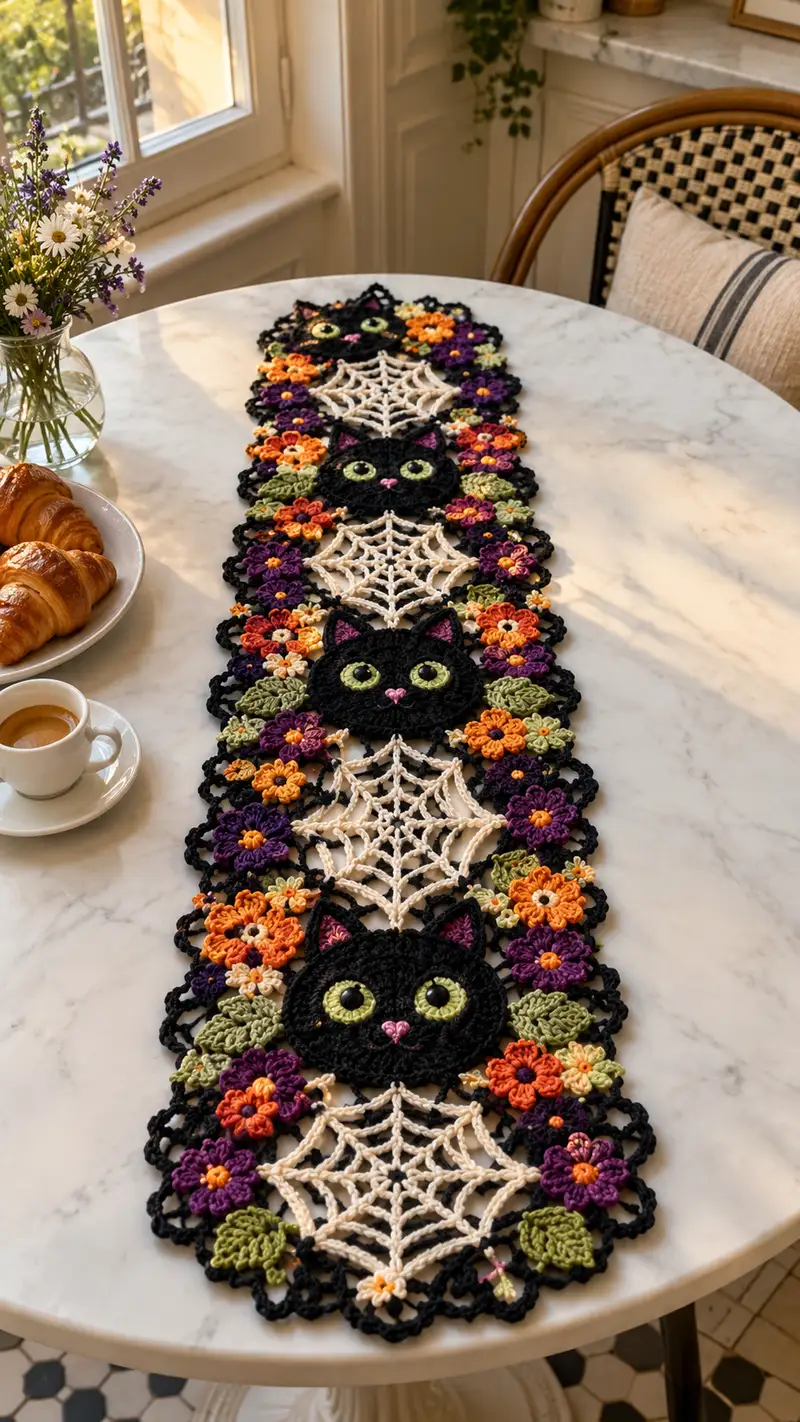
Black And Ivory Cat And Web Table Runner Pattern crochet pattern - detailed view of completed project

The motifs are designed for join-as-you-go assembly but can also be made separately and sewn. Color changes are simple and mostly worked in rounds; no advanced tapestry colorwork is required. This makes the design approachable for intermediate crocheters comfortable with motifs, picots, and small embroidery.

Why You'll Love This Black And Ivory Cat And Web Table Runner Pattern

I love this pattern because it blends playful motif work with delicate lace—cats and spiderwebs together feel spooky and sweet. The colorful floral clusters bring warmth and balance to the high-contrast black and ivory, and the join-as-you-go construction keeps assembly tidy. Working each motif gives frequent small wins as the runner grows, and the assembly produces a very satisfying, photogenic finished piece.

Black And Ivory Cat And Web Table Runner Pattern step 1 - construction progress Black And Ivory Cat And Web Table Runner Pattern step 2 - assembly progress Black And Ivory Cat And Web Table Runner Pattern step 3 - details and accessories Black And Ivory Cat And Web Table Runner Pattern step 4 - final assembly and finishing

Switch Things Up

I absolutely love how easily you can personalize this runner—swap the orange and purple for pastel hues to make a spring version, or use metallic thread for a glam holiday take. I find changing a single accent color completely alters the mood of the runner.

I often adjust size by adding or removing repeating units: add an extra cat + web pair to extend the runner for longer tables, or make a single cat-and-web square as a coaster. Using a thicker yarn and larger hook also makes a cozy, heavier table runner that lays even flatter.

For a child-safe version, I replace safety eyes with embroidered ones and use muted, playful colors. If you want a sturdier piece, consider lining the back with a matching fabric attached with a ladder stitch for a smooth underside.

Common Mistakes & How to Fix Them

✗ Skipping stitch markers at round starts can cause misaligned joins and uneven edges; always mark the first stitch of each round. ✗ Inconsistent tension between motifs creates size variation making joining tricky; keep a steady tension and measure motifs as you go. ✗ Not blocking motifs before joining leads to mismatched edges and a wavy runner; lightly block each motif to flatten and square edges. ✗ Failing to weave in ends neatly before joining results in visible tails later; tidy ends as you complete each motif for a clean finish. ✗ Joining motifs without pinning allows shifting during sewing; always pin or clip pieces in place to ensure symmetry. ✗ Using a hook size that differs too much from the recommended size will change scale and break the motif pattern; swatch and adjust hook size first.
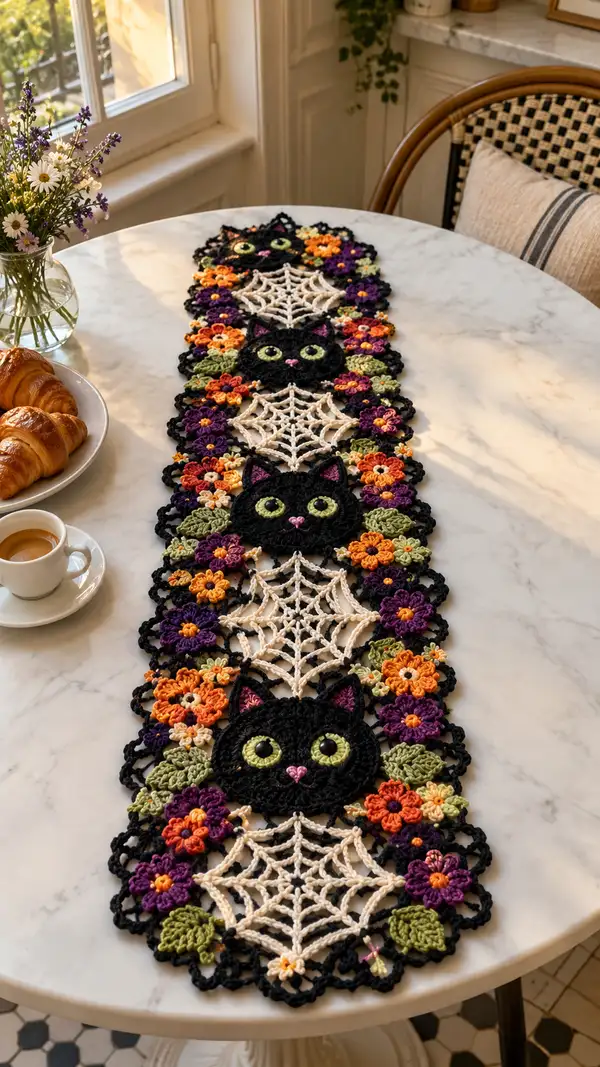
Black And Ivory Cat And Web Table Runner Pattern

A spooky-chic table runner featuring alternating black cat medallions and delicate ivory spiderwebs, surrounded by colorful autumnal flowers and leaves. This detailed motif-based pattern uses join-as-you-go assembly for a seamless finish. Perfect for seasonal decor or Halloween centerpieces, with contrasting greens, purples, oranges and neutral black edging.

Intermediate 8-10 Hours

Materials Needed for Black And Ivory Cat And Web Table Runner Pattern

— Main Fabric

  • 01
    Worsted weight yarn (#4), approximately 220-260g in black (main motif outlines and border)
  • 02
    Worsted weight yarn (#4), approximately 90-110g in ivory/cream (spiderwebs and small accents)
  • 03
    50-70g in purple (flowers)
  • 04
    50-70g in orange (flowers)
  • 05
    40-60g in chartreuse/sage green (leaves and inner accents)
  • 06
    Small amounts (10-20g each) in pale peach and pink for flower centers and cat nose

— Tools Required

  • 01
    3.5mm (E) crochet hook for the main work (adjust to tension)
  • 02
    3.0mm (D) hook for tighter details and smaller flower pieces (optional)
  • 03
    Tapestry/yarn needle for sewing and embroidery
  • 04
    Scissors
  • 05
    Stitch markers (at least 6)
  • 06
    Blocking pins and blocking mat
  • 07
    Measuring tape or ruler
  • 08
    Optional: small safety eyes or crocheted eye appliques (if you prefer 10mm plastic eyes)
  • 09
    Optional: fabric glue for securing tiny beads or delicate centers

Progress Tracker

0% Complete

— Cat Face Medallion (Make 4) :

Round 1 :

6 sc in magic ring (6)

Round 2 :

6 inc (12)

Round 3 :

(1 sc, inc) x 6 (18)

Round 4 :

(2 sc, inc) x 6 (24)

Round 5 :

(3 sc, inc) x 6 (30)

Round 6 :

(4 sc, inc) x 6 (36)

Info :

Use black yarn for the face. Maintain a tight tension so the motif lies flat. From here we will build a slightly larger disc for embroidered features.

Round 7 :

(5 sc, inc) x 6 (42)

Round 8 :

(6 sc, inc) x 6 (48)

Round 9 :

(7 sc, inc) x 6 (54)

Round 10-14 :

1 sc in each st (54)

Info :

At the end of round 12, make a small stitch-map: mark the center top, bottom and left/right on round 12. This helps place eyes and ears symmetrically. Embroidered or crocheted eyes will be added after round 14.

Round 15 :

Sc in each st BLO (54)

Round 16 :

1 sc in each st (54)

Round 17 :

(7 sc, dec) x 6 (48)

Round 18 :

(6 sc, dec) x 6 (42)

Info :

Begin slight shaping to keep the face slightly domed but largely flat. Stuffing is not required—these are flat medallions. If you prefer slight loft, insert a thin layer of interfacing or batting when joining.

Round 19 :

(5 sc, dec) x 6 (36)

Round 20 :

(4 sc, dec) x 6 (30)

Round 21 :

(3 sc, dec) x 6 (24)

Round 22 :

(2 sc, dec) x 6 (18)

Round 23 :

(1 sc, dec) x 6 (12)

Round 24 :

6 dec (6)

Info :

Fasten off leaving a long tail for weaving in or attaching ear base if you will sew the ears on. We will create a decorative outer rim next to frame the face; reattach black yarn with sl st on round 12 position.

Round 25 :

Join black at marked round 12 st. Ch1, *sc in next 2 sts, ch3, skip 2 sts* rep around to create small chain loops for joining (approx 18 chain loops, adjust to maintain even spacing). Sl st to first sc to join. (54)

Round 26 :

Working into chain loops: *(sl st, ch3, 3 dc, ch3, sl st) into each ch3 loop* - creates small scalloped petals. Continue around, sl st to join end.

Round 27 :

Insert a round of surface slip stitch around the face for definition: sl st into front loops only around (54)

Info :

Embroider facial features now or create crocheted eyes and nose appliques. Eyes are worked as separate small discs in green with black pupils to be sewn onto the face.

— Cat Eyes (Make 8: 2 per medallion) :

Round 1 :

Using chartreuse/green yarn: 6 sc in mr (6)

Round 2 :

6 inc (12)

Round 3 :

(1 sc, inc) x 6 (18)

Round 4 :

1 sc in each st (18)

Round 5 :

Switch to black for pupil: join black, sc in next 6 sts to create crescent pupil shape; leave remainder green to create highlight when stitching. Fasten off leaving tails to sew. (18)

Info :

Position these eyes on the cat face around round 12 (marked) leaving 9-10 stitches between them for the wide-eyed look shown. Sew eyes flat to the face using matching thread; use small French knots for highlights if desired.

— Cat Nose & Mouth Details :

Round 1 :

Small heart nose - Using pink: ch 4, (sc in 2nd ch from hook, sl st next, hdc next), ch 1, turn and sc into base to make tiny heart shape. Fasten off leaving tail. (Work as a small applique)

Info :

Sew nose centrally below eyes on round 13-14. Use black embroidery yarn and a few short stitches to add a small smiling mouth curving down slightly. Use a yarn needle and secure ends well.

— Cat Ears (Make 8: 2 small inner, 2 outer per medallion) :

Outer Ear Round 1 :

With black, 6 sc in mr (6)

Round 2 :

6 inc (12)

Round 3 :

(1 sc, inc) x 6 (18)

Round 4 :

1 sc in each st (18)

Round 5 :

Fold ear and sc across base (10 sc) to shape triangle. Fasten off leaving tail for sewing

Inner Ear (small) :

Using deep magenta or rose: 4 sc in mr, inc x4 (8), sc round (8), fasten off leaving tail. Sew onto inner face of black ear for contrast.

Info :

Sew ears to the top rim of the cat medallion at positions marked on round 12. Ears should point slightly outward and forward as shown in the photo.

— Spiderweb Motif (Make 3) :

Round 1 :

Use ivory/cream. 6 sc in mr (6)

Round 2 :

6 inc (12)

Round 3 :

(1 sc, inc) x 6 (18)

Round 4 :

(2 sc, inc) x 6 (24)

Round 5 :

1 sc in each st (24)

Info :

We will build the web surface on top of a small circular base: this gives enough stability for the stretched web spokes.

Round 6 :

Ch5 (counts as tr+ch2 here for spokes), *skip 3 sts, sl st in next st, ch5* rep around to create 8 spokes. Sl st to first st to join. (8 spokes)

Round 7 :

Work along each ch5: sl st into base, ch6, sl st in same base to create small loop on each spoke. Repeat around to make 8 loop petals.

Round 8 :

Switch to working web: Join ivory to center. Ch1, *sl st to next spoke base, ch5, sl st to next spoke base* - connect spokes by working chains and slip stitches to form the first ring of webbing. (8 chain arches)

Round 9 :

*Into middle of each ch5 arch: sc, ch3, 3 dc, ch3, sc* to make a decorative arch ring around each spoke junction (repeat 8 times). Sl st to join.

Round 10 :

For the inner web: working from center, make a ring of short chain nets: sl st to center, ch8, sl st to next spoke center, continue to create 8 chain spokes creating triangular web shape. Fasten off loosely leaving tail for joining to base.

Info :

Spiderweb construction is deliberately airy and slightly irregular for a handcrafted feel. Block lightly with pins so spokes are evenly spaced before final joining to adjacent motifs.

— Large 2-Tier Flower (Make 12) :

Round 1 :

Using orange (flower color): 6 sc in mr (6)

Round 2 :

6 inc (12)

Round 3 :

(1 sc, inc) x 6 (18)

Round 4 :

Change to a slightly darker orange for depth (Info: join a new color here). Petal round: *ch3, 3 dc, ch3, sl st in same base* into each stitch around to make 18 petals.

Round 5 :

Underlayer: join purple yarn at back, sc around to provide backing and small picots between petals: *(sc in next st, ch3, sl st in same st) x 9* - creates little points for texture.

Info :

Make these flowers slightly tight so they puff slightly when sewn onto the black border. Add a French knot or small bead in the center for a finished look.

— Small 1-Tier Flower (Make 20) :

Round 1 :

Using purple: 6 sc in mr (6)

Round 2 :

6 inc (12)

Round 3 :

Petal round: *ch3, 3 dc, ch3, sl st in next st* around to make 6 petals. Fasten off. Add small peach center with a single sc bobble (ch2, 3 dc in same st, ch2, sl st) and sew to center.

Info :

Use small stitchwork here; these are decorative clusters filling the spaces between cats and webs. Make a few in contrasting colors for a lively palette.

— Leaf (Make 24) :

Round 1 :

With sage green: ch 8, sc in 2nd ch from hook, hdc next, dc next 2, hdc next, sc next; turn and work along opposite side of chain: sc, hdc, dc, dc, hdc, sc; sl st to first sc. (approx 14 sts)

Round 2 :

Edge: ch1, sc around working 2 sc in each dc apex for a rounded leaf. Fasten off. Block flat if desired.

Info :

Leaves are slightly cupped; steam-block carefully to hold subtle shape. Sew leaves into clusters around flowers.

— Connector/Background Lace Motif (Make 20) :

Round 1 :

With black: 8 sc in mr (8)

Round 2 :

*(sc, ch4) x 8, sl st to join* - creates eight chain arches (8 arches)

Round 3 :

Into each ch4 arch: sl st, ch5, sl st to form loop; repeat to create a lacy ring. Fasten off.

Round 4 :

Rejoin black and add tiny picot decoration: *sl st, ch3, sl st into base* between arches to add texture. Fasten off leaving long tails for join-as-you-go sewing.

Info :

These lace motifs act as small connectors between larger pieces and are also used along the edge. Make slightly looser tension than the solid medallions so the border sits flat and decorative.

— Outer Scallop Border :

Round 1 :

With black, rework round along edge of full runner after joining all motifs: join black at a midpoint, ch1, *sc in each st around outer edges where motifs meet to create continuous foundation (count varies depending on final assembled width)*. This stabilizes join edges.

Round 2 :

Sc into foundation: *ch5, skip 3 foundation sts, sc into next* repeat around to create outer loops. Sl st to join.

Round 3 :

Scallop round: Into each loop work (sl st, ch3, 4 dc, ch3, sl st) to create a full scallop shell. Fasten off and weave ends.

Round 4 :

Picot edging: Rejoin and work small picot spaces between scallops: *sc, ch3, sl st into base* - this gives delicate points pictured on the runner edge. Fasten off and block entire runner lightly to set shape.

Info :

The outer border should be worked after motifs are fully assembled so spacing and count can be matched to the actual piece. Keep notes of your foundation stitch counts as you progress for symmetry.

— Join-As-You-Go Assembly Sequence :

Info :

Work left-to-right: arrange motifs in alternating order: Cat Medallion, Small Lace Connector, Spiderweb, Small Lace Connector, Cat Medallion, etc. Use the black chain loops created on cat medallion rounds to sl st into matching points on adjacent motifs to join as you complete a round. Pin motifs before final joining and use long tails to whip stitch through both motifs' edges for reinforcement.

Round 1 :

When joining a cat to a connector: align the connector ch loops to the cat's outer chain loops, insert hook through both loop openings, sl st through both to join, ch1 and continue to next join point. Repeat until the connector is attached at all designated loops.

Round 2 :

When joining to the web: attach the chain arches from the web to the cat scalloped loops using sl st or small whip stitch. For a stronger join, use a yarn needle and matching yarn to blanket-stitch through both chain bases. Blending joins into the black border keeps them subtle.

Info :

Place flowers and leaves into gaps as you join motifs. Sew flower centers to the black connectors and tack leaves under petals so clusters appear naturally woven into the lace border.

— Detailed Round Counts & Spacing Notes :

Info :

Each large cat medallion finishes approx 54 stitches round; outer chain loops approx 18. Spiderwebs are built on a 24-st base with 8 spokes. Plan spacing so each repeated set of (Cat + Web + Cat) occupies about 9-10 inches of runner length. For a final length near 42 inches with 4 cat medallions and 3 webs, maintain consistent motif diameter by checking with a ruler after completing round 14-16 of main motifs.

— Finishing & Blocking :

Info :

Weave in all ends. Pin the runner on blocking mats at the outer scallop points and gently steam or wet-block to open lace and flatten motifs. Allow to dry fully before use. If motifs shift, secure with extra tie-stitches in hidden back loops.

— Alternate Color & Size Tips :

Info :

To scale runner larger: use a thicker yarn (#5) and a 4.5-5.0mm hook. For a smaller runner, use a #3 sport weight and 3.0mm hook. Always make a sample motif to set your gauge. For different seasons, swap accent colors (pastels for spring, deep reds for autumn).

Assembly Instructions

  • Lay out all motifs in final order before joining: Cat Medallion, Lace Connector, Spiderweb, Lace Connector, Cat Medallion, etc. This helps you see spacing and color balance before attaching anything.
  • Attach cat medallions to adjacent lace connectors using the cat outer chain loops and connector arches. Match loop to loop and join by slip stitching through both loops, then secure with a couple of whip stitches using a yarn needle.
  • Join spiderweb motifs to neighboring connectors and cat medallions by aligning web spokes and connector arches; pin in place and sew using small, tight whip stitches through chain bases for an invisible seam.
  • Sew flowers and leaves into the gaps as you go: place flowers over the black connector loops and tack them with a few stitches through the flower base and connector ring so clusters sit naturally.
  • When all motifs are joined, work the outer border: pick up stitches along the outside edges where motifs meet and work the foundation round in sc. Proceed with scallops and picot edge following counts from the pattern.
  • Weave in tails into the back of the runner; use a thin yarn to tidy visible seams. Block the assembled runner on a mat, pinning out scallops and floral points for a neat finish.
  • For extra stability, use a matching thread to stitch through paired seam areas (where three motifs meet) and tie knots on back. Avoid bulky knots on the front side.
  • Optionally add tiny beads or French knot centers to flower middles after blocking for a polished look and to add slight weight to hold motifs flat.

Important Notes

  • 💡Use stitch markers consistently at the beginning of each round to avoid counting errors and maintain proper shaping.
  • 💡Stuffing is not necessary for these flat motifs; if you prefer a slight loft in the cat face, insert a thin piece of batting before joining.
  • 💡Block each motif lightly after completion to ensure consistent size before join-as-you-go assembly.
  • 💡Keep a small pile for each motif type to stay organized—work in sets (e.g., make all eyes, then noses, then ears) to ensure uniformity.
  • 💡When sewing motifs together, use small, tight stitches and avoid bulk—weave tails neatly at the back for a clean front.
  • 💡If using safety eyes, attach them before joining or blocking and make sure they are fully locked; alternatively, crochet or embroider eyes for child-safe decor.
  • 💡Measure motif diameter periodically; a variance of more than 1/4 inch can distort the runner shape during assembly.
  • 💡Work the outer border last so you can adapt your foundation count to the actual assembled width for perfect symmetry.

This Black and Ivory Cat and Web Table Runner is such a joyful seasonal project that balances playful character faces with delicate lace. Each motif you crochet adds a small, satisfying win and the assembly reveals the runner's beautiful rhythm. The contrast of black and cream with pockets of orange, purple and green makes it a standout centerpiece for autumn or Halloween gatherings. I hope you enjoy making and displaying it—happy stitching! 🎃🧶

You ask,

we answer.

FAQs

What is the finished size of this table runner?

Based on the specified yarn weight and hook (worsted, 3.5mm) and the motif counts in this pattern, the finished runner measures approximately 40-44 inches long and 8-10 inches wide. Using thicker or thinner yarn will change size proportionally.

Can I use a different yarn weight?

Yes. Using a heavier yarn and larger hook will produce a larger, sturdier runner. Use a thinner yarn and smaller hook to make a more delicate runner. Always make a motif swatch to determine how many motifs you'll need for desired length.

Do I need to block motifs?

Blocking is strongly recommended. Light blocking flattens motifs, evens stitch tension, and makes join-as-you-go assembly much easier for a polished final piece.

How are motifs joined?

This pattern uses join-as-you-go slip stitch joins for edges and additional whip stitch reinforcement with a yarn needle. You can also sew motifs together separately if you prefer.

Are safety eyes required for the cat medallions?

Safety eyes are optional—embroidered or crocheted eyes create a child-safe runner without small plastic parts. If using safety eyes, secure them before blocking and joining.

How much yarn will I need in total?

Approximately 220-260g black, 90-110g ivory, and 40-70g of each accent color (purple, orange, green) as listed in materials. Exact amounts vary based on stitch tension and final runner length.

Can I make this runner longer or shorter?

Yes. Add or remove pairs of cat/web motif sections to scale the length. Remember to adjust the number of connectors and outer border counts accordingly.

What is the best way to secure small flower centers?

Sew small French knots with embroidery thread or secure tiny seed beads with a drop of fabric glue and a stitch for reinforcement. Avoid heavy embellishments if you plan to launder the runner frequently.