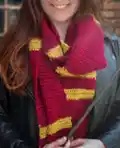
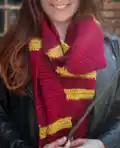
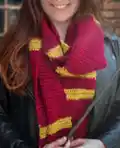
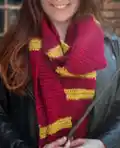
About This Hogwarts House Scarf Pattern
This pattern creates a circular, striped Hogwarts House scarf worked in the round with contrasting house stripes and fringe. It is written for knitters who want a wearable fan accessory that is easy to customize by house color. The instructions include gauge, measurements, and detailed finishing steps so your scarf looks neat and polished.
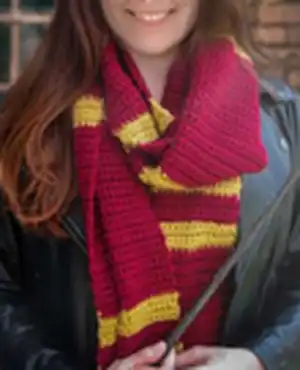
You will alternate 22-row stripes of main and contrast colors to form ten dark and nine light stripes. The pattern also covers washing, blocking, and step-by-step fringe/tassel instructions for a professional finish.
Why You'll Love This Hogwarts House Scarf Pattern
I absolutely love this pattern because it creates an instantly recognizable house scarf using simple techniques that produce a big visual impact. I enjoy how quick it is to see progress — broad 22-row stripes knit up satisfyingly fast. I love that the pattern is easy to customize for any house color and that the finishing instructions give the scarf a clean, store-bought look. I take pride in sharing a pattern that both beginners and seasoned knitters can enjoy making and gifting.
Switch Things Up
I love experimenting with color: try swapping the dark and light yarns for a reversed look or use three colors for an ombre stripe effect.
I sometimes change the stripe length to 11 or 33 rows to make thinner or wider stripes; this alters the visual rhythm nicely.
If you want a chunkier scarf, use a bulkier yarn and larger circular needle — the stitch pattern and stripes stay the same but the final scarf will be thicker and warmer.
Make a mini version by using fingering yarn and smaller needles to create a narrow, shorter scarf perfect for children or as a neckwarmer.
Try adding a simple slipped-stitch border for contrast by working a couple of rounds in garter or seed stitch at the ends before adding fringe.
I like to embroider a small initial or house crest on one end using duplicate stitch for a personalized finish.
For a more dramatic fringe, increase the number of strands per tassel or double the tassel length; for a subtle finish, reduce the strands and trim shorter.
You can add pompoms instead of tassels for a playful variation — attach them securely using strong yarn and weave in the tails well.
Mix different fiber types for texture: pair a wool main color with an acrylic contrast for durability and soft halo effects.
I often knit matching beanies or mitts in the same stripe sequence to create a coordinated set for gifts and holiday markets.
If you like structured edges, pick up stitches along the cast-on edge and work a short ribbed band to stabilize the scarf before blocking.
Don’t be afraid to combine film and book Ravenclaw accents (bronze vs. grey) to create a unique homage to your favorite version of the house.
Common Mistakes & How to Fix Them
✗ Casting on the wrong number of stitches will change the scarf width; count your cast-on stitches carefully and recount before joining the round.
✗ Joining the round twisted will ruin the tube shape; check that your cast-on edge is not twisted before slipping the marker and joining.
✗ Not aligning color changes when washing and folding will make stripes look uneven; align all color changes along one side fold before blocking.
✗ Overstuffing fringe bundles or using inconsistent lengths causes messy tassels; measure and cut all fringe pieces uniformly and use the same number of strands per tassel.
✗ Leaving tails too short when tying in the contrast color makes finishing messy; leave a 2-inch (5.1 cm) tail of contrast color and trim the main color to match for neat ends.