🧢 Beautiful ✨ Detailed πŸ’ Adorable

Jack in Love Amigurumi Pattern

Jack in Love Amigurumi Pattern
4.6β˜… Rating
5-7 Hours Time Needed
1.3K Made This
βœ‚οΈ

Intermediate Level

Ideal for those with basic crochet experience, featuring slightly more advanced stitches and techniques to expand your skills.

⏱️

Weekend Treat

Takes 5-7 hours, making it an enjoyable project to finish over a couple of days.

🧸

Cute Companion

An adorable friend to cherish, handcrafted with love to bring comfort and joy for years to come.

About This Jack in Love Amigurumi Pattern

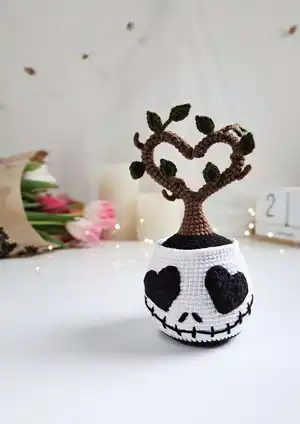
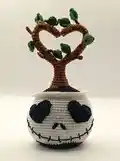
This pattern creates a whimsical Jack in Love amigurumi: a little skull-shaped pot with a heart-formed tree growing from it. It features a wired, poseable tree, tiny crocheted leaves, and embroidered facial details for personality. Techniques include working in continuous spirals, front/back loop work, and simple embroidery.

Jack in Love Amigurumi Pattern crochet pattern - detailed view of completed project

You will crochet the pot base, a soil/top insert, the stem and two branches that form a heart, plus separate leaves and heart-shaped eyes. Full step-by-step photos, tips on wiring, and assembly guidance are included.

Why You'll Love This Jack in Love Amigurumi Pattern

I absolutely love this pattern because it mixes playful character design with a touch of structural craft β€” the wired branches let you shape a perfect heart every time. I enjoy the contrast between the smooth pot and textured tree, and the tiny embroidered mouth gives so much personality. The pattern is satisfying to stitch from start to finish and makes a wonderful gift or decor piece. I also love that the techniques here help you practice invisible decreases, front/back loop crochet, and neat finishing skills.

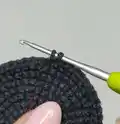
Jack in Love Amigurumi Pattern step 1 - construction progress Jack in Love Amigurumi Pattern step 2 - assembly progress Jack in Love Amigurumi Pattern step 3 - details and accessories Jack in Love Amigurumi Pattern step 4 - final assembly and finishing

Switch Things Up

I love changing the color palette to make different moods: try pastel pinks and mint greens for a springtime version or deep jewel tones for a gothic look.

To make the piece larger or smaller, switch yarn weight and hook size: bulky yarn and a larger hook creates a chunky statement piece, while fingering yarn and a thinner hook makes a tiny keychain-sized version.

I often replace the wired branches with pipe cleaners for a kid-friendly version that still bends into shape but is safer for children.

Try using metallic or variegated yarn for the tree to add shimmer and visual interest on the branches and leaves.

If you prefer a non-wired tree, stuff the branches more firmly and add internal embroidery stitches to help hold the shape.

I like to experiment with different leaf styles: larger layered leaves, small bud clusters, or tiny flowers crocheted and sewn on for a seasonal twist.

For a more stable base, glue or stitch a thicker plastic disc or small wooden circle into the bottom before finishing to prevent tipping.

Swap the embroidered face for felt appliques or safety eyes to change the expression and style quickly.

Add a removable miniature accessory like a tiny crocheted hat or scarf for gifting or seasonal decoration.

Try combining yarn texturesβ€”cotton for the pot and a fluffier acrylic for the treeβ€”to create tactile contrast and a cozier appearance.

Common Mistakes & How to Fix Them

βœ— Skipping stitch markers while working in continuous spirals makes it hard to track rounds; place a marker at the start of each round and move it after every round to stay accurate. βœ— Not stuffing as you go can lead to lumps or a misshapen pot; stuff gradually and firmly in small amounts to maintain smooth shape and control. βœ— Using too thick or too loose tension when making branches will change their length and shape; maintain consistent tension and compare your row counts to the pattern to match both branches. βœ— Forgetting to leave long yarn tails for sewing and embroidering causes extra work later; always leave the recommended tail lengths (15-20 cm or 40-50 cm) so you can finish and sew pieces neatly. βœ— Not reinforcing the wired branches can cause them to slip inside the crochet work; bend the wire ends and secure them inside the branch before closing the opening to keep them stable.

Jack in Love Amigurumi Pattern

Make a charming Jack in Love amigurumi β€” a heart-shaped tree growing from a cute skull pot. This pattern guides you through shaping the pot, crocheting a bendable heart tree with wired branches, and adding tiny leaves and embroidered facial details. Perfect as a handmade gift or a whimsical home accent.

Intermediate 5-7 Hours

Materials Needed for Jack in Love Amigurumi Pattern

β€” Main Fabric

  • 01
    Sport weight yarn (Fine yarn) or Fingering (super fine) for 100% cotton - recommended
  • 02
    White yarn (approx. 20g) - Alize Cotton Gold #55 (the pot)
  • 03
    Black yarn (approx. 15g) - Yarn Art Jeans #53 (bottom of base, soil, eyes, mouth, nose)
  • 04
    Brown yarn (approx. 10g) - Yarn Art Jeans #40 (tree and branches)
  • 05
    Green yarn (approx. 5g) - Yarn Art Jeans #82 (leaves)
  • 06
    Sample yarns: Yarn Art Jeans (50g/160m, 55% Cotton, 45% Acrylic) and Alize Cotton Gold (100g/330m, 55% cotton 45% polyacrylic)

β€” Tools Required

  • 01
    Crochet hook suitable for your yarn (I used 2 mm Clover Amour, corresponds to 1.75 mm regular crochet hook)
  • 02
    Optional sample: Crochet hook 2.25 mm (Clover Amour) used in testing sample
  • 03
    Scissors
  • 04
    Tapestry needle for sewing and embroidery
  • 05
    Pins for positioning pieces
  • 06
    Stitch marker (I use a piece of yarn)
  • 07
    Fiberfill stuffing
  • 08
    Stuffing tool (wooden skewers and tweezers recommended)
  • 09
    Wire 2 mm (about 60 cm total for both branches) - copper recommended but steel or aluminum may be used
  • 10
    A piece of plastic to make the bottom steady (e.g., lid of a plastic container)

Progress Tracker

0% Complete

β€” Base :

Info :

Work with black yarn.

Round 1 :

6 sc in a MR (6)

Round 2 :

6 inc (12)

Round 3 :

(inc, 1 sc) * 6 (18)

Round 4 :

(inc, 2 sc) * 6 (24)

Round 5 :

(inc, 3 sc) * 6 (30)

Round 6 :

2 sc, (inc, 4 sc) * 5, inc, 2 sc (36)

Round 7 :

(inc, 5 sc) * 6 (42)

Round 8 :

3 sc, (inc, 6 sc) * 5, inc, 3 sc (48)

Round 9 :

(inc, 7 sc) * 6 (54)

Round 10 :

4 sc, (inc, 8 sc) * 5, inc, 4 sc (60)

Info :

Change to white color (fasten off black yarn).

Round 11 :

BLO (p.8) 60 sc (60)

Round 12 :

(inc, 9 sc) * 6 (66)

Round 13 :

66 sc (66)

Round 14 :

5 sc, (inc, 10 sc) *5, inc, 5 sc (72)

Round 15 :

72 sc (72)

Round 16 :

(inc, 11 sc) * 6 (78)

Round 17-21 :

(5 rows) 78 sc (78)

Round 22 :

(dec, 11 sc) * 6 (72)

Round 23-25 :

(3 rows) 72 sc (72)

Round 26 :

5 sc, (dec, 10 sc) * 5, dec, 5 sc (66)

Round 27-30 :

(4 rows) 66 sc (66)

Info :

Cut out a piece of plastic to fit the bottom (it will help to make the base steady) and put it inside the base (as shown in the p.9). If your plastic is too flexible, cut out 2 or 3 pieces and put them together.

Round 31 :

FLO 66 sc (p.10) (66)

Round 32 :

66 sc (p.11) (66)

Info :

Cut the yarn off leaving a tail 15-20 cm to weave in the end. Use the "straight edge" method (see the next page for instructions).

Info :

Skip one stitch and insert the needle into the 2nd one (p.12), pull it out. Insert the needle into the last stitch of the round (between the front and the back loop of the stitch) (p.13). Pull the needle out, tighten the thread, weave in the end (p.14).

β€” Top (Soil) :

Info :

Attach black yarn to the back loop of 30th round (p.15).

Info :

Make regular decreases in the next round instead of invisible ones: pull a loop through one stitch, pull a loop through the next stitch (p.16), yarn over, pull through 3 loops on the hook (p.17).

Round 1 :

(dec, 9 sc) * 6 (60)

Round 2 :

4 sc, (dec, 8 sc) * 5, dec, 4 sc (54)

Round 3 :

(dec, 7 sc) * 6 (48)

Round 4 :

(dec, 6 sc) * 6 (42)

Round 5 :

(dec, 5 sc) * 6 (36)

Round 6 :

(dec, 4 sc) * 6 (30)

Info :

Stuff the base firmly.

Round 7 :

(dec, 3 sc) * 6 (24)

Info :

Change to brown color (fasten off black yarn).

Round 8 :

FLO 24 sc (24)

Round 9 :

(dec, 2 sc) * 6 (18)

Round 10-11 :

(2 rounds) 18 sc (18)

Round 12 :

(dec, 1 sc) * 6 (12)

Round 13-16 :

(4 rounds) 12 sc (12)

Info :

Stuff the stem. From the next round, we will start to make branches.

Round 17 :

6 sc, ch 2 (8)

Info :

Continue crocheting the next round starting from the 1st stitch of the previous round (p.20). Mark the 2nd of 2 chains (p.21 - red loop), we will need it while crocheting the second branch.

Round 18 :

6 sc, 2 sc along the chain, make sure to crochet only into BLO of the chain (p.21 - white loops), as we will need the front loops (red and yellow) to crochet the second branch (p.22).

Round 19-27 :

(9 rounds) 8 sc (8)

Round 28 :

dec, 6 (7)

Round 29-32 :

(4 rounds) 7 sc (7)

Round 33 :

dec, 5 (6)

Round 34-43 :

(10 rounds) 6 sc (6)

Info :

Measure how much wire you will need, it should be inserted into the branch and about half of the body (p.23), cut 2 such pieces. Bend the bottom and top parts (p.24), insert the wire (p.25).

Info :

Cut the yarn off leaving a 15 cm tail for closing the opening. Insert the yarn tail into a needle, go under the front loops of all 6 sc (p.26), tighten the thread and weave in the yarn end (p.27).

Info :

Crochet the 2nd branch. Attach yarn to the marked loop of 17th round (p.28), leave 10-15 cm yarn tail, we will need it later.

Round 17 (2nd branch) :

2 sc along the chain, 6 sc (p.29) (8)

Round 18 (2nd branch) :

8 sc (8)

Info :

Repeat rounds 19-43 of the first branch.

Info :

Insert the 2nd piece of wire into the 2nd branch. Cut the yarn off and close the opening. If there is a hole left between two branches, sew it using the yarn tail left from starting the 2nd branch (p.30,31). Bend the branches to form a heart (p.32,33).

β€” Leaves :

Item Separate leaves (make 4) :

Ch 4, turn, work from the 2nd ch from hook (p.34 - white loop): 1. 1 sc, 2 hdc in 1 loop, 1 sc, ch 2, sl st into the 2nd ch from hook (p.35,36), continue on the other side of the chain, 1 sc, 2 hdc in 1 loop, 1 sc, sl st into the 1st stitch of the row (p.37,38).

Info :

Cut the yarn off leaving 10-15 cm for sewing.

Item Leaves on branches (make 4) :

Crochet the leaves in the same way, but make the last sl st with brown yarn (p.39,40). Ch 5, attach it to the tree with a sl st (p.41,42).

Info :

Weave in the ends. Sew the leaves on the branches randomly (p.48), you may attach some small branches on the inner side of the tree, and then sew the leaf to the outer side (p.45-47).

Info :

Make a few small branches without leaves: attach brown yarn to the tree (p.49), ch 6, starting from the 2nd ch from the hook (p.50): 5 sl st, sl st to the same place from where the ch begins (p.51). Cut the yarn off and weave in the ends. If the branch looks down, make a few stitches to make it look up (p.52).

β€” Eyes :

Info :

Work with black yarn. Eyes will be worked in rows with a turning ch. Ch 2, turn, work from the 2nd ch from hook:

Round 1 :

3 sc in 1 stitch (p.54), ch 1, turn (3)

Round 2 :

inc, 1 sc, inc (p.55), ch 1, turn (5)

Round 3 :

inc, 3 sc, inc, ch 1, turn (7)

Round 4 :

inc, 5 sc, inc, ch 1, turn (p.56) (9)

Info :

Before crocheting the next row, watch the video.

Round 5 :

Skip 2 stitches, crochet into the 3rd stitch (p.56): (1 hdc, 2 dc, 2 tr, 2 dc, 1 hdc) (p.57), sl st into the next stitch, skip 2 stitches, crochet into the 3rd stitch: (1 hdc, 2 dc, 2 tr, 2 dc, 1 hdc).

Info :

Continue crocheting around the heart (p.59,60): 3 sc on the side part, 3 sc into the base ch, 3 sc on the side part.

Info :

Cut the yarn off leaving 40-50 cm. Weave in the end using the "straight edge" method, but in this case do not skip any stitches, insert the needle into the 1st stitch of the row. Do not cut off the yarn, we will need it to sew the eyes to the base.

β€” Assembling :

Info :

Pin the eyes between rounds 15 and 25 (if you count from the 1st white round, the eyes will be between the 8th and 18th rounds), the shortest distance between eyes is 6 stitches (on the 14th round) (p.61).

Info :

Make sure that the middle part of the tree (the place where the branches are divided) corresponds with the middle part of the face.

Info :

Sew them around using an invisible stitch: grab a stitch on the head (p.62), insert the needle into a stitch on the eye (from the inner side - p.63), insert it back into the next stitch on the eye (from the outer side - p.64).

Info :

Sew the eyes around and weave in the end.

Info :

Cut a piece of yarn (approximately 10 cm) and pin it to create a guideline for embroidering the mouth (as shown in the p.65).

Info :

Embroider the mouth with black yarn, you will need 50-60 cm for the mouth and nose. If your yarn looks thin, you may use 2 threads for embroidery. Thread a needle and embroider the mouth following this guideline using running stitch (p.66,67).

Info :

Cover the blank spaces left with vertical stitches (p.68-70). Don't cut the yarn off, continue to embroider the nose.

Info :

Mark the points where the nose should be (if you count from the 1st white row, the nose will be between 6th and 8th rounds). The distance between the upper points is 1 stitch and between the lower points is 5 stitches (p.71).

Info :

Embroider the nose making 3 stitches for each nostril (p.71-74). Weave in the yarn end.

Assembly Instructions

  • Pin the eyes between rounds 15 and 25 of the white body (or between the 8th and 18th rounds counting from the first white round); space the eyes at least 6 stitches apart on the 14th round.
  • Align the central split of the tree branches with the middle of the face so the heart shape sits symmetrically above the skull, then adjust and pin before securing.
  • Sew each heart-eye piece to the pot using an invisible stitch: grab a stitch on the head, insert the needle into the eye from the inner side, then back into the next stitch from the outer side, and continue around.
  • Insert and secure the wire inside each branch by bending the ends, inserting the wire into the branch tube, and closing the openingβ€”use the leftover yarn tails to sew any gaps closed.
  • Embroider the mouth using a pinned guideline, using running stitch with 50-60 cm of black yarn; cover blank spaces with vertical stitches, and embroider nostrils with 3 stitches each.
  • Sew leaves onto branches randomly using the 10-15 cm tails left on each leaf and weave in all ends securely so nothing unravels.

Important Notes

  • πŸ’‘All parts are worked in continuous spirals (without slip stitch and ch), unless noted otherwise; use a stitch marker to keep track of the rounds.
  • πŸ’‘Use the "straight edge" method for finishing edges and sewing details to keep a neat seam; follow the instructions and photos provided for the technique.
  • πŸ’‘I crochet using semi-X stitches (insert hook into stitch, yarn under, pull through, yarn over, pull through 2 loops) for a slightly tighter fabric on some samples.
  • πŸ’‘Stuff firmly but not overstuffed for best shape; stuff the base and stem gradually and use a stuffing tool for tight areas.
  • πŸ’‘Measure and cut the wire pieces carefully so they extend into about half the body for stable shaping, and bend/secure wire ends before closing branches.

This Jack in Love amigurumi brings a whimsical heart-tree to life inside a tiny skull planter β€” a perfect handmade gift or shelf companion. The wired branches let you pose a tidy heart, and detailed embroidery adds all the personality. Enjoy making this little character and share the love! πŸ§ΆπŸ’š

You ask,

we answer.

FAQs

What size will the finished piece be?

The finished amigurumi measures approximately 15 cm (6 inches) tall using the recommended yarn and a 2 mm crochet hook; sample sizes vary with hook and yarn choice.

Can I use different yarn weights for this pattern?

Yes, but changing yarn weight will affect the final size; use an appropriate hook size for your chosen yarn and expect the toy to be larger with thicker yarn or smaller with thinner yarn.

Do I need wire for the branches?

Yes, wire (2 mm recommended) is used to make the branches poseable; measure the required length so it reaches into about half of the body and trim/bend the ends before inserting.

Do I need advanced crochet skills to make this?

This pattern is rated intermediate and uses techniques like invisible decreases, working in BLO/FLO, sewing pieces, and simple embroidery, so basic amigurumi experience is helpful.

How long does this project typically take to complete?

Most crocheters finish this project in about 5-7 hours, depending on experience, assembly time, and embroidery detail.