🧢 Beautiful ✨ Detailed πŸ’ Adorable

Kangaroo Amigurumi Pattern

Kangaroo Amigurumi Pattern
4.0β˜… Rating
12-15 Hours Time Needed
1.9K Made This
βœ‚οΈ

Intermediate Level

Ideal for those with basic crochet experience, featuring slightly more advanced stitches and techniques to expand your skills.

⏱️

Multi-Day Project

A rewarding 12+ hour journeyβ€”perfect for dedicated crafters who love detailed work.

🧸

Cute Companion

An adorable friend to cherish, handcrafted with love to bring comfort and joy for years to come.

About This Kangaroo Amigurumi Pattern

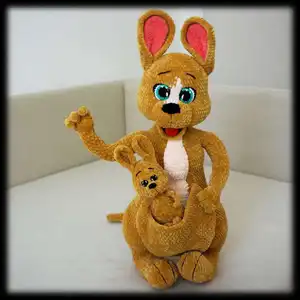
This pattern creates a plush, seated kangaroo amigurumi with a detachable tail and wired handles for shaping the arms. The large finished toy measures approximately 55 cm tall when made with the specified materials, with a baby version at about 19 cm. It uses Himalaya Dolphin Baby velvet yarn for a soft, cuddly texture and includes many step-by-step photos for guidance.

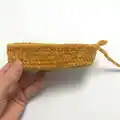
Kangaroo Amigurumi Pattern crochet pattern - detailed view of completed project

The pattern covers legs, tail, crotch, body, hands, and head with full stitch counts and assembly diagrams. Techniques include working in rounds, joining legs to form the body, inserting wire for posable limbs, and careful stuffing for a professional finish.

Why You'll Love This Kangaroo Amigurumi Pattern

I absolutely love this pattern because it transforms plush velvet yarn into a charming, huggable kangaroo with character. I enjoy the shaping steps β€” joining the legs to form the body is clever and satisfying. I like the addition of wire in the hands which makes the finished toy slightly posable and customizable. I appreciate the detailed stitch counts and photos which make it easier for me to follow and replicate the original look.

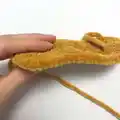
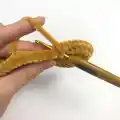
Kangaroo Amigurumi Pattern step 1 - construction progress Kangaroo Amigurumi Pattern step 2 - assembly progress Kangaroo Amigurumi Pattern step 3 - details and accessories Kangaroo Amigurumi Pattern step 4 - final assembly and finishing

Switch Things Up

I love customizing this kangaroo by changing the main yarn color; try soft pastels for a nursery-friendly version or bold shades for a playful look.

To make a mini keychain version, use fingering weight yarn and a smaller hook like 2.5mm, adjust stitch counts proportionally, and skip the internal wire for safety.

For a chunkier, cuddlier kangaroo, use a bulky plush yarn and a larger hook; you will get a much softer toy but the stitch details will appear larger.

I often add felt or embroidered patches to the belly or ears for extra personalityβ€”these small details make each finished piece unique.

Try swapping the last few rounds of the tail for a tapered finish or a curled tail by adding short rows and shaping with stuffing.

If you want poseable arms, keep the wire but also add a thin layer of padding around it to prevent sharpness; this gives structure without risking the yarn.

Change eye style by sewing small safety eyes (securely) or embroidering eyes for a fully child-safe toy; each option changes the character of the face.

I sometimes add tiny crocheted accessories like a scarf or a pocket for the joey to make the toy more interactive and gift-ready.

Experiment with facial expressions by moving the eye placement slightly; higher eyes create a more surprised look, lower eyes give a calmer expression.

For durability, reinforce key seams (legs, hands, tail) with an extra pass of sewing thread and anchoring stitches to keep everything firmly in place over time.

Common Mistakes & How to Fix Them

βœ— Not securing stitch markers when joining the legs can shift your stitch alignment; place markers and check counts before sewing to maintain symmetry. βœ— Skipping the suggested hook changes (between β„–3 and β„–3.5) can produce incorrect shaping; switch hook sizes exactly at the rounds indicated for proper fit. βœ— Overstuffing limbs will distort the shape of the toy and make sewing parts difficult; stuff gradually and shape as you go, leaving room to manipulate parts. βœ— Failing to adjust the working thread position before further rounds will misplace increases or decreases; reposition the working thread as instructed and verify stitch counts before continuing.

Kangaroo Amigurumi Pattern

Make a lovable handmade kangaroo amigurumi with detailed step-by-step instructions, photos, and clear stitch counts. This pattern guides you through crocheting the legs, tail, crotch, body, hands, and head using plush velvet yarn and provides assembly tips for a sturdy finished toy. Perfect for makers who enjoy shaping, stuffing, and adding small details like wired arms for posability. Follow the full instructions to create a cuddly 55 cm kangaroo or a smaller 19 cm baby version.

Intermediate 12-15 Hours

Materials Needed for Kangaroo Amigurumi Pattern

β€” Main Fabric

  • 01
    Velvet yarn DOLPHIN BABY Color 80330 (brown) - main color, 4 1/4 skeins for a large kangaroo (4.25 skeins) and 1/4 skein for a baby kangaroo
  • 02
    Color 80353 (light powder) - 0.5 skeins for crocheting the belly and muzzle
  • 03
    Color 80311 (black) - a little, for the nose and mouth decoration
  • 04
    Color 80318 (red) - a little, for the tongue
  • 05
    Color 80332 (coral) - 1/4 skein for ears
  • 06
    Yarn weight information: 100 g, 120 m, 100% polyester (Himalaya Dolphin Baby)
  • 07
    Kamtex mercerized cotton for sewing parts - 50 g, 200 m, 100% cotton (use brown, black, red, milky colors as needed)
  • 08
    YarnArt Jeans for eye details: Color 53 (black), Color 63 (emerald), Color 62 (white) - small amounts for crocheting eyes; 50 g, 160 m, 55% cotton, 45% acrylic

β€” Tools Required

  • 01
    Crochet hook β„–3 (US D)
  • 02
    Crochet hook β„–3.5 (US E) for toy making
  • 03
    Crochet hook β„–1.5 (US 8) for the eyes
  • 04
    Lighter (to process the yarn tips)
  • 05
    Thin sewing needle for regular sewing threads and sewing eyes
  • 06
    Thicker sewing needle for ears sewing
  • 07
    Long needle for needle sculpting
  • 08
    Sewing threads in black (for sewing parts)
  • 09
    Wire 1 mm (used to make a frame in the handles) - approx. 200 cm (78.74 inches)
  • 10
    Plaster or tape to wrap wire ends
  • 11
    Stitch markers
  • 12
    Holofiber (polyester stuffing)
  • 13
    Scissors
  • 14
    Yarn needle for sewing and finishing

Progress Tracker

0% Complete

β€” Legs :

Info :

Take Himalaya Dolphin Baby yarn, color 80330 (brown color), crochet hook β„–3.5 (US E).

Round 1 :

make a foundation chain 21ch, work 2 sc into the second chain from the hook, work 9 sc more, next 9 hdc, work 4 hdc into one chain, turn and work on the other side 9 hdc more, 9 sc, work 2 sc into one ch (44)

Info :

x - single crochet (sc). Ο„ - half double crochet (hdc).

Round 2 :

2 inc (sc), 9 sc, 9 hdc, 4 inc (hdc), 9 hdc, 9 sc, 2 inc (sc) (52)

Round 3 :

(1 sc, 1 inc (sc))*2, 9 sc, 9 hdc, (1 hdc, 1 inc (hdc))*4, 9 hdc, 9 sc, (1 sc, 1 inc (sc))*2 (60)

Round 4 :

60 sl sts (60)

Round 5 :

60 sc in BLO (60)

Round 6-8 :

60 sc (60) - repeat 3 times

Round 9 :

crochet hook β„–3 (US D), 24 sc, (1 sc, 1 dec)*4, 24 sc (56)

Round 10 :

crochet hook β„–3 (US D), 24 sc, 4 dec, 24 sc (52)

Info :

Please observe the photo located on the upper right-hand side. The positioning of the stitches: there ought to be a total of 18 stitches on the back portion, while the front portion should have 34 stitches.(toes part).

Round 11-12 :

use the crochet hook β„–3.5 (US E) starting from this round and for the next rounds, 18 sc (18). Proceed to fill the toy with stuffing material at this point.

Round 13 :

(5 sc, 1 inc)*3 (21)

Round 14 :

(6 sc, 1 inc)*3 (24)

Round 15 :

(3 sc, 1 inc)*6 (30)

Round 16 :

(4 sc, 1 inc)*6 (36)

Round 17 :

15 sc, 2 inc, 19 sc (38)

Round 18 :

15 sc, (1 sc, 1 inc)*2, 19 sc (40)

Round 19 :

12 sc, (1 sc, 1 inc)*6, 16 sc (46)

Info :

Fasten off, cut off. Stuff it. The first leg has been completed, and the second leg will be crocheted in a similar manner.

β€” Tail :

Info :

Take Himalaya Dolphin Baby yarn, color 80330 (brown color), crochet hook β„–3.5 (US E). Stuff as you go every 3-4 cm (1-2 inch)

Round 1 :

6 sc in MR (6)

Round 2 :

6 sc (6)

Round 3 :

5 sc, 1 inc (7)

Round 4 :

7 sc (7)

Round 5 :

6 sc, 1 inc (8)

Round 6 :

8 sc (8)

Round 7 :

7 sc, 1 inc (9)

Round 8 :

9 sc (9)

Round 9 :

8 sc, 1 inc (10)

Round 10 :

10 sc (10)

Round 11 :

9 sc, 1 inc (11)

Round 12 :

11 sc (11)

Round 13 :

10 sc, 1 inc (12)

Round 14 :

12 sc (12)

Round 15 :

11 sc, 1 inc (13)

Round 16 :

13 sc (13)

Round 17 :

12 sc, 1 inc (14)

Round 18 :

14 sc (14)

Round 19 :

13 sc, 1 inc (15)

Round 20 :

15 sc (15)

Round 21 :

14 sc, 1 inc (16)

Round 22 :

16 sc (16)

Round 23 :

15 sc, 1 inc (17)

Round 24 :

17 sc (17)

Round 25 :

16 sc, 1 inc (18)

Round 26 :

18 sc (18)

Round 27 :

17 sc, 1 inc (19)

Round 28 :

19 sc (19)

Round 29 :

18 sc, 1 inc (20)

Round 30 :

20 sc (20)

Round 31 :

19 sc, 1 inc (21)

Round 32 :

21 sc (21)

Round 33 :

20 sc, 1 inc (22)

Round 34 :

22 sc (22)

Round 35 :

21 sc, 1 inc (23)

Round 36 :

23 sc (23)

Round 37 :

22 sc, 1 inc (24)

Round 38 :

24 sc (24)

Round 39 :

23 sc, 1 inc (25)

Round 40 :

25 sc (25)

Round 41 :

24 sc, 1 inc (26)

Round 42 :

26 sc (26)

Info :

Fasten off, cut off.

β€” The crotch :

Info :

Take Himalaya Dolphin Baby yarn, color 80330 (brown color), crochet hook β„–3.5 (US E).

Round 1 :

8 sc in MR (8)

Round 2 :

8 inc (16)

Round 3 :

(1 sc, 1 inc)*8 (24)

Round 4 :

(2 sc, 1 inc)*8 (32)

Round 5 :

(3 sc, 1 inc)*8 (40)

Round 6 :

(4 sc, 1 inc)*8 (48)

Info :

Do not cut off

β€” We connect the legs, form the body :

Info :

For sewing the legs, use Kamtex yarn in brown color or any other yarn that matches the color of the toy. Also, prepare four markers. Before beginning the sewing process, ensure that the legs are positioned evenly and attached at the crotch area. Mark the points where the legs will be joined using the markers. The stitch division is depicted in the picture below, with 8 stitches to be joined on each side. Additionally, make sure that the working thread is located at the back.

Round 7-9 :

108 sc (108) repeat 3 times, that is, we crochet 10 sc - on the back, 38 sc - on the left leg, 16 sc - on the crotch, 38 sc - on the right leg, 6 sc - on the back.

Round 10 :

32 sc, (1 sc, 1 dec)*6, 16 sc, (1 sc, 1 dec)*6, 24 sc (96)

Info :

The next step is to "sew" the tail onto the toy. First, mark 10 stitches on the tail from the back and in the middle. If needed, adjust the position of the working thread (by undoing 2 stitches). Then, sew the tail onto the toy using brown Kamtex thread.

Round 11 :

96+26-10-10=102 sc (102)

Info :

Adjust the position of the working thread. It was -> has become (see photos).

Round 12 :

6 sc, 1 dec, (11 sc, 1 dec)*3, 55 sc (98)

Round 13 :

5 sc, 1 dec, (10 sc, 1 dec)*3, 55 sc (94)

Round 14 :

4 sc, 1 dec, (9 sc, 1 dec)*3, 55 sc (90)

Round 15 :

(13 sc, 1 dec)*6 (84)

Round 16 :

(12 sc, 1 dec)*6 (78)

Round 17 :

(11 sc, 1 dec)*6 (72)

Round 18 :

(10 sc, 1 dec)*6 (66)

Round 19 :

(9 sc, 1 dec)*6 (60)

Round 20-32 :

60 sc (60) - repeat 13 times

Info :

Please note the photo above, and ensure that the working thread is positioned in the middle of the side.

Round 32 :

35 sc, (1 sc, 1 inc)*10, 5 sc (70)

Round 33-36 :

70 sc (70) - repeat 4 times

β€” Hands :

Info :

Take Himalaya Dolphin Baby yarn, color 80330 (brown color), crochet hook β„–3.5 (US E).

Round 1 :

foundation chain 6ch, work 1 sc into the second chain from the hook, work 4 sc more

Round 2 :

make ch 6, work 1 sc into the second chain from the hook, work 4 sc

Round 3 :

make ch 6, work 1 sc into the second chain from the hook, work 4 sc

Round 4 :

we crochet along the edge 8 sc

Round 5 :

making a ring: we have a round of 8 sts. Next, we crochet 8 sc in FLO, turn, continue crocheting other side 8 sc in FLO. Thus, a round of 16 sc (16)

Round 6 :

(2 sc, 1 dec)*4 (12)

Round 7 :

(4 sc, 1 dec)*2 (10)

Round 8 :

10 sc (10)

Info :

At this point, it is necessary to insert a wire. To do so, prepare two pieces of wire, each measuring 100 cm/40 inches in length. Twist the two pieces together to obtain a wire with two strands. Wrap the edge of the wire with adhesive tape and insert it into the hand. During the crocheting process, make sure to loosely fill the hand.

Round 9-11 :

10 sc (10) - repeat 3 times

Round 12 :

(4 sc, 1 inc)*2 (12)

Round 13-16 :

12 sc (12) - repeat 4 times

Round 17 :

(5 sc, 1 inc)*2 (14)

Round 18-21 :

14 sc (14) - repeat 4 times

Round 22 :

(6 sc, 1 inc)*2 (16)

Round 23-27 :

16 sc (16) - repeat 5 times

Info :

Fasten off, cut off. Make 2 pieces.

Item Name (P1) :

Connect the hands to the body using three stitches, stitching with a semi-cotton thread that matches the color of the yarn. Refer to the photo diagram for stitch distribution (sew in 3 loops on each side).

Round 37 :

use the crochet hook β„–3 (US D) starting from this round and for the next rounds, crochet 29 sc on the back, 13 sc on the left arm, 2 sc, (1 sc,1 dec)*10, 2 sc on the chest, 13 sc on the right arm, 1 sc on the back. Stuff the toy as you go (80)

Round 38 :

28 sc, (3 sc, 1 dec)*3, 22 sc, (1 dec, 3 sc)*3 (74)

Round 39 :

28 sc, (2 sc, 1 dec)*3, 22 sc, (1 dec, 2 sc)*3 (68)

Round 40 :

28 sc, (1 sc, 1 dec)*3, (6 sc, 1 dec)*2, 6 sc, (1 dec, 1 sc)*3 (60)

Round 41 :

(13 sc, 1 dec)*4 (56)

Round 42 :

(5 sc, 1 dec)*8 (48)

Round 43 :

(4 sc, 1 dec)*8 (40)

Round 44 :

(3 sc, 1 dec)*8 (32)

Round 45 :

(2 sc, 1 dec)*8 (24)

β€” Head :

Info :

Don`t cut off, we continue to crochet. From the 46th round we use the hook β„–3.5 (US E).

Round 46 :

24 sc (24)

Assembly Instructions

  • Sew the legs to the crotch area using Kamtex yarn, mark the joining points with four markers and join 8 stitches on each side so the legs sit symmetrically before connecting the body.
  • Sew the tail onto the toy by marking 10 stitches at the tail (back and middle), adjusting the working thread position if needed, and use brown Kamtex thread to secure it to the body.
  • Insert and secure the twisted wire into each hand (wrap the edge with tape) before stuffing; sew the hands to the body with three stitches on each side using semi-cotton thread matching the yarn.
  • Attach the head to the body opening by aligning stitch counts at the neckline, stuff the head firmly, then whipstitch or mattress stitch around the opening to secure with a long yarn tail.
  • Position facial features (crocheted eyes, muzzle, nose) and embroider the mouth using black yarn; pin features before sewing to ensure correct placement.

Important Notes

  • πŸ’‘Use stitch markers to keep track of join points and the working thread position, especially when connecting legs and forming the body.
  • πŸ’‘Switch crochet hook sizes as instructed (β„–3 and β„–3.5) to achieve the correct shaping and even tension for different rounds.
  • πŸ’‘Stuff the toy gradually and shape as you go; overstuffing can distort seams and make assembly more difficult.
  • πŸ’‘When inserting wire into hands, wrap the wire ends with tape or plaster to protect the yarn and prevent poking through the fabric.

This kangaroo amigurumi pattern is full of personality and thoughtful construction to create a cuddly, poseable toy. The plush velvet yarn gives it a soft, huggable finish and the detailed instructions help you achieve professional shaping. Make one for a loved one or keep it as a cozy handmade companion. 🧢🐾

You ask,

we answer.

FAQs

What size will the finished piece be?

The finished large kangaroo measures approximately 55 cm (21.65 inches) tall using the recommended yarn and hook sizes; the baby kangaroo measures about 19 cm (7.48 inches).

Can I use different yarn weights for this pattern?

Yes, you can change yarn weight but this will affect the final size and texture; choose an appropriate hook for the yarn and adjust stuffing and wire length as needed.

Do I need prior crochet experience for this pattern?

This is an intermediate-level pattern, so basic knowledge of working in rounds, increases and decreases, and simple assembly skills are recommended for best results.

How long does this project typically take to complete?

Most crocheters take between 12-15 hours to complete the full kangaroo, depending on experience and how much time you spend on finishing and assembly.