🧢 Beautiful ✨ Detailed πŸ’ Adorable

Mushroom Backpack Charm Amigurumi Pattern

Mushroom Backpack Charm Amigurumi Pattern
4.1β˜… Rating
2-4 Hours Time Needed
2.7K Made This
βœ‚οΈ

Intermediate Level

Ideal for those with basic crochet experience, featuring slightly more advanced stitches and techniques to expand your skills.

⏱️

Bite-Sized Project

Finishes in 2-4 hoursβ€”perfect for an afternoon of creative relaxation.

🎁

Tiny Treasure

Small, sweet, and gift-worthy creations that fit perfectly in the palm of your hand with detailed charm.

About This Mushroom Backpack Charm Amigurumi Pattern

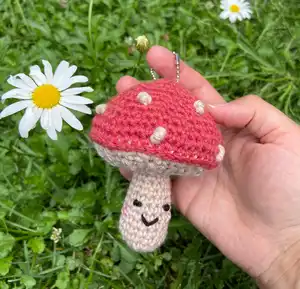
This pattern creates a small, adorable mushroom amigurumi designed to attach to backpacks, tote straps, or keyrings. It features a worked support circle for attaching a ball chain, a stuffed stem, turned-row gills that become a circular disc, and a shaped cap with tiny spots. The project uses worsted weight yarn scraps and basic to intermediate crochet techniques.

Mushroom Backpack Charm Amigurumi Pattern crochet pattern - detailed view of completed project

Perfect for using leftover yarn, the finished mushroom measures about 4" (10 cm) tall and is stitched in pieces that are assembled securely. Finished details include embroidered face features and French-knot spots on the cap.

Why You'll Love This Mushroom Backpack Charm Amigurumi Pattern

I absolutely love this pattern because it turns small yarn scraps into a delightful, portable amigurumi that brightens any bag. I love the clever support circle that hides the ball chain and helps the cap shape nicely when you stitch the stem in place. The gills worked in turned rows add a lovely textured detail that makes the mushroom feel handcrafted and special. I also enjoy how customizable it is β€” changing colors or adding embroidered details makes each charm unique.

Mushroom Backpack Charm Amigurumi Pattern step 1 - construction progress Mushroom Backpack Charm Amigurumi Pattern step 2 - assembly progress Mushroom Backpack Charm Amigurumi Pattern step 3 - details and accessories Mushroom Backpack Charm Amigurumi Pattern step 4 - final assembly and finishing

Switch Things Up

I love changing the color of the cap to create different personalitiesβ€”try pastel shades for a sweet look or bright jewel tones for a playful charm.

I sometimes use bulky yarn and a larger hook to make a chunky version; this makes a cuddly decorative piece instead of a tiny charm.

I also enjoy making mini versions with fingering weight yarn and a small hook to create tiny keychain mushrooms that fit on zipper pulls.

I like to swap the ball chain for a lobster clasp or a split keyring if I want the mushroom to be easily removable from different bags.

I often add tiny felt accessories like a miniature leaf or flower sewn to the cap to make each charm unique and gift-ready.

I sometimes embellish the cap with beads or sequins instead of French knots for a sparkling, festive look.

For a posable version, I insert flexible wire into the stem while stuffing so the mushroom can be posed slightly when displayed.

I experiment with facial expressions by adjusting eye placement and mouth shape to create grumpy, sleepy, or surprised mushrooms.

I like to create sets of mushrooms in varying sizes and colors to stitch together into a mini forest keychain collection that looks lovely grouped on a bag.

To make this pattern faster to stitch for gifts, I’ll pre-assemble several stems and caps and then do finishing (spots and embroidery) assembly-line style.

Common Mistakes & How to Fix Them

βœ— Not checking the support circle gauge can make the cap opening too big or too small; make the Support Circle first and compare it to the specified measurement so the stuffing does not show through. βœ— Forgetting to leave long yarn tails when instructed leads to difficulties sewing pieces together; follow the pattern and cut longer tails for sewing and finishing instead of trying to reattach later. βœ— Stuffing too little or too much will distort the shape of the stem or cap; stuff gradually and adjust as you join the stem to the gills and cap to achieve a balanced look. βœ— Placing decreases too close to each other during stem shaping creates unsightly dimples; space decreases as instructed and rotate their placement over rounds as the pattern directs. βœ— Not trapping the ball chain correctly when closing the cap can cause the chain to slip out over time; follow the trapping instructions carefully and position strands as you close the top. βœ— Skipping the back-loop rounds or YOslst instructions for the gills changes the texture and edge length; work the YOslst and back-loop rows exactly to create the raised ridges needed to join the gills into a circle.

Mushroom Backpack Charm Amigurumi Pattern

Make a cute, pocket-sized mushroom backpack charm you can attach to a bag or keyring. This amigurumi pattern uses worsted-weight yarn scraps and simple shaping to create a charming mushroom with gills, a stuffed stem, and tiny spots on the cap. Clear, step-by-step instructions guide you through the support circle, stem, gills, cap, and finishing details so you can create this little handmade treasure.

Intermediate 2-4 Hours

Materials Needed for Mushroom Backpack Charm Amigurumi Pattern

β€” Main Fabric

  • 01
    Approximately 35 yds [32 m] worsted weight yarn (CYCA #4) for Main Color (Cap)
  • 02
    Approximately 35 yds [32 m] worsted weight yarn (CYCA #4) for Contrast Color (Stem, Gills, and Support Circle)
  • 03
    We Crochet Wool of the Andes Worsted (worsted weight, 100% Peruvian Highland Wool), 110 yards [100 m]/1.75 oz [50 grams]; shown in Papaya Heather #25071 (MC) and Oyster #24649 (CC); partial skein of each

β€” Tools Required

  • 01
    US E/4 (3.5mm) crochet hook or size needed to obtain gauge
  • 02
    Stitch marker
  • 03
    Small amount of fiberfill for stuffing
  • 04
    Yarn needle
  • 05
    Small amount of black embroidery floss (or thin black yarn)
  • 06
    Small amount of pink embroidery floss (or thin pink yarn)
  • 07
    6" [15.5 cm] (or similar) ball chain for attaching to backpack (or a chain/loop you prefer)

Progress Tracker

0% Complete

β€” Support circle :

Rnd 1 :

With CC, make an adjustable loop, 6 SC into loop, pull on beginning yarn tail to close loop. 6 sts.

Rnd 2 :

2 SC into each st around. 12 sts.

Rnd 3 :

[SC into the next st, 2 SC into next st] 6 times. 18 sts.

Rnd 4 :

[2 SC into the next st, SC into each of the next 2 sts] 6 times. 24 sts.

Info :

Fasten off leaving long yarn tail.

Info :

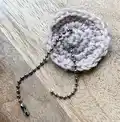
Check gauge. Insert one end of the ball chain down through the top surface of the support circle, and then up through the Support circle so that it comes out through the top surface of the circle about 1/2" [1.5 cm] away from where it went down. Fasten ends of ball chain together.

β€” Stem :

Rnd 1 :

With CC, make an adjustable loop, 6 SC into loop, pull on beginning yarn tail to close loop. 6 sts.

Rnd 2 :

2 SC into each st around. 12 sts.

Rnd 3 :

[SC into each of the next 3 sts, 2 SC into next st] 3 times. 15 sts.

Rnd 4-8 :

SC into each st around.

Rnd 9-11 :

SC around making one inv dec per round. Place each decrease in a different place during each round so that a decrease is not worked into another decrease. 12 sts after working Rnd 11. Stuff stem firmly with fiberfill.

Rnd 12 :

Working into the back loop only on this round, SC2tog 6 times. 6 sts.

Info :

Fasten off with a sl st. Using a yarn needle, weave yarn tail through each of the remaining 6 sts and pull tight to close hole. Do not weave in end, instead, use ending yarn tail for sewing later.

β€” Gills :

Info :

With CC, ch 6.

Row 1 :

Beginning with 2nd Ch from hook YOslst in each of next 5 chs. 5 sts.

Rows 2-30 :

Ch 1 turn, YOslst blo in each st.

Info :

Do not fasten off.

Info :

Rotate work 90-degrees to work along the side edge of previous rows. You will be working only into the raised ridges that occur every other row in the YOslst blo stitch pattern. SC2tog across edge 7 times, SC into the last raised ridge. Fasten off leaving long yarn tail for sewing. 8 sts.

Info :

Weave yarn tail through each of the SC stitches made along edge and pull tight to form a circle. Continue using yarn tail to whip stitch short edges of fabric together to create circle. Weave in ends.

β€” CC edging :

Info :

With a new piece of CC, pull up a loop anywhere around outer edge of Gills circle. Ch 1 to anchor yarn, SC twice between ridges, and SC once in each ridge for a total of 45 SC around, sl st to fasten off. 45 sts.

β€” Cap of mushroom :

Rnd 1 :

Pull up loop of MC in any st from CC edging rnd. Sl st in each st around. Do not join but continue working in continuous rnds.

Rnd 2 :

Working into the SC sts from the CC edging round (not working into the previous Rnd of sl sts), [SC in each of next 14 sts, 2 SC in next st] 3 times. 48 sts.

Rnd 3 :

[SC in each of next 3 sts, 2 SC in next st, SC in each of next 4 sts] 6 times. 54 sts.

Rnd 4 :

[SC in each of next 7 sts, inv dec] 6 times. 48 sts.

Rnd 5 :

[SC in each of next 3 sts, inv dec, SC in each of the next 3 sts] 6 times. 42 sts.

Rnd 6 :

[SC in each of next st, inv dec, SC in each of the next 4 sts] 6 times. 36 sts.

Rnd 7 :

[SC in each of next 3 sts, inv dec, SC in the next st] 6 times. 30 sts.

Rnd 8 :

SC in each st.

Rnd 9 :

[Inv dec, SC in each of the next 3 sts] 6 times. 24 sts.

Info :

Place stitch marker in working loop so that it will not ravel while you are working on the next step.

Info :

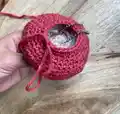
Stuff cap with fiberfill. Place Support circle (with ball chain attached) on the inside of the cap on top of the fiberfill. This should fit just inside of the opening at the top of the cap. Using the ending yarn tail at the top of the stem and a yarn needle, stitch the top of the stem to the underside of the gills (stitching through the fiberfill and through the top surface of the Support circle. In other words, you are using the support circle to squish the fiberfill so that the gills indent a bit where the stem is attached. Tip: the unused loops around the top edge of the stem will give you a distinct edge to stitch to the gills.

β€” Continuing with the Cap :

Info :

Remove stitch marker and place hook back in working loop. Continue to add fiberfill as needed.

Rnd 11 :

SC in each st.

Rnd 12 :

[SC in the next st, inv dec, SC in the next st] 6 times. 18 sts.

Rnd 13 :

[Inv dec, SC in the next st] 6 times. 12 sts.

Rnd 15 :

When you work this round you will need to "trap" each strand of the ball chain in place with your stitches. Un-hook the ball chain so there are two separate ends. *Place one strand of the ball chain just to the left (right if you crochet left-handed) of the working loop. Let the chain hang to the outside of your work. Inv dec in next st, trapping the ball chain in place, inv dec twice more, repeat from * trapping the other end of the ball chain, and working 3 more decreases. 6 sts.

Info :

Fasten off. Using yarn needle, weave yarn tail through the front loop of each of the remaining 6 sts and pull tight to close top of Cap. Weave in ends.

Info :

Use a double strand of CC to make French knots on mushroom cap as desired.

β€” Finishing :

Info :

Weave in ends.

Info :

Use black embroidery floss and embroidery needle to embroider a small "v" shape for a mouth, and two large French knots for eyes onto the stem using photos for reference. Use light pink embroidery floss to embroider small circular shapes below each eye using small chain stiches.

Assembly Instructions

  • Place the Support Circle inside the cap on top of the fiberfill and stitch the top of the stuffed stem through the fiberfill and the Support Circle so the stem is anchored to the underside of the gills.
  • Attach and fasten the ball chain through the Support Circle before closing the top of the cap, then trap each strand of the ball chain in the final round of the cap so the chain is securely held in place.
  • Whip stitch the short edges of the gills rectangle together to form a circular gills disc, then add the CC edging and continue to work the cap around the gills edge.
  • Stuff the stem firmly before closing the bottom and use the ending yarn tail to sew the stem to the gills and hide tails; leave long tails where instructed for sewing.
  • Add French knots (double strand CC) for spots on the cap and embroider the face on the stem with black and pink embroidery floss using photos as reference for placement.

Important Notes

  • πŸ’‘Make the small Support Circle first to check gauge; it should measure about 1 5/8" [4 cm] in diameter so stuffing will not show through the holes.
  • πŸ’‘The stem is worked in continuous rounds from the bottom up and should be stuffed before closing the top for best shape and support.
  • πŸ’‘Gills are worked in turned rows to form a rectangle, then cinched and whip-stitched into a circle before adding the CC edging and cap.
  • πŸ’‘Place decreases in different positions across rounds when instructed so you do not work a decrease into another decrease and create uneven shaping.
  • πŸ’‘Turning chains in the gills do not count as a stitch; work the YOslst blo pattern exactly to form the raised ridges used to join the gills edge.

This sweet Mushroom Backpack Charm is designed to bring a bit of forest magic wherever you go. It’s small, adorable, and perfect for using yarn scraps to create something truly delightful. Make one for yourself or stitch a whole collection to gift to friends and family. πŸ„πŸ§΅

You ask,

we answer.

FAQs

What size will the finished piece be?

The finished mushroom stands about 4" [10 cm] tall when made with the recommended worsted weight yarn and the suggested hook size.

Can I use different yarn weights for this pattern?

Yes, you can use different yarn weights but the finished size will change; choose an appropriate hook for your yarn and check the Support Circle gauge so the cap fits correctly.

Do I need prior crochet experience for this pattern?

This pattern is rated intermediate and uses techniques like invisible decreases, YOslst, and working gills in turned rows, so basic crochet experience is recommended.

How long does this project typically take to complete?

Most crocheters complete this project in 2-4 hours, depending on experience level and how much time you spend on finishing details like embroidery and French knots.