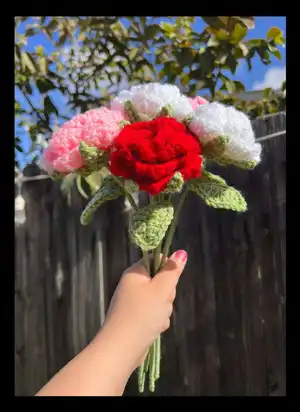
🧢 Beautiful ✨ Detailed πŸ’ Adorable

Rose Pattern

Rose Pattern
4.1β˜… Rating
2-3 Hours Time Needed
1.9K Made This
βœ‚οΈ

Beginner Friendly Level

Perfect for those just starting their crochet journey, with clear instructions and simple techniques

⏱️

Bite-Sized Project

Finishes in 2-4 hoursβ€”perfect for an afternoon of creative relaxation.

🏑

Cozy Accent

A warm touch for your space that transforms ordinary corners into inviting nooks filled with handmade charm.

About This Rose Pattern

This pattern teaches you how to crochet a realistic rose with layered petals, a calyx, and wired leaves. It uses weight 4 acrylic yarn and a 4.0 mm hook for a balanced size and texture. The instructions are written in US terms and include step-by-step assembly to create a finished flower that holds on a wired stem.

Rose Pattern crochet pattern - detailed view of completed project

Perfect for beginners with basic crochet knowledge, the pattern includes clear steps for petals, calyx, and leaf construction. Use it to make single stems or full bouquets for gifts and decor.

Why You'll Love This Rose Pattern

I absolutely love this pattern because it turns simple stitches into a beautiful, dimensional rose that looks much more intricate than it is. I enjoy how flexible the design isβ€”changing color or yarn weight gives the flower a completely new personality. The wired leaf and stem method makes the finished rose poseable and durable, which I always appreciate when gifting. I also love that the pattern is beginner-friendly yet yields a professional-looking result you can be proud of.

Rose Pattern step 1 - construction progress Rose Pattern step 2 - assembly progress Rose Pattern step 3 - details and accessories Rose Pattern step 4 - final assembly and finishing

Switch Things Up

I love customizing this rose by changing yarn colors; swap the petal color to blush or cream for a soft, romantic bouquet.

I sometimes use a sport or DK weight yarn with a smaller hook to create a more delicate, detailed rose variant.

For a bold statement, I use a bulky yarn and a larger hook to make oversized blooms that are great for decorative displays.

I often add tiny beads or french knots to the center for a subtle sparkle or textured focal point.

If I want a posable stem, I replace the floral wire with a thicker gauge or double the wire for extra stiffness and durability.

I enjoy creating mixed bouquets by combining roses with small crocheted filler flowers and different leaf shapes for variety.

To make mini roses for keychains, I use thinner yarn and short pieces of wire and reduce chain counts proportionally.

I like wrapping stems with floral tape or contrasting yarn to match different wrapping papers for gift-ready bouquets.

For an elegant touch, I finish stems with satin ribbon bows and a small tag or charm for gifting.

When I want texture, I add the optional textured edge to leaves or use a boucle yarn sparingly for a furry petal effect.

Common Mistakes & How to Fix Them

βœ— Skipping the second chain when working the HDC row leads to one missing stitch at the edge; always start HDC in the 2nd chain from the hook to keep stitch counts correct. βœ— Not leaving the 12" tail after finishing the petal row makes sewing the petals together awkward; leave and secure the long tail for assembly and sewing. βœ— Pulling the magic ring too tightly in the calyx reduces the hole size and prevents the floral wire from fitting; leave a small hole and do not cinch the MR tightly. βœ— Forgetting to crochet around the floral wire for leaves causes the wire to slide out; hold the wire and make sure each stitch encases the wire securely. βœ— Using a thicker yarn or larger hook than recommended will produce an overly chunky rose that loses detail; stick to weight 4 yarn and 4.0 mm hook for best results.

Rose Pattern

Create a beautiful, hand-crocheted rose bouquet using this easy-to-follow pattern. You will learn how to make the rose petals, calyx, and wired leaves, then assemble them into a professional-looking stemmed flower. This pattern is perfect for gifting, home decor, or making a charming bouquet to brighten any room.

Beginner Friendly 2-3 Hours

Materials Needed for Rose Pattern

β€” Main Fabric

  • 01
    Weight 4 acrylic yarn for petals (example: Big Twist Value or Red Heart Super Saver) - quantity depends on number of roses
  • 02
    Weight 4 acrylic yarn in green for calyx, leaf, and stem wrap - small skein required
  • 03
    Petal color suggestions: red, pink, white - one skein each for multiple blooms

β€” Tools Required

  • 01
    Crochet hook (4.0 mm)
  • 02
    Darning needle
  • 03
    Scissors
  • 04
    Hot glue and hot glue gun
  • 05
    Floral wire stems, 2mm thick, 15 inches long (for stems)
  • 06
    Flexible floral wire, 22 gauge (for leaves)
  • 07
    Ribbon (optional, for bouquet assembly)
  • 08
    Decorative paper (optional)
  • 09
    Ruffled mesh (optional)

Progress Tracker

0% Complete

β€” Rose :

Step 1 :

Ch 47 (47)

Step 2 :

In the 2nd chain from the hook, HDC down the entire chain (46)

Step 3 :

Ch 5. Turn your work. Dc in the same stitch as the chain. Sk 2, (1 dc, ch 3, 1 dc) in the same stitch. Repeat [Sk 2, 1 dc, ch 3, 1 dc] until you reach the end of the row. Place 1 DC in the last stitch.

Info :

Rose after Step 3 is completed:

Step 4 :

Ch 3. Turn your work. In the chain spaces, repeat [3 dc, 1 tr, 3 dc] and sl st in the space between the two dc from the previous row. Ch 1. Repeat [(3 dc, 1 tr, 3 dc), sl st, ch 1] to create the petals. Place 3 dc in the final chain space of the row. FO. Leave a 12" tail for sewing.

β€” Calyx :

Step 1 :

Place 6 dc in a ring. After the sixth dc, sl st to the top of the first dc to form a ring.

Info :

Leave a small hole in the center of the MR! Don't pull too tight - you need the hole to be big enough to fit your floral wire / wooden skewer through.

Step 2 :

[Ch 7. Starting from the 1st stitch from your hook: (sl st, sc, hdc, dc, dc, tr)]. Sl st to the next stitch in the MR. Repeat this 6 times total to form 6 leaves of the calyx. FO after the sixth leaf and leave a short tail. Tie this tail and the tail from the MR in a knot and weave in the ends.

β€” Leaf :

Info :

* OPTIONAL, 1 LEAF PER STEM *

Info :

First, cut approximately an 8" piece of 22 gauge flexible floral wire. You will need this for the leaf.

In green :

Step 1: Ch 12 (12)

Step 2 :

For the leaf, you will be crocheting around the floral wire. Starting from the third chain from the hook: sc, HDC, DC, DC, TR, TR, DC, DC, HDC, 3 sc in the last chain.

Info :

To crochet around the wire, hold the wire in your hand alongside your work. Insert your hook through the chain and create a single crochet as usual, but make sure your stitch is created around the wire, holding it in place.

Step 3 :

Fold your wire in half, with your work on the right side of the wire. We will now be working on the lefthand side of the wire, from right to left. Sk 1 st, HDC, DC, DC, TR, TR, DC, DC, HDC, sc.

Info :

This is what your leaf will look like after Step 2 and after folding your wire in half. For Step 3, you'll be working down the opposite side of your chain and wire to form the other half of your leaf. Crochet over your tail so you don't need to weave it in later.

Step 4 :

If you like the look of your leaf, FO, leaving a short tail. Weave in your tail. Twist the remaining wire together so your work doesn't slide off.

Info :

Your leaf should look like this when finished. Twist the bottom of the wire to prevent your work from sliding off.

Step 5 :

If you want to add a textured edge to your leaf, proceed with Step 5. This is an optional step. Sl st, chain 1, and sl st to the next st. Repeat this around the entire leaf. FO, weave in the end. Cut off any excess.

β€” Rose Assembly :

* PART 1: THE PETALS * :

Step 1: Begin with the side that does not have the yarn tails. Make sure the correct side of your work is facing you.

Step 2 :

For the first petal only, fold it in half on itself. Take point A and fold it to touch point B.

Step 3 :

Continue wrapping your work from right to left, folding the petals in on each other. The rose shape will become more pronounced.

Step 4 :

Once you reach the end of your work, you can adjust the petals to your liking. I prefer the center petals to be tighter and the outside petals to be looser, like a real rose.

Step 5 :

Thread your darning needle onto the longest tail for sewing.

Step 6 :

Sew several stitches horizontally to secure the very last petal.

Step 7 :

Sew several stitches through the base of your rose to secure it. These stitches do not need to be uniform. The more you sew, the more secure your rose will be.

Step 8 :

Once your rose is secure, sew one final stitch so your two yarn tails are next to each other. Tie the yarn tails in a knot, and then weave the remaining tails in. Cut any excess yarn.

* PART 2: THE WIRE, CALYX, AND LEAF * :

You will need a 2mm floral wire stem and hot glue for this part.

Step 1 :

Insert your floral wire through the center of your rose. Turn your rose upside down to make sure you can't see the wire from the top of the rose. Once you're satisfied with the placement, remove the wire, place a small amount of hot glue on the wire, and reinsert it into the rose to secure it.

Step 2 :

With the wrong side of your calyx facing you, insert the floral wire through the middle of the MR. Push the calyx down the wire until it meets the rose.

Step 3 :

The calyx should be positioned so that there is a leaf between each of the rose petals.

Step 4 :

Once positioned properly, place a small amount of hot glue around the base of the rose. Slide the calyx down the wire to glue it in place.

Step 5 :

Place a small amount of hot glue along the leaves, leaving the top portion without glue. Glue the leaf down in place. Repeat this for all six leaves of the calyx.

Step 6 :

Place a small amount of hot glue at the base of the calyx and wire. Attach the same green yarn you used for the calyx and leaf. Quickly twist the wire to begin wrapping it before the glue dries.

Step 7 :

After wrapping the wire for about 1.5-2 inches, add your leaf. Hold the leaf with the wire parallel to the wire stem. Wrap the yarn around both the leaf and stem, securing the leaf in place.

Step 8 :

Your rose will look like this once you wrap and secure the leaf. Continue wrapping the entirety of the stem to finish.

Assembly Instructions

  • Thread the longest yarn tail through a darning needle and sew several horizontal stitches across the folded petals to secure the rose shape.
  • Insert the 2mm floral wire through the center of the rose, remove it, add a dab of hot glue, then reinsert and push the calyx down the wire until it meets the rose.
  • Position the calyx so there is a calyx leaf between each rose petal, then add small amounts of hot glue around the base and slide the calyx down to glue in place.
  • Glue the leaves down along their bases (leave top portion glue-free), then twist and wrap green yarn around the wire stem to secure the calyx and create a finished stem.
  • After wrapping 1.5-2 inches of stem, add a leaf by aligning its wire parallel to the stem and wrapping yarn around both leaf and stem to secure it.

Important Notes

  • πŸ’‘This pattern is written in US crochet terminology; check abbreviations before starting to ensure correct stitch conversion.
  • πŸ’‘Use weight 4 yarn and a 4.0 mm hook for the recommended size and detail; larger yarn will make the rose bulky and lose definition.
  • πŸ’‘Leave the magic ring center slightly open in the calyx so the floral wire will pass through easily and not be obstructed.

This charming rose pattern lets you craft realistic flowers with yarn and wire, perfect for bouquets and decor.🌹 Make single stems or a full bouquet to gift or display.🎁 Youll love the way simple stitches transform into elegant petals and leaves.🧢

You ask,

we answer.

FAQs

What size will the finished piece be?

The finished rose measures approximately 8-10 cm across for the bloom and the stem length depends on the floral wire used; using a 15" stem yields a long display stem.

Can I use different yarn weights for this pattern?

Yes, but changing yarn weight will affect the final size and detail; use a larger hook for thicker yarn and expect a chunkier bloom with less definition.

Do I need prior crochet experience for this pattern?

This pattern is beginner friendly and written in US terms, so basic knowledge of common stitches such as SC, HDC, DC, and TR is helpful.

How long does this project typically take to complete?

Most crafters can complete a single rose in 2-3 hours, though time will vary based on experience and how many embellishments you add.