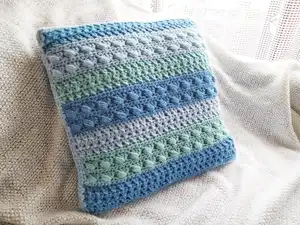
Make a stylish Snowberry cushion cover using simple stitches and the textured Sideways Puff stitch. This pattern gives step-by-step instructions in both UK and US terms so you can follow whichever you prefer. Perfect for adding a handmade accent to your living space or creating a thoughtful gift. Clear photos and finishing notes guide you through assembly.
Progress Tracker
0% Complete
— Special Stitches :
Info :
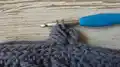
Sideways Puff Stitch (SWPuff ST) - UK TERMS: Before you make a sideways puff stitch you always have 3 TR STS (Picture 1). Yarn over hook, insert hook in indicated stitch (this is going to be the ST you put the first TR into the base of the first TR, NOT the TR itself!), pull up a long loop through that stitch/space (3 loops on hook) (Picture 2). Yarn over hook again and insert hook into the same stitch, pull up a loop (same height as the previous one) 3 more times. You should have 9 loops on your hook. (Pictures 3-5). Yarn over and pull through 8 loops, (2 loops on your hook) (Pictures 6-7), yarn over and pull through both loops. (Pictures 8-9).
Info :
Sideways Puff Stitch (SWPuff ST) - US TERMS: Before you make a sideways puff stitch you always have 3 DC STS (Picture 1). Yarn over hook, insert hook in indicated stitch (this is going to be the ST you put the first DC into the base of the first DC, NOT the DC itself!), pull up a long loop through that stitch/space (3 loops on hook) (Picture 2). Yarn over hook again and insert hook into the same stitch, pull up a loop (same height as the previous one) 3 more times. You should have 9 loops on your hook. (Pictures 3-5). Yarn over and pull through 8 loops, (2 loops on your hook) (Pictures 6-7), yarn over and pull through both loops. (Pictures 8-9).
Info :
Gauge: 3 HTR = 1" (3 HTR = 2.5 cm) (UK). Gauge (US): 3 HDC = 1" (3 HDC = 2.5 cm).
Infos :
If a row/round starts with a Chain 1, it is not counted as a stitch, unless stated otherwise. Slip stitches do not count as stitches. Chain 2 always count as treble crochet (UK). UK terms used throughout. At the end of the round, there’s going to be a note with the stitch count, so you can keep track of your work easily and avoid any mistakes. It’s written in a different color in bold. Weave in the ends after every 8-10 rows to reduce the amount of ends to weave in at the end. Notes are written in a different color in (brackets) to help you through the pattern. When working on the corners, always remember that there might be a hidden stitch hiding under the corner stitches which is the first stitch of the previous row. You can start each round as I did in the pattern or you can use a standing stitch or chains, it’s totally up to you!
— Instructions (UK Terms) :
Row 0 :
To start: With Color 1 (Dolphin Blue) CH 52
Row 1 :
1 TR into the 4th CH from the hook, 1 TR in each CH to end (50 TR)
Row 2 :
CH 2 (counts as TR), {SK 1 ST, 1 TR in next ST, 1 TR in skipped ST} 24 times, 1 TR in top of 3 CH (2 TR, 24 TR "crosses")
Row 3 :
Same as Row 2 (2 TR, 24 TR "crosses")
Row 4 :
Same as Row 2 (2 TR, 24 TR "crosses")
Row 5 (WS) :
Join Color 2 (Washed Teal) to the last ST of last row with a standing HTR or alternatively, you can CH 1 and HTR in same ST. 1 HTR in next 48 STS, 1 HTR in top of CH 2 (50 HTR)
Row 6 (RS) :
CH 2 (counts as TR), {1 TR in next 3 STS, 1 SWPuff ST, SK 1 ST} 12 times, 1 TR in last ST (38 TR, 12 SWPuff ST)
Row 7 (WS) :
CH 1, 1 HTR in same ST, 1 HTR in next 48 STS, 1 HTR in top of CH 2 (50 HTR)
Row 8 :
Same as Row 6 (50 HTR)
Row 9 :
Same as Row 7 (50 HTR)
Row 10 (RS) :
Join Color 3 (Duck Egg Blue) to the last ST of last row with a standing TR or alternatively, you can CH 1 and TR in same ST. {SK 1 ST, 1 TR in next ST, 1 TR in skipped ST} 24 times, 1 TR in last ST (2 TR, 24 TR "crosses")
Row 11 :
Same as Row 2 (2 TR, 24 TR "crosses")
Row 12 :
Same as Row 2 (2 TR, 24 TR "crosses")
Row 13 (WS) :
Join Color 1 (Dolphin Blue) to the last ST of last row with a standing HTR or alternatively, you can CH 1 and HTR in same ST. Same as Row 5 (50 HTR)
Row 14 :
Repeat Row 6 (50 HTR)
Row 15 :
Repeat Row 7 (50 HTR)
Row 16 :
Repeat Row 6 (50 HTR)
Row 17 :
Repeat Row 7 (50 HTR)
Row 18-20 :
Join Color 2 (Washed Teal) to the last ST of last row with a standing TR or alternatively, you can CH 1 and TR in same ST. Same as Row 10-12 (2 TR, 24 TR "crosses")
Row 21-25 :
Join Color 3 (Duck Egg Blue) to the last ST of last row with a standing HTR or alternatively, you can CH 1 and HTR in same ST. Same as Row 13-17 (50 HTR)
Row 26-28 :
Join Color 1 (Dolphin Blue) to the last ST of last row with a standing TR or alternatively, you can CH 1 and TR in same ST. Same as Row 10-12 (2 TR, 24 TR "crosses"). Fasten off.
— Edge :
Round 1 :
Join Color 3 (Duck Egg Blue) to the first ST of last Row (that's the top right corner on the right side). CH 1, 2 DC in same ST, 1 DC in next 48 STS, 3 DC in next ST, DC 48 evenly on the side, 3 DC into the base of 3 CH, 1 DC in next 48 CH, 3 DC in last CH, DC 48 evenly on the side, 1 DC into the first ST with the 2 DC in it, join with a SLST to first DC. (Corner: 3 DC Sides: 48 DC)
Round 2 :
CH 1, 2 DC in same ST, 1 DC in next 50 STS, 3 DC in next ST, 1 DC in next 50 STS, 3 DC in next ST, 1 DC in next 50 STS, 3 DC in next ST, 1 DC in next 50 STS, 1 DC in first ST with the 2 DC in it, join with a SLST to first DC. Fasten off, weave in all ends. (Corner: 3 DC Sides: 50 DC)
— Finishing :
Info :
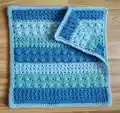
As you have 2 squares (one for each side), line them up, facing with the right side. (Picture 1)
Info :
Start in one of the corners and start sewing the sides together with the yarn left from the project. (I used the Duck Egg Blue shade) (Picture 2-3)
Info :
Keep sewing (Picture 4) and when you sew 3 sides together, insert the pillow form.
Info :
Continue to sew up the last side and then weave in the loose ends.
— Instructions (US Terms) :
Row 0 :
To start: With Color 1 (Dolphin Blue) CH 52
Row 1 :
1 DC into the 4th CH from the hook, 1 DC in each CH to end (50 DC)
Row 2 :
CH 2 (counts as DC), {SK 1 ST, 1 DC in next ST, 1 DC in skipped ST} 24 times, 1 DC in top of 3 CH (2 DC, 24 DC "crosses")
Row 3 :
Same as Row 2 (2 DC, 24 DC "crosses")
Row 4 :
Same as Row 2 (2 DC, 24 DC "crosses")
Row 5 (WS) :
Join Color 2 (Washed Teal) to the last ST of last row with a standing HDC or alternatively, you can CH 1 and HDC in same ST. 1 HDC in next 48 STS, 1 HDC in top of CH 2 (50 HDC)
Row 6 (RS) :
CH 2 (counts as DC), {1 DC in next 3 STS, 1 SWPuff ST, SK 1 ST} 12 times, 1 DC in last ST (38 DC, 12 SWPuff ST)
Row 7 (WS) :
CH 1, 1 HDC in same ST, 1 HDC in next 48 STS, 1 HDC in top of CH 2 (50 HDC)
Row 8 :
Same as Row 6 (50 HDC)
Row 9 :
Same as Row 7 (50 HDC)
Row 10 (RS) :
Join Color 3 (Duck Egg Blue) to the last ST of last row with a standing DC or alternatively, you can CH 1 and DC in same ST. {SK 1 ST, 1 DC in next ST, 1 DC in skipped ST} 24 times, 1 DC in last ST (2 DC, 24 DC "crosses")
Row 11 :
Same as Row 2 (2 DC, 24 DC "crosses")
Row 12 :
Same as Row 2 (2 DC, 24 DC "crosses")
Row 13 (WS) :
Join Color 1 (Dolphin Blue) to the last ST of last row with a standing HDC or alternatively, you can CH 1 and HDC in same ST. Same as Row 5 (50 HDC)
Row 14-17 :
Repeat Row 6-7 twice (50 HDC)
Row 18-20 :
Join Color 2 (Washed Teal) to the last ST of last row with a standing DC or alternatively, you can CH 1 and DC in same ST. Same as Row 10-12 (2 DC, 24 DC "crosses")
Row 21-25 :
Join Color 3 (Duck Egg Blue) to the last ST of last row with a standing HDC or alternatively, you can CH 1 and HDC in same ST. Same as Row 13-17 (50 HDC)
Row 26-28 :
Join Color 1 (Dolphin Blue) to the last ST of last row with a standing DC or alternatively, you can CH 1 and DC in same ST. Same as Row 10-12 (2 DC, 24 DC "crosses"). Fasten off.
This Snowberry cushion cover pattern was designed to add handmade charm to your home with lovely textures and cozy stripes. Create two matching squares, seam them together, and slip in a 14" pillow form to finish a stylish handmade accent. Perfect for gifting or updating your living space with a personal touch. 🧶🛋️