🧢 Beautiful ✨ Detailed πŸ’ Adorable

Yumi the Dachshund Bicolor Amigurumi Pattern

Yumi the Dachshund Bicolor Amigurumi Pattern
4.0β˜… Rating
5-7 Hours Time Needed
3.7K Made This
βœ‚οΈ

Intermediate Level

Ideal for those with basic crochet experience, featuring slightly more advanced stitches and techniques to expand your skills.

⏱️

Weekend Treat

Takes 5-7 hours, making it an enjoyable project to finish over a couple of days.

🧸

Cute Companion

An adorable friend to cherish, handcrafted with love to bring comfort and joy for years to come.

About This Yumi the Dachshund Bicolor Amigurumi Pattern

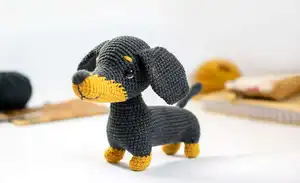
This addition teaches how to make a bicolor version of the Yumi the Dachshund amigurumi with clear round-by-round instructions. It focuses on the head, ears, legs and bicolor transitions that differ from the single-color pattern. You will also get precise placement notes for eyes and embroidered facial details.

Yumi the Dachshund Bicolor Amigurumi Pattern crochet pattern - detailed view of completed project

Photo references and step notes guide each color change and shaping technique. Use this alongside the main pattern to complete the full dog body and assembly.

Why You'll Love This Yumi the Dachshund Bicolor Amigurumi Pattern

I absolutely love this pattern because it brings a classic amigurumi character to life with smart color changes that add personality. I enjoy how simple stitch combinations create expressive shaping for the snout and head. The pattern encourages careful finishing β€” the embroidered details make each dog unique. Working through the color transitions is satisfying and gives a polished, professional look to the finished toy.

Yumi the Dachshund Bicolor Amigurumi Pattern step 1 - construction progress Yumi the Dachshund Bicolor Amigurumi Pattern step 2 - assembly progress Yumi the Dachshund Bicolor Amigurumi Pattern step 3 - details and accessories Yumi the Dachshund Bicolor Amigurumi Pattern step 4 - final assembly and finishing

Switch Things Up

I love experimenting with color palettes, and this bicolor pattern is perfect for trying unexpected combinations like teal and cream or soft pastels.

You can change the stripe frequency on the body or make a monochrome version by substituting one of the colors for a close shade.

To make a larger dog, switch to a thicker cotton or acrylic yarn and increase hook size; for a tiny keychain version, use a finer thread and smaller hook.

I often add tiny crocheted accessories like a scarf, hat, or collar to personalize each dog and give it character.

For different eye looks try embroidery, safety eyes of varying sizes, or French knot highlights to change expression.

I sometimes stiffen the ears slightly with a bit of fabric interfacing or light felting to get different ear positions.

Try replacing the tail with a curly crocheted tail or a little pompom for a playful finish.

You can add posable limbs by inserting floral wire inside the legs and shaping them before stuffing fully.

For extra texture, use boucle or linen-blend yarn for the body while keeping smooth cotton for the snout and paws for contrast.

I recommend practicing the color-change method on a small swatch first so you get comfortable starting changes one stitch earlier.

Common Mistakes & How to Fix Them

βœ— Starting rounds without a stitch marker can cause you to lose track of the spiral rounds; use a marker to mark your first stitch and move it every round. βœ— Changing colors in the middle of the round at the wrong stitch can leave visible gaps; always change color one stitch earlier and carry or secure tails neatly. βœ— Not stuffing as you go makes shaping difficult and can create lumps; stuff gradually throughout shaping rounds to create smooth curves. βœ— Forgetting to place safety eyes at the correct marked rounds will misalign facial features; mark eye positions exactly as instructed before continuing. βœ— Embroidering facial features with uneven tension will distort the muzzle shape; keep consistent tension and hide yarn tails securely after knotting.

Yumi the Dachshund Bicolor Amigurumi Pattern

This is an addition to the Yumi the Dachshund pattern that shows you exactly how to make a charming bicolor dachshund. You will learn color-change techniques, shaping, and finishing details to give your dog a neat two-tone look. The instructions are photo-guided and written in rounds so you can follow along easily and create a delightful handmade companion.

Intermediate 5-7 Hours

Materials Needed for Yumi the Dachshund Bicolor Amigurumi Pattern

β€” Main Fabric

  • 01
    Cotton yarn - black - 40g / 128m (140 yards) (sample used YarnArt Jeans black #28)
  • 02
    Cotton yarn - mustard - 15g / 48m (54 yards) (sample used YarnArt Jeans mustard #84)
  • 03
    Cotton yarn - white - 5g / 16m (18 yards) (sample used Alize Cotton Gold white #55)
  • 04
    Optional: small amounts of grey for sample details (Alize Cotton Gold grey #21)

β€” Tools Required

  • 01
    2 mm crochet hook (size C)
  • 02
    A pair of 10 mm (0.5") safety eyes
  • 03
    Polyfill to stuff
  • 04
    Tapestry needle
  • 05
    Stitchmarkers and pins

Progress Tracker

0% Complete

β€” Head :

Info :

All details are crocheted in continuous spirals, without joining the rounds. You can use a stitch marker to keep track of your rounds.

Info :

Start with color B

Round 01 :

6 sc into the center of magic adjustable ring, pull tail to close the ring (6)

Round 02 :

(inc) 6x (12)

Round 03 :

(sc, inc) 6x (18)

Round 04 :

(2sc, inc) 6x (24)

Round 05 :

sc in each st around (24)

Info :

In next rnds the color of yarn will be changed alternately:

Info :

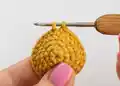
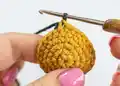
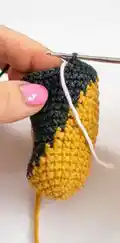
How to change the color yarn: with the two loops from the previous yarn on the hook, wrap new yarn over the hook (image 1.1) and pull it through the two loops of the stitch. (image 1.2) It is important to remember, that the color change must always be started one stitch earlier.(image 1.3)

Round 06 :

color B (next - B): 6sc, color A (next - A): 4sc, B: 14sc (24)

Round 07 :

B: 5sc, A: 6sc, B: 13sc (24)

Round 08 :

B: 4sc, A: (dec, sc) 2x, dec, B: 12sc (21)

Round 09 :

B: 3sc, A: 7sc, B: 4sc, (inc, 2sc) 2x, inc (24)

Round 10 :

B: 3sc, A: 7sc, B: 14sc (24)

Round 11 :

B: 2sc, A: 9sc, B: 13sc (24)

Round 12 :

B: 2sc, A: 5sc, inc, 3sc, B: 4sc, inc, 7sc, inc (27)

Round 13 :

B: 2sc, A: 10sc, B: 15sc (27)

Round 14 :

B: sc, A: 12sc, B: 14sc (27)

Round 15 :

B: sc, A: 7sc, inc, 5sc, B: 3sc, inc, 8sc, inc (30)

Round 16 :

A: 16sc, B: 13sc, A: sc (30)

Round 17 :

A: 4sc, (inc, sc) 4x, inc, 4sc, B: 11sc, A: 2sc (35)

Round 18 :

A: 5sc, (inc, 2sc) 4x, inc, 5sc, B: 9sc, A: 3sc (40)

Info :

In next rnd we should mark points for eyes:

Round 19 :

A: 4sc, with a contrast thread mark here a point for the first eye (image 1.5), 19sc, mark here a point for the second eye, 6sc, B: 7sc, A: 4sc (40)

Round 20 :

A: (inc, 3sc, inc, 7sc) 2x, inc, 3sc, inc, sc B: 5sc, A: 5sc (46)

Round 21 :

A: 37sc, B: 3sc, A: 6sc (18)

Info :

For the next rnds use color A only:

Round 22 :

sc, (inc, 4sc, inc, 8sc) 2x, inc, 4sc, inc, 11sc (image 1.6) (52)

Round 23-29 :

(7) sc in each st around (52)

Info :

If you use safety eyes, it is the best moment to place them. Place them in points we marked earlier in rnd 19. (image 1.7)

Round 30 :

(11sc, dec) 4x (48)

Round 31 :

3sc, (dec, 6sc) 5x, dec, 3sc (42)

Round 32 :

(5sc, dec) 6x (36)

Info :

Start stuffing the head with filling material. And continue stuffing it during crocheting.

Round 33 :

2sc, (dec, 4sc) 5x, dec, 2sc (30)

Round 34 :

(3sc, dec) 6x (24)

Round 35 :

sc, (dec, 2sc) 5x, dec, sc (18)

Round 36 :

(sc, dec) 6x (12)

Round 37 :

(dec) 6x (6)

Info :

Fasten off, leaving a long tail. Using tapestry needle, weave the yarn tail through the front loop of each remaining stitch and pull tight to close. Weave in the yarn end. (image 1.8)

β€” EARS (make 2) :

Info :

Start with color A

Round 01 :

ch10, sc in 2ndch from hook and remaining 7sc, inc in the last st, turn and continue on the other side of a chain 8sc, inc in the last st (image 2.1) (20)

Round 02-03 :

(2) sc in each st around (20)

Round 04 :

(9sc, inc) 2x (22)

Round 05 :

(10sc, inc) 2x (24)

Round 06 :

(11sc, inc) 2x (26)

Round 07 :

(12sc, inc) 2x (28)

Round 08-13 :

(6) sc in each st around (28)

Round 14 :

(12sc, dec) 2x (26)

Round 15 :

(11sc, dec) 2x (24)

Round 16 :

(10sc, dec) 2x (22)

Round 17 :

(9sc, dec) 2x (20)

Round 18 :

(8sc, dec) 2x (18)

Round 19 :

(7sc, dec) 2x (16)

Round 20 :

Crochet 3sc, then flatten an ear and line up stitches, 8sc through both sides to the end (image 2.2) (8)

Info :

Fasten off, cut the yarn, leaving a long tail for sewing. (image 2.3)

Info :

Sew ears to the both sides of a head between 22 and 31 rnds of a head. The distance between ears - 15sc along the 23rd rnd of a head. The distance between ear and eye - 3sc up from the eye. (image 2.4, 2.5, 2.6)

Info :

Take a piece of color A yarn and tapestry needle, insert needle from under the head (level of of 25th rnd) (image 2.7) and bring it out right next to the eye, and insert it back on the opposite side of an eye (image 2.8, 2.9), then bring it back down under the head, one stitch from the entry. Repeat with the second eye, inserting the needle in the same points from the bottom (image 2.10). Then properly pull all yarn ends and, keeping yarn tension, tie a knot of all yarn ends, hide an ends. (image 2.11, 2.12)

Info :

Take a piece of black yarn and embroider the nose between 1 and 7 rnds of a head's top part. The size of a nose - 5sc in height, 3sc - the bottom side, 7sc - the top side. (image 2.13, 2.14)

Info :

Embroider the line from the bottom of a nose to the 3 rnd of the head's bottom part. Then embroider a smile to the both sides from the line between 3 and 8 rnds of a head. (image 2.15, 2.16)

Info :

With the color B yarn embroider the eyebrows, placing them between 20 and 22 rnds over eyes (make 2 loops of yarn). The length of the eyebrow - 2sc, the height - 1sc. (image 2.17)

Info :

With the white yarn embroider lines under the eyes (image 2.17).

β€” LEGS (make 4) :

Info :

Start with color B

Round 01 :

ch5, sc in 2ndch from hook and remaining 2sc, 3sc in the last st, turn and continue on the other side of a chain 3sc, 3sc in the last st (image 3.1) (12)

Round 02 :

(3sc, 3inc) 2x (18)

Round 03 :

This rnd work with back loops only (image 3.2) sc in each st around (18)

Round 04 :

sc in each st around (18)

Round 05 :

sc, 6dec, 5sc (12)

Round 06 :

sc in each st around (12)

Info :

Change yarn to color A

Round 07 :

2sc, 3inc, 7sc (15)

Info :

The next rnd will be different for each leg.

For a back right leg (Round 08) :

3sc, (inc, sc) 2x, inc, 7sc

Info :

Make slst. Fasten off, cut the yarn. Attach a pink marker on the 3rd st from the last slst. (image 3.3)

For a back left leg (Round 08) :

3sc, (inc, sc) 2x, inc

Info :

Make slst. Fasten off, cut the yarn. Attach a green marker on the 3rd st from the last slst.

For a front left leg (Round 08) :

3sc, (inc, sc) 2x, inc, sc

Info :

Make slst. Fasten off, cut the yarn. Attach a yellow marker on the 3rd st from the last slst.

For a front right leg (Round 08) :

3sc, (inc, sc) 2x, inc, 7sc

Info :

Make slst. Fasten off, cut the yarn. Attach a blue marker on the 3rd st from the last slst. (image 3.4)

Info :

The next process is the same, as in the main pattern, so next follow the main pattern since page 6 (body), but use colors you chose for your dog.

Assembly Instructions

  • Place safety eyes at the marked points made in Round 19 before continuing the head shaping or closing the head.
  • Sew ears to both sides of the head between rounds 22 and 31, spacing them 15sc apart along the 23rd round and placing them 3sc up from the eye for symmetry.
  • Use the colored markers on the legs (pink, green, yellow, blue) to identify back/right/front placement and sew each leg to the body according to the main pattern, aligning the 3rd stitch marker with attachment points.
  • Embroider the nose and mouth as described: nose between rounds 1 and 7 (5sc height, 3sc bottom, 7sc top) and stitch the smile from the bottom of the nose to the 3rd round of the head; secure all ends and hide knots.
  • After stuffing head and body, attach head to body following the main pattern instructions on page 6 and sew firmly using a tapestry needle and matching yarn for a smooth join.

Important Notes

  • πŸ’‘All details are crocheted in continuous spirals so use a stitch marker to keep track of your rounds.
  • πŸ’‘Start stuffing the head early and continue stuffing during crocheting to achieve smooth shaping and avoid lumps.
  • πŸ’‘When changing colors, always start the color change one stitch earlier to hide the join and maintain a neat edge.
  • πŸ’‘If instructed to work in back loops only (for example leg rnd 3) be careful to pick the correct loop to maintain the intended texture and shape.
  • πŸ’‘Place safety eyes at the marked points (rnd 19) before continuing with later rounds to ensure correct positioning.

This bicolor Yumi dachshund pattern is a delightful way to practice color changes and shaping techniques. It makes a lovable handmade gift or a charming shelf buddy for any crochet lover. Mix colors and create a whole pack of tiny dachshunds to brighten any room. 🧢🐾

You ask,

we answer.

FAQs

What size will the finished piece be?

The finished amigurumi measures approximately 7.5" (19 cm) in height and 7" (17 cm) wide when using the recommended yarn and 2 mm hook.

Can I use different yarn weights for this pattern?

Yes, you can use different yarn weights but the final size and gauge will change; choose an appropriate hook for your yarn and expect a different finished measurement.

Do I need prior crochet experience for this pattern?

This pattern is rated intermediate, so basic knowledge of single crochet, increases, decreases, and working in continuous spirals is recommended for best results.

How long does this project typically take to complete?

Most crocheters complete this project in 5-7 hours, though time may vary based on experience level, color changes, and finishing details.