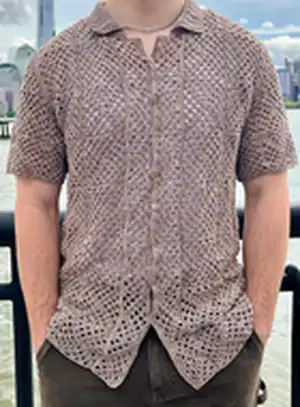
Create a breezy, openwork Amalfi crochet shirt designed for effortless summer style. This pattern guides you through modular squares and smart assembly to build a relaxed button-up top with short sleeves and a classic collar. You will enjoy piecing together full, half and diagonal squares for a customizable fit and textured finish.
Progress Tracker
0% Complete
— Diagonal Squares :
All sizes: make 5 :
Make 5 diagonal squares for all sizes.
Round 1 :
Ch 2. In the 2nd ch from hook, make: [dc 3, ch 2, dc 3]. (8, 8, 8, 8, 8, 8)
Round 2 :
Ch 1 (does not count as st), turn, dc 3 times in the next st from hook. Ch 2, in the next ch-2 space from your hook, make: [dc 3, ch 2, dc 3]. Then, ch 2, and make 3 dc into the very last st. (18, 18, 18, 18, 18, 18)
Round 3 :
Ch 1 (does not count as st), turn, dc 3 times in the next st from hook. Ch 2, in the next ch-2 space from your hook, dc 3 times. Then, ch 2. In the next ch-2 space from your hook, make: [dc 3, ch 2, dc 3]. Then, ch 2, and dc 3 times in the next ch-2 space from your hook. Ch 2, and dc 3 times into the very last st. (28, 28, 28, 28, 28, 28)
Round 4 :
Ch 1 (does not count as st), turn, dc 3 times in the next st from hook. Ch 2, in the next ch-2 space from your hook, dc 3 times. Again, ch 2, and dc 3 times in the next ch-2 space from your hook. Then, ch 2, and in the next ch-2 space from your hook, make: [dc 3, ch 2, dc 3]. Then, ch 2, and make 3 dc into the next ch-2 space from hook. Again, ch 2 and make 3 dc into the next ch-2 space from hook. Finally, ch 2 and dc 3 times into the very last st. (38, 38, 38, 38, 38, 38)
Round 5 :
Ch 1 (does not count as st), turn, dc 3 times in the next st from hook. Ch 2, in the next ch-2 space from your hook, dc 3 times. Again, ch 2, and dc 3 times in the next ch-2 space from your hook. Once more, ch 2 and dc 3 times in the next ch-2 space from your hook. Then ch 2, in the next ch-2 space from your hook make: [dc 3, ch 2, dc 3]. Ch 2, dc 3 times in the next ch-2 space from hook. Ch 2, dc 3 times in the next ch-2 space from hook. Again, ch 2 and make 3 dc into the next ch-2 space from hook. Once more, ch 2 and make 3 dc into the next ch-2 space from hook. Lastly, ch 2 and dc 3 times into the very last st. (48, 48, 48, 48, 48, 48)
— Full Squares :
Make (72, 77, 86, 91, 102, 107) :
Make full squares—number required listed by size.
Round 1 :
Ch 2. In the 2nd ch from hook, make: [dc 3, ch 2, dc 3, ch 2, dc 3, ch 2]. Then, sl st across your first 3 dc of the round, and sl st once more into the first ch-2 space of the round. You will begin each round going forward from a ch-2 space. (20, 20, 20, 20, 20, 20)
Round 2 :
Ch 1 (does not count as st), in the same ch-2 space, make: [dc 3, ch 2, dc 3]. **Ch 2, in the next ch-2 space from hook, make: [dc 3, ch 2, dc 3]. Repeat from ** two more times. Then, sl st across the first 3 dc of the round, and sl st once more into the very first ch-2 space of the round. (40, 40, 40, 40, 40, 40)
Round 3 :
Ch 1 (does not count as st), in the same ch-2 space, make: [dc 3, ch 2, dc 3]. **Ch 2, dc 3 times in the next ch-2 space from hook. Ch 2, in the next ch-2 space from hook make: [dc 3, ch 2, dc 3]. Repeat from ** once more. Then, ch 2, dc 3 times in the next ch-2 space from hook. Ch 2, and sl st across the first 3 dc of the round, and then sl st once more into the first ch-2 space of the round. (60, 60, 60, 60, 60, 60)
Round 4 :
Ch 1 (does not count as st), in the same ch-2 space, make: [dc 3, ch 2, dc 3]. **Ch 2, dc 3 times in the next ch-2 space from hook. Ch 2, dc 3 times in the next ch-2 space from hook. Ch 2, in the next ch-2 space from hook make: [dc 3, ch 2, dc 3]. Repeat from ** once more. Then, ch 2, dc 3 times in the next ch-2 space from hook. Again, ch 2, dc 3 times in the next ch-2 space from hook. Lastly, ch 2, and sl st across the first 3 dc of the round, and then sl st once more into the first ch-2 space of the round. (80, 80, 80, 80, 80, 80)
Round 5 :
Ch 1 (does not count as st), turn, dc 3 times in the next ch-2 space from hook. Ch 2, dc 3 times in the next ch-2 space from hook. Ch 2, in the next ch-2 space from hook make: [dc 3, ch 2, dc 3]. Ch 2, dc 3 times in the next ch-2 space from hook. Again, ch 2, dc 3 times in the next ch-2 space from hook. Then ch 2, and sl st across the first 3 dc of the round, and then sl st once more into the first ch-2 space of the round. (100, 100, 100, 100, 100, 100)
— Half Squares :
Make (18, 18, 20, 20, 18, 18) :
Make the listed number of half squares for your size.
Round 1 :
Ch 2. In the 2nd ch from hook, make: [dc 3, ch 2, dc 3, ch 2, dc 3]. (13, 13, 13, 13, 13, 13)
Round 2 :
Ch 1 (does not count as st), turn, dc in the next st from hook. Ch 2, in the next ch-2 space from hook, make: [dc 3, ch 2, dc 3]. Ch 2, in the next ch-2 space from hook, make: [dc 3, ch 2, dc 3]. Ch 2, dc in the very last st. (26, 26, 26, 26, 26, 26)
Round 3 :
Ch 1 (does not count as st), dc 3 times in the next ch-2 space from hook. Ch 2, in the next ch-2 space from hook make: [dc 3, ch 2, dc 3]. Ch 2, dc 3 times in the next ch-2 space from hook. Ch 2, in the next ch-2 space from hook make: [dc 3, ch 2, dc 3]. Ch 2, dc 3 times in the next ch-2 space from hook. (33, 33, 33, 33, 33, 33)
Round 4 :
Ch 1 (does not count as st), turn, dc in the next st from hook. Ch 2, dc 3 times in the next ch-2 space from hook. Ch 2, in the next ch-2 space from hook make: [dc 3, ch 2, dc 3]. Ch 2, dc 3 times in the next ch-2 space from hook. Again, Ch 2, dc 3 times in the next ch-2 space from hook. Ch 2, dc in the very last st. (44, 44, 44, 44, 44, 44)
Round 5 :
Ch 1 (does not count as st), turn, dc 3 times in the next ch-2 space from hook. Ch 2, dc 3 times in the next ch-2 space from hook. Ch 2, in the next ch-2 space from hook make: [dc 3, ch 2, dc 3]. Ch 2, dc 3 times in the next ch-2 space from hook. Ch 2, dc 3 times in the next ch-2 space from hook. Again, Ch 2, dc 3 times in the next ch-2 space from hook. Then ch 2, in the next ch-2 space from hook make: [dc 3, ch 2, dc 3]. Ch 2, dc 3 times in the next ch-2 space from hook. (53, 53, 53, 53, 53, 53)
— Assembly :
Info :
By now, you should have all of your diagonal squares, full squares and half squares made.
Top Base :
Start by assembling the top base. This is the portion of the top that goes from underneath the armpit, down to the hips. Depending on what size you are making, the top base will be a large rectangle that is (8, 9, 10, 11, 12, 13) full squares wide, and 5 full squares tall.
Info :
If you wanted your top shorter or longer, you could add or remove rows of squares from your top base to get your preferred height.
Attach Front Panels :
Next, you will attach front panels to your top base. Each front panel is made up of a 2x2 square of 'full squares' and one full square + one diagonal square stacked on top. Sew each front panel to the first two and last two columns of the top base. Make sure your diagonal square is facing out for each one (as pictured).
Back Panel :
The back panel is another rectangle that is (4, 4, 4.5, 4.5, 5, 5) squares wide, and 3 full squares tall. Note: the '.5' refers to a half square. Sew your back panel in between your front panels, all on the top base. Make sure to space out your back panel evenly so there is the same amount of space in between both of the front panels.
Sew Front Top Edges :
Then, sew the edge of your front panels' top-most full square to the top edge of the back panel, starting at the corner and working inward until the front panels' full square is completely attached.
Half Squares on Edges :
Once you have both front panels connected to the back panel, sew a line of 'half squares' all down the edge of each front panel, starting directly underneath the diagonal square and working all the way to the bottom of the top.
Sleeves - Create Loop :
Now you can move onto creating the sleeves! You will need two sleeves, one for each sleeve hole. To create a sleeve, you first create one large loop, made up of (4.5, 4.5, 5, 5, 5.5, 5.5) squares all connected together in the loop. (Remember, the '.5' here refers to a half-square).
Sleeves - Stack :
This loop should fit comfortably around the widest part of the arm. If needed, add or remove a half-square accordingly to get the best fit. Next, stack another loop of (4.5, 4.5, 5, 5, 5.5, 5.5) squares to the first loop, so it is now 2 squares tall.
Sleeves - Top Piece :
Lastly, sew (.5, .5, 1, 1, 1.5, 1.5) square to the top of your loop. Then, sew a diagonal square on either end of this square(s). When flattened, your sleeve should look like the diagram. Then, sew your sleeves to each of the sleeve holes. The stitch count is not important to line up at this step - instead, pin the sleeve to the top and bottom of your sleeve hole at the midpoints, so that when you sew it will be spaced out evenly.
Info :
When both sleeves are attached, check fit and adjust if any shaping tension is needed.
Shirt Collar :
With your sleeves fully attached, you can now crochet the collar for the shirt.
Round 1 :
For all sizes, ch 19. Turn, dc in 2nd ch from hook and in each ch across. (18)
Round 2 :
Ch 1 (does not count as st), turn, dc in each st across. (18)
Rounds :
Rounds (3-42, 3-42, 3-52, 3-52, 3-62, 3-62): Repeat Round 2. Fasten off.
Sew Collar :
Sew the edges of the collar to the shirt's neckline - starting ~1 inch in from the front panel, and working all the way around to the other front panel. Make sure to space out your collar evenly and if you can, try to pin it before sewing.
Finishing :
When finished, weave in all ends. For the last step, sew your buttons to the edge of a front panel. Leave ~2 inches in between each button. Then, your top is ready to wear!
This Amalfi Top pattern brings together classic crocheted squares into a modern button-up shirt you can wear with confidence. Customize the length and sleeve fit by adding or removing rows for your ideal silhouette. Perfect for gifting or treating yourself to a handmade wardrobe staple. 🧶👕