🧢 Beautiful ✨ Detailed πŸ’ Adorable

Appletosaurus Amigurumi Pattern

Appletosaurus Amigurumi Pattern
4.0β˜… Rating
5-7 Hours Time Needed
1.2K Made This
βœ‚οΈ

Intermediate Level

Ideal for those with basic crochet experience, featuring slightly more advanced stitches and techniques to expand your skills.

⏱️

Weekend Treat

Takes 5-7 hours, making it an enjoyable project to finish over a couple of days.

🧸

Cute Companion

An adorable friend to cherish, handcrafted with love to bring comfort and joy for years to come.

About This Appletosaurus Amigurumi Pattern

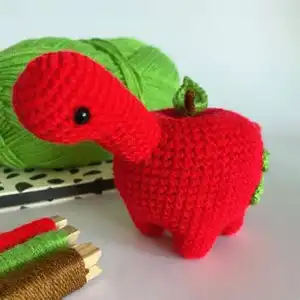
This pattern creates a small apple-inspired dinosaur amigurumi called Appletosaurus, with a rounded body, tail, head, leaf and decorative spots. It uses DK weight yarn and a small hook to create a compact 10cm tall finished piece. The instructions include assembly guidance and photo references to help with placement and finishing. Techniques like invisible decrease and invisible closing are explained to give your toy a tidy, professional look.

Appletosaurus Amigurumi Pattern crochet pattern - detailed view of completed project

You'll make four legs, a stuffed body, a detachable leaf and stem, plus a cluster of spots for detail. The pattern is richly illustrated and includes tips for balancing and positioning the head and tail.

Why You'll Love This Appletosaurus Amigurumi Pattern

I absolutely love this pattern because it mixes playful design with classic amigurumi techniques to create a truly charming little toy. I enjoy how the apple shape and dinosaur silhouette combine to make a unique and whimsical character. The pattern taught me clever placement techniques for balancing the head and tail so the finished toy stands nicely. I also love that the tiny leaf, stem and spots give you opportunities to add personality and custom color choices.

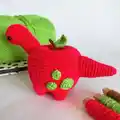
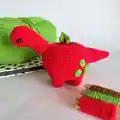
Appletosaurus Amigurumi Pattern step 1 - construction progress Appletosaurus Amigurumi Pattern step 2 - assembly progress Appletosaurus Amigurumi Pattern step 3 - details and accessories Appletosaurus Amigurumi Pattern step 4 - final assembly and finishing

Switch Things Up

I love offering suggestions for customization β€” try changing the main colour to pale pink or yellow for a fruity twist on the Appletosaurus.

Swap Grass Green for mint or lime to make the leaf and spots pop, or use variegated DK yarn for a playful speckled look.

If you want a larger toy, use a thicker DK or aran weight yarn and increase your hook size; smaller versions can be made with fingering yarn and a smaller hook.

I often add embroidered smiles or tiny felt cheeks to give each toy a unique expression and personality.

Change the spot placement or number to create different patterns on the apple-body β€” three spots on each side is the pattern here, but you can add more or fewer.

Try making the stem longer and adding a tiny ribbon for a decorative touch on a gift version.

For a posable version, you can thread thin floral wire through the tail before stuffing to gently shape or pose it.

I sometimes make matching mini accessories like a tiny hat or scarf to create a seasonal set of Appletosauruses.

Experiment with safety eye sizes or embroidered eyes to give your toy a softer or more stylized facial look.

If making for small children, avoid safety eyes and embroider the facial features securely for safety and durability.

Common Mistakes & How to Fix Them

βœ— Not placing safety eyes at the correct rounds can alter the face placement; insert the safety eyes between rounds 7 and 8, ten stitches apart to ensure proper placement. βœ— Skipping stuffing until late causes uneven shaping and lumps; start to stuff firmly at the indicated round and continue stuffing as you decrease to maintain an even form. βœ— Forgetting to join the legs correctly will leave gaps between parts; follow Round 5 carefully when joining legs to the body, inserting your hook through leg stitches and the body round as described. βœ— Pulling the yarn too tightly when finishing the invisible close can distort the top; pull until you make a small dip then secure with a few stitches on the bottom to raise the tummy slightly without over-tightening.

Appletosaurus Amigurumi Pattern

Make a charming Appletosaurus β€” a tiny apple-shaped dinosaur amigurumi that is perfect for gifting or decorating. This pattern walks you through making the legs, body, head, tail, leaf, stem and spots with clear step-by-step rounds and photos. You'll learn invisible decreases and invisible closes to create a neat, professional finish. Ideal for crafters who enjoy small, detailed crochet projects.

Intermediate 5-7 Hours

Materials Needed for Appletosaurus Amigurumi Pattern

β€” Main Fabric

  • 01
    Stylecraft Special DK - Matador (red) - DK weight yarn (used as main colour for body, head, tail and legs)
  • 02
    Stylecraft Special DK - Grass Green - DK weight yarn (used for leaf and spots)
  • 03
    Stylecraft Special DK - Gingerbread - DK weight yarn (used for stem)

β€” Tools Required

  • 01
    Crochet hook size 2.5 mm
  • 02
    Two 6mm safety eyes
  • 03
    Stitch markers
  • 04
    Yarn needle
  • 05
    Scissors
  • 06
    Fibrefill (polyester stuffing)
  • 07
    Pins for assembly (optional)

Progress Tracker

0% Complete

β€” Techniques used in this pattern :

Info :

How to close amigurumi invisibly: 1. Insert needle in the FLO of each stitch around 2. Pull tight to close 3. Insert needle through centre exiting a few rounds down 4. Weave in the end and admire your work!

Info :

How to decrease invisibly: 1. Insert hook into FLO of first stitch 2. Insert hook into FLO of next stitch 3. Yarn over and pull through two loops 4. Yarn over and pull through two loops again. Invisible decrease complete!

β€” Legs (make four) :

Round 1 :

Using Matador 6sc in MR (6)

Round 2 :

inc each st around (12)

Round 3 :

in BLO sc each st around (12)

Round 4 :

sc each st around (12)

Info :

Cut yarn and weave in ends (photo 1)

β€” Body :

Round 1 :

Using Matador 6sc in MR (6)

Round 2 :

inc each st around (12)

Round 3 :

*1sc, inc* rep 6 times (18)

Round 4 :

*2sc, inc* rep 6 times (24)

Round 5 :

2sc, with the body still on your hook (photo 2) Insert hook through any st in leg 1 and through the next st of rnd 4 (photo 3) complete sc, complete a further 2sc in this way, 3sc, 3sc through leg 2 and rnd 4, 3sc, 3sc through leg 3 and rnd 4, 3sc, 3sc through leg 4 and rnd 4, sc (24)

Info :

All four legs should now be attached to the body (photo 4)

Round 6 :

2sc, 9sc around leg 1, 3sc, 9sc around leg 2, 3sc, 9sc around leg 3, 3sc, 9sc around leg 4, sc (48) (photo 5)

Round 7-11 :

sc each st around (48) (5 rnds)

Round 12 :

*7sc, inc* rep 6 times (54)

Round 13-20 :

sc each st around (54) (8 rnds)

Round 21 :

*7sc, dec* rep 6 times (48)

Round 22 :

*6sc, dec* rep 6 times (42)

Round 23 :

*5sc, dec* rep 6 times (36)

Info :

Start to stuff firmly and continue to stuff as we decrease.

Round 24 :

*4sc, dec* rep 6 times (30)

Round 25 :

*3sc, dec* rep 6 times (24)

Round 26 :

*2sc, dec* rep 6 times (18)

Info :

Stop stuffing here.

Round 27 :

sc each st around (18)

Round 28 :

*1sc, dec* rep 6 times (12)

Round 29 :

sc each st around (12)

Round 30 :

dec 6 times (6)

Info :

Cut yarn leaving a long tail.

Info :

Complete invisible close up to step 2 (photo 6). Insert the needle into the centre, push it through the body coming out directly at the bottom (photo 7 and 8). Pull the yarn tight making a dip in the top of the body (photo 9). Make a few sts on the bottom to secure. This should also raise the tummy slightly. Weave in ends.

β€” Head :

Round 1 :

Using Matador 6sc in MR (6)

Round 2 :

inc each st around (12)

Round 3 :

*1sc, inc* rep 6 times (18)

Round 4 :

*2sc, inc* rep 6 times (24)

Round 5-9 :

sc each st around (24) (5 rnds)

Round 10 :

6sc, *sc, dec* rep 4 times, 6sc (20)

Round 11 :

4sc, *sc, dec* rep 4 times, 4sc (16)

Info :

Insert safety eyes between rnds 7 - 8 ten sts apart so they appear either side of the head.

Round 12-18 :

sc each st around (16) (7 Rnds)

Info :

Finish the final rnd with a slst to join. Cut yarn leaving a long tail.

β€” Tail :

Round 1 :

Using Matador 6sc in MR (6)

Round 2 :

*sc, inc* rep 3 times (9)

Round 3-4 :

sc each st around (9) (2 rnds)

Round 5 :

*2sc, inc* rep 3 times (12)

Round 6-7 :

sc each st around (12) (2 rnds)

Round 8 :

*3sc, inc* rep 3 times (15)

Round 9-10 :

sc each st around (15) (2 rnds)

Round 11 :

6sc, 3inc, 6sc (18)

Round 12-13 :

sc each st around (18) (2 rnds)

Info :

Finish the final rnd with a slst to join. Cut yarn leaving a long tail.

Info :

Head and tail shown in (photo 10)

β€” Leaf :

Round 1 :

Using Grass Green ch8, sc in 2nd st from hook, hdc, dc, dcinc, dc, hdc, dc, work the following sts in the final st (sc, ch2, slst in 2nd ch from hook, sc) Now working down the other side of the ch, hdc, dc, dcinc, dc, hdc, sc, slst to join (16)

Info :

Cut yarn leaving a long tail.

β€” Stem :

Row 1 :

Using Gingerbread Ch10, slst in 2nd ch from hook, 8slst (9)

Info :

Cut yarn leaving a long tail.

Info :

Leaf and stem shown in (photo 11)

β€” Spots :

Item Name (Small Spots) :

Using Grass green Small Spots (make two) Rnd 1 6sc in MR close with a slst (6)

Info :

Cut yarn leaving a long tail.

Item Name (Medium Spots) :

Using Grass green Medium Spots (make two) Rnd 1 8sc in MR close with slst (8)

Info :

Cut yarn leaving a long tail.

Item Name (Large Spots) :

Using Grass green Large Spots (make two) Rnd 1 6sc in MR (6)

Round 2 :

inc each st around close with slst (12)

Info :

Cut yarn leaving a long tail. All spots shown in (photo 12)

β€” Assembly :

Info :

We will use the long tails to attach everything.

Info :

Using a few small sts attach the leaf half way up the stem (photo 13) then sew in the centre of the dip (photo 14 and 15)

Info :

Stuff head firmly and sew over rnds 18 - 22. You may need to adjust this positioning if you find your Appletosaurus won't balance correctly. (photo 16)

Info :

Stuff tail firmly and sew over rnds 14 - 19 ensuring the 3 increases from rnd 11 are towards the top (photo 17)

Info :

Sew the spots on each side towards the rear (photo 18)

Assembly Instructions

  • Using a few small stitches attach the leaf half way up the stem, then sew the stem into the centre of the dip on the top of the body (photo 13, photo 14 and 15).
  • Stuff the head firmly and sew it to the body over rounds 18 - 22, adjusting placement so the Appletosaurus balances correctly (photo 16).
  • Stuff the tail firmly and sew it to the body over rounds 14 - 19, making sure the three increases from round 11 are oriented towards the top (photo 17).
  • Sew the small, medium and large spots on each side towards the rear of the body to create the decorative apple-spot pattern (photo 18).

Important Notes

  • πŸ’‘We will use the long tails to attach everything, so do not fasten off completely until you are ready to place and sew each piece.
  • πŸ’‘Insert safety eyes between rounds 7 and 8, ten stitches apart for the correct facial placement.
  • πŸ’‘Start stuffing firmly during the decreases and continue stuffing as you go to achieve even shaping and avoid lumps.
  • πŸ’‘Pin parts in place before sewing to check balance and position, especially the head and tail to ensure the toy stands correctly.
  • πŸ’‘Weave in ends after assembly to keep the finish neat and secure all attachments with multiple small stitches.

This Appletosaurus pattern turns simple DK yarn into a sweet apple-dinosaur with personality and charm. Whether you sell them, gift them, or keep one for a shelf, they make a delightful handmade keepsake. Have fun choosing colors, adding spots, and making each one unique β€” happy hooking! 🧢🍎✨

You ask,

we answer.

FAQs

What size will the finished piece be?

If made using the suggested yarn and 2.5 mm hook, the finished product is approximately 10 cm tall.

Can I use different yarn weights for this pattern?

Yes, you can use different yarn weights but this will affect the final size; use an appropriate hook size for your yarn and expect changes in proportions.

Do I need prior crochet experience for this pattern?

This pattern is rated intermediate, so basic knowledge of single crochet, increasing, decreasing, and working in rounds is recommended for best results.

How long does this project typically take to complete?

Most crocheters complete this project in 5-7 hours, though time may vary based on experience and the speed at which you work.