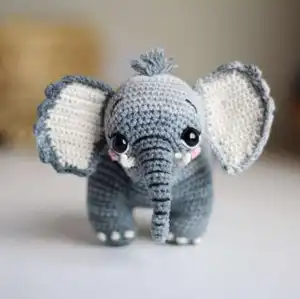
Create a sweet little Elephant named Elf with this detailed amigurumi pattern. You will crochet a movable trunk, delicate ears, tusks, cheeks and a heart-shaped balloon with full step-by-step photos and clear instructions. Perfect for gifting or keeping as a charming handmade companion, this pattern guides you through assembly, embroidery and optional wire reinforcement for a playful pose.
Progress Tracker
0% Complete
— CONVENTIONS :
Info :
l - loop = chain. sc - single crochet; dc - double crochet; sl st - slip stitch; P - picot (small and big, see section "EARS"). inc - increase; dec - decrease; (...) - total number of loops in a round; [...]xN - repeat what is indicated in round brackets N times.
— TRUNK & FACE (Yarn A) :
Round 1 :
2 loops, 6sc in 2nd loop from hook (amigurumi ring) (6l)
Round 7 :
[2sc, inc]x2 (8l)
Round 11 :
[3sc, inc]x2 (10l)
Round 13 :
[4sc, inc]x2 (12l)
Round 15 :
[5sc, inc]x2 (14l)
Round 16 :
[6sc, inc]x2 (16l)
Info :
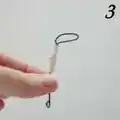
Cut a piece of decorative wire 2 - 3 cm (0,8 - 1,2 inches) longer than the trunk (see photo 1). Twist one end of the wire into a loop, and twist the other end into the ring (of diameter equal to the trunk opening) with the help of round nose pliers (see photo 2). Wrap the place of twisting with electrical tape (see photo 3). Insert crochet trunk to the wire. Crochet and fix the wire on two points to the trunk - before every increase, crocheting the next round (see photos 4-6). If you decide not to use wire, then skip these steps and continue crochet.
Round 17 :
[7sc, inc]x2 (18l)
Round 18 :
3sc, [sc, inc]x6, 3sc (24l)
Round 19 :
3sc, [2sc, inc]x6, 3sc (30l)
Round 20 :
3sc, [3sc, inc]x6, 3sc (36l)
Round 21 :
[5sc, inc]x6 (42l) Fill the trunk with synthepus. Cut and fix the thread.
— LEGS 4 pcs (Yarn A) :
Round 1 :
2 loops, 8sc in 2nd loop from hook (amigurumi ring) (8l)
Round 2 :
[sc, 3sc in the next loop]x4 (16l)
Round 3 :
2sc, inc, [3sc, inc]x3, sc (20l)
Round 4 :
20sc only through back loops (20l)
Round 5 :
[dec]x2, 4sc, [inc]x4, 4sc, [dec]x2 (20l)
Info :
Cut and fix the thread. Don’t remove the pins of the round’s beginning, they also note the place of the legs' and the belly’s connection (see photo 7).
— BELLY (Yarn B) :
Round 1 :
4 loops, turning, 3sc (starting from the 2nd loop from the hook) (3l)
Round 2-3 :
1 loop, turning, 3sc (3l)
Info :
Crocheted the belly around the perimeter in a counter-clockwise direction from the point "Start" (see photo 8).
Round 4 :
3sc in the corner, 1sc down the side, 3sc in the corner, 3sc across, 3sc in the corner, 1sc up the side, 3sc in the corner, 3sc across (20l)
Info :
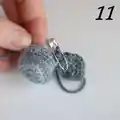
In the next round you need to crochet the belly around the perimeter in a counter-clockwise direction from the point "Start" and join the legs (see photo 9). To connect the details insert the hook initially into the leg, and then into the belly.
Round 5 :
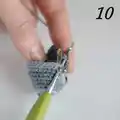
1sc, join the 1st leg with sc, 19sc around the leg (see photos 10-13); 3sc down; join the 2nd leg with sc, 19sc around the leg (see photos 14, 15); 5sc across; join the 3rd leg with sc, 19sc around the leg (see photos 16, 17); 3sc up; join the 4th leg with sc, 19sc around the leg (see photos 18, 19); 4sc across (see photos 20) (96l)
Info :
Don’t cut the thread. Sew holes under the thighs of both legs using extra thread (see photo 21). Start crocheting the body.
— BODY & HEAD (Yarn A) :
Info :
Mark with a pin the junction of the face with the body. To do this, move the pin on the 18th loop from the beginning of the face round (see photo 22). Crocheted the next round from the point "Start" and attach the face to the body. To connect the details insert the hook initially into the face (from the inside to the outside), and then into the body (from the outside to the inside) (see photos 23, 24).
Round 8 :
45sc along the body, crochet 6sc of the face together with 6sc of the body, then crochet 45sc along the body (see photo 25)
Round 9 :
[13sc, dec]x3, [5sc, inc]x6, [13sc, dec]x3 (126l) (see photo 26)
Round 10 :
[12sc, dec]x3, [2sc, dec]x3, [2sc, inc]x6, [2sc, dec]x3, [12sc, dec]x3 (120l)
Round 11 :
[11sc, dec]x3, 42sc, [11sc, dec]x3 (114l)
Info :
Put an extra pin on the 32nd loop clockwise from the round’s beginning (see photo 27).
Round 12 :
86sc, 6 loops, sc in the loop marked with a pin (the last sc becomes the beginning of the new round, you need to move the pin) (see photos 28-30)
Info :
After 12th round, the shape has two holes (see photo 31) - hole for the head (left) and hole for the back (right). We continue to work with the left hole for the head (see photos 32, 33).
Round 14 :
[sc, dec]x2, 42sc, [sc, dec]x4 (54l)
Round 15 :
[dec]x2, 42sc, [dec]x4 (48l)
Round 18 :
[6sc, dec]x6 (42l)
Round 19 :
[5sc, dec]x6 (36l)
Info :
Insert safety eyes between the rounds 20 and 21 (count from the top of the trunk), the distance between them is approximately 14 stitches, don’t fix yet (see photo 34). Using yarn needle to do around the eye "loose stitch" with white threads of mouline (see photo 35). Separate one thread and fasten with a needle "loose stitch" (see photos 36, 37). Make a "loose stitch" with black threads of mouline around the upper half of the eye (see photos 38, 39). Separate one thread and fasten with a needle "loose stitch" (see photos 40, 41). Embroider a cilia (see photos 42, 43). Press the eye to the embroidered line and fasten it. Embroider the stripes on the trunk (see photo 44).
Round 20 :
[4sc, dec]x6 (30l)
Round 21 :
[3sc, dec]x6 (24l)
Round 22 :
[2sc, dec]x6 (18l)
Round 23 :
[sc, dec]x6 (12l)
Info :
Completely fill the head.
Info :
Cut a circle out of white felt, it should be a little larger than the resulting hole (see photo 67, 68). Insert it into the hole in order to synthepus does not cling to the needle during closing the detail. Trim the thread. Pass the thread through all the loops using the yarn needle. Tighten and secure. See the holes between the neck and the head (see photo 69).
— BACK (Yarn A) :
Round 1 :
[9sc, dec]x6 (60l)
Round 2 :
[8sc, dec]x6 (54l)
Round 4 :
[7sc, dec]x6 (48l)
Info :
Fill the legs with synthepus.
Round 5 :
[6sc, dec]x6 (42l)
Round 6 :
[5sc, dec]x6 (36l)
Round 7 :
[4sc, dec]x6 (30l)
Info :
Start stuffing the body with synthepus. Place the counterweight in the hole in the back (so that the head does not outweigh and the elephant stands steadily). You can use a round heavy object (stone or metal detail wrapped with electrical tape) as a counterweight.
Round 8 :
[3sc, dec]x6 (24l)
Round 9 :
[2sc, dec]x6 (18l)
Round 10 :
[sc, dec]x6 (12l)
Info :
Completely fill the body.
Info :
Cut a circle out of white felt, insert into the hole to prevent stuffing cling, trim the thread, pass thread through all loops using yarn needle, tighten and secure. See the holes between the neck and the back.
— TOES (Yarn B, in two folds) :
Info :
TOES, 3 pcs on each leg. Embroider 3 toes on each leg with French knot (see photos 76-81).
— TAIL (Yarn A) :
Info :
Leave the long end of the thread, it will be needed for sewing. Crochet 10 loops (see photo 82). Make a brush at the end of the tail: use the hook to pull out the loop on 1 cm (0,4 inches). Wrap the thread around the loop and tighten it tightly, creating a knot (see photos 83, 84). In the same way make 4 more loops (see photo 85-87). Swipe your scissors through the loops and cut it in half one by one (see photo 88). Cut the thread and trim the brush and fluff it with the needle (see photo 89). Sew the tail to the body (see photo 90). Don’t cut the thread, but "squeeze" the head to the body with a few stitches (see photo 91-93).
— EARS (2 pcs) :
Info :
The inner part of the ear is crocheted with Yarn B, and the outer part with Yarn A according to the same pattern (see photo 94).
Round 1 :
9 loops, turning, 8sc (starting from the 2nd loop from the hook) (8l)
Round 2 :
inc, 6sc, inc (10l)
Round 6 :
inc, 8sc, inc (12l)
Round 10 :
dec, 8sc, dec (10l)
Round 16 :
2dc, 2sc, dec (5l) Cut and fasten the thread on the inner ear, and do not cut on the outer ear. Fold the left and right ears as shown in photos 95, 96.
Info :
RIGHT EAR (by the observer): 17: 15sc up, 8sc straight, 15sc down, 5sc straight (43l). 18: 3 sl st, [P* small]x2, [P* big]x3. P* - picot. Picot small = 3 loops, dc in the 1st loop, skip 1sc, sl st into the next sc. Picot big = 5 loops, dc in the 1st loop, skip 2sc, sl st into the next sc. Cut and fix the thread, leaving a long end for sewing.
Info :
LEFT EAR (by the observer): 17: 5sc straight, 15sc up, 8sc straight, 15sc down (43l). 18: 1 loop, turning, 3 sl st, [P* small]x2, [P* big]x3. P* - picot. Cut and fix the thread, leaving a long end for sewing. Sew the ears to the head, prefixed with needles for cutting, in order to achieve perfect symmetry.
— CHEEKS, 2 pcs (Pink threads mouliné) :
Round 1 :
2 loops, 6sc in 2nd loop from hook (amigurumi ring), sl st in 1st sc (6l)
Info :
Cut and fix the thread, leaving a long end for sewing. Sew the cheeks to the head with the wrong side outward (see photos 50, 51).
— TUSKS, 2 pcs (Yarn B) :
Info :
Tusks are crocheted in the form of a cord of two threads at once. At the beginning leave the long end of the thread. Put the end of the thread on the hook, then grab the working thread and pull it through two loops on the hook, crochet 5 more loops in the same way. Trim and secure the thread, leaving a long end for sewing. Sew the tusks to the head (see photos 58-60).
— FORELOCK (Yarn A) :
Info :
Forelock positioned in the top of the head. Insert the needle and pull out the thread, then insert it in the same place (see photo 61). Do not tighten the thread to the end, but leave a 1 cm (0,4 inches) long "loose stitch" (see photo 62). Secure the "loose stitch" from the wrong side, making a knot. Make another 4 loops in the same way (see photo 63, 64). Swipe your scissors through all loops and cut it in half (see photo 65). Trim the forelock from both sides to get a triangular shape (see photos 66). Start stuffing the head with synthepus and continue crocheting.
— HEAD FINISHING :
Round 20 :
[4sc, dec]x6 (30l)
Round 21 :
[3sc, dec]x6 (24l)
Round 22 :
[2sc, dec]x6 (18l)
Round 23 :
[sc, dec]x6 (12l)
Round 24 :
[dec]x6 (6l) Cut a circle of felt and insert it into the hole before closing, then pass the thread through all loops and secure.
— BALLOON :
HEART (Yarn C) - Round 1 :
2 loops, 6sc in 2nd loop from hook (amigurumi ring) (6l)
Round 3 :
[sc, inc]x6 (18l)
Round 5 :
[2sc, inc]x6 (24l)
Round 6 :
24sc (24l) Cut and fix the thread. Crochet the second detail by the same scheme and do not cut the thread to join.
Round 7 (incomplete) :
Crochet 6sc of the first detail together with 6sc of the second detail, then crochet 18sc along the second detail (see photo 113).
Round 8 :
Crochet 18sc on the first part, crochet 18sc on the second part (36l)
Round 9 :
[4sc, dec]x6 (30l)
Round 10 :
[3sc, dec]x6 (24l)
Round 11 :
[2sc, dec]x6 (18l) Start stuffing the heart with synthepus.
Round 12 :
[sc, dec]x6 (12l)
Round 13 :
12sc (12l) Completely fill the heart.
Round 16 :
[inc]x6, sl st in 1st sc (12l) Cut and fix the thread, push the end of the thread into the heart.
BALLOON ROPE :
Cut off a piece of wire approximately 20 cm (7,9 inches) long. Wrap the wire with a thread: glue the thread to the wire leaving the long end of the thread free. Spread a small section of the wire with glue and wrap it tightly with the thread in a spiral. Repeat until all the wire is wrapped. Cover the wire with transparent glossy acrylic glaze and leave to dry. Using a hook pull the free long end of the thread through the bottom of the heart and pull the wire inward. Wrap the bottom of the ball with the thread and make a bow. Attach the balloon rope to the leg or to the trunk (see photos 128, 129). Embrace your elephant!
This Elephant Elf amigurumi is a tiny charmer that brings personality to every stitch. Its movable trunk option and sweet heart balloon make it a perfect gift or keepsake. Add your favorite colors and small embroidered details to create a one-of-a-kind friend. 🧶💕