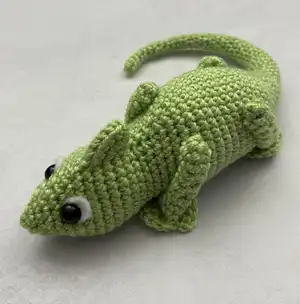
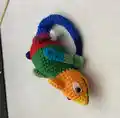
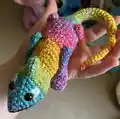
Make your own Clyde the Chameleon — a cheerful, tail-to-nose amigurumi with a distinctive curled tail and little attached legs. This intermediate pattern guides you step-by-step through shaping, attaching legs, and finishing details so your chameleon sits proudly on a shelf or becomes a lovable gift. Clear pictures and shaping notes help you achieve a smooth, polished finish for a charming handmade critter.
Progress Tracker
0% Complete
— Before You Begin :
Infos :
Please read over entire pattern including pictures before starting. Watch for any section specific notes or directions. Stitch markers, or a way to track stitches, are needed to know when rounds begin and end and for keeping count. When starting with a chain, first row stitches will always be worked into the back bump of the chain unless otherwise noted. Chain stitches are not counted into the final row/ round count unless otherwise noted. I crochet amigurumi stitches by yarning under/ yarning over. This method produces tighter "x" like stitches and can minimize the natural spiral obtained when sometimes working in the round. If at any point you have any questions or need any help, do not hesitate to contact me. I can be reached at any of the places in the link below. This pattern may contain affiliate links to yarn, tools & notions being used within. By using my links to make a purchase (where applicable), I will earn a small commission of your sale, at no extra cost to you.
Infos :
Find up to date contact, community & social media information: www.critterifficcrochet.com
— Stitch Key :
Infos :
Ch: Chain. Sl St: Slip Stitch. St(s): Stitch(es). Sc: Single Crochet. Sc Inc: Place 2 Sc Sts into the same stitch to increase. Sc Dec: Sc 2 Sts together to decrease. Sk: Skip. Yo: Yarn Over. FLO: Front loop only. BLO: Back loop only. MR: Magic Ring. [ ]: Repeat between as many times as stated (ex. x 6). ( ): Place all noted within ( ) into the same stitch. FO: Fasten off with a Sl St to the first St or use the invisible join method (preferred).
— Pattern Info :
Infos :
Text only print formatted section - Print pages 6-8. Clyde is an intermediate skill level pattern that has slight shaping in the body, and attached legs. While I have tried to make it as easy to follow as possible, some previous crochet knowledge is required to complete. While gauge itself is not important to this project. The main sizing concern is to use a hook and yarn combo that creates a tight enough fabric that does not have holes between stitches for stuffing to poke through. If made with suggested yarn and hook size, Clyde will be approx 10" long when completed. Clyde is worked from tail to nose.
— Yarn & Hooks Needed :
Infos :
*Worsted weight (4) & 4mm hook. I recommend Paintbox Aran or Stylecraft Special Aran which are super worsted/ aran weight 4 yarns. Main color: 100 yards. Other materials: Crochet Hook Used: 4mm. Eyes Used: 9mm (2) Safety Eyes. I get mine from GlassEyesOnline.com. 1/2" white felt circles. Alternatively you can use white yarn behind the eyes. Yarn needle. Stitch marker. Stuffing. Scissors.
— Example Line :
Info :
Round 4: [Sc, Sc Inc, Sc] x 6. (24) Single crochet into the next St, place 2 Single crochet into the next stitch to increase, Single crochet into the next stitch. Repeat this set of instructions within the [ ] 6 times around, ending with a count of 24 stitches total in round 4.
— Body :
Info :
In your main color yarn. Worked in the round. Stuff as you go.
Round 1 :
Sc x 3 into MR. (3)
Round 2-5 :
Sc x 3. (3) (4 rounds)
Round 6 :
Sc Inc, Sc x 2. (4)
Round 7-10 :
Sc x 4. (4) (4 rounds)
Round 11 :
Sc Inc, Sc x 3. (5)
Round 12-15 :
Sc x 5. (5) (4 rounds)
Round 16 :
Sc Inc, Sc x 4. (6)
Round 17-20 :
Sc x 6. (6) (4 rounds)
Round 21 :
Sc Inc, Sc x 5. (7)
Round 22-24 :
Sc x 7. (7) (3 rounds)
Round 25 :
Sc Inc, Sc x 6. (8)
Round 26-28 :
Sc x 8. (8) (3 rounds)
Round 29 :
Sc Inc, Sc x 7. (9)
Round 30-31 :
Sc x 9. (9) (2 rounds)
Round 32 :
Sc Inc, Sc x 8. (10)
Info :
Sc x 2. Do not count these Sts. First stitch worked in round 34 is where your marker will go, and where the round begins. (figures 1 & 2)
Round 34 :
Sc Inc x 2, Sc x 8. (12)
Round 35 :
Sc, Sc Inc x 2, Sc x 9. (14)
Round 36 :
Sc x 2, Sc Inc x 2, Sc x 10. (16)
Round 38 :
Sc x 4, Sc Inc x 2, Sc x 10. (18)
Round 39 :
Sc x 5, Sc Inc x 2, Sc x 11. (20)
Round 40 :
Sc x 6, Sc Inc x 2, Sc x 12. (22)
Round 41 :
Sc x 7, Sc Inc x 2, Sc x 13. (24)
Round 42 :
Sc Inc, Sc x 7, Sc Inc x 2, Sc x 7, Sc Inc, Sc x 6. (28)
Round 43 :
Sc Inc, Sc x 9, Sc Inc x 2, Sc x 9, Sc Inc, Sc x 6. (32)(figure 3)
Round 44-53 :
Sc x 32. (32) (10 rounds)(figure 4)
Info :
Sc x 3. Do not count these Sts. First stitch worked in round 54 is where your marker will go, and where the round begins.
Round 54 :
Sc Dec, Sc x 9, Sc Dec x 2, Sc x 9, Sc Dec, Sc x 6. (28)
Round 55 :
Sc Dec, Sc x 7, Sc Dec x 2, Sc x 7, Sc Dec, Sc x 6. (24)
Round 56 :
Sc x 8, Sc Dec x 2, Sc x 12. (22)
Round 57 :
Sc x 7, Sc Dec x 2, Sc x 11. (20)
Round 58 :
Sc x 6, Sc Dec x 2, Sc x 10. (18)
Round 59 :
Sc, [Sc Inc, Sc x 5] x 2, Sc Inc, Sc x 4. (21)
Round 60 :
Sc, [Sc Inc x 2, Sc x 5] x 2, Sc Inc x 2, Sc x 4. (27)
Round 61 :
Sc x 10, Sc Inc x 4, Sc x 13. (31)
Round 62 :
Sc x 2, Sc Inc, Sc x 7, Sc Inc x 8, Sc x 7, Sc Inc, Sc x 5. (41)
Round 63 :
Sc x 41. (41)(figure 6)
Round 64 :
Sc x 13, Pinch together the 8 Sc Inc from round 62. Work a Sc Dec into the BLO of Sts 14 and St 26 to close off the veil (figure 7), leaving Sts 15-25 unworked. Sc x 13, Sc Dec. (28)
Round 65 :
Sc x 3, Sc Dec, Sc x 7, Sc the next 3 Sts together (figure 8), Sc x 7, Sc Dec, Sc x 4. (24)
Round 66 :
Sc x 3, [Sc Dec, Sc x 6] x 2, Sc Dec, Sc x 3. (21)
Round 67 :
Sc x 3, [Sc Dec, Sc x 5] x 2, Sc Dec, Sc x 2. (18)
Round 68 :
Sc x 2, [Sc Dec, Sc x 4] x 2, Sc Dec, Sc x 2. (15)
Info :
Cut small holes into felt circles and insert the safety eye into the hole. (figure 9) Then place one eye on each side of the top of the head between rounds 66 & 67 with about 4 Sts between them across the top. (figures 10 & 11)
Round 69 :
Sc x 2, [Sc Dec, Sc x 3] x 2, Sc Dec, Sc. (12)
Round 70 :
[Sc Dec, Sc x 2] x 3. (9)
Round 71 :
[Sc Dec, Sc] x 3. (6)
Info :
FO, and leave a long tail.
Info :
Thread tail onto your needle, and pick up the FLO of round 71. Pull to close. (figure 12)
Info :
Insert needle into head and pull up to where the opening begins in round 64. Make sure the nose is stuffed firmly by adding if needed before closing the hole.
Info :
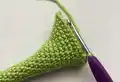
Stitch the BLO of rounds 15-25 together to close the veil. (figure 14)
Info :
Weave in end. (figure 15)Dec x 2, Sc x 10. (18) (figure 5)
— Legs :
Info :
Make 4. In your main color yarn. Worked in the round.
Round 1 :
Sc x 6 into MR. (6)
Rounds 2-10 :
Sc x 6. (6) (9 rounds)
Info :
Pinch closed and Sc x 3 across. Ch x 1 , turn. (3) The foot is worked in 2 parts starting from these Sts.
Row 1A :
FLO: Sc x 3, Ch 1, turn. (3) (figure 17)
Rows 2-4 :
Sc x 3. (3) (3 rows)
Info :
Sc x 3 down the side of the foot. (3) (figure 18)
Row 1B :
In the unworked BLO, Sc x 3. (3) (figure 19)
Rows 2-3 :
Sc x 3. (3) (2 rows)
Info :
Sc x 2 down the side of the foot. (2) (figure 20)
Info :
FO, leave long tail.
Info :
Sew to the body. The longer sides will face the head on the front legs, and the tail on the back legs. (figures 22 & 23)
Create your own Clyde the Chameleon and add a playful critter to your handmade collection! This pattern brings shaping, tiny feet, and a curled tail together in a compact, satisfying make. Whether for gifting or keeping, Clyde is a charming project that shows off your crochet skills. 🧶💕🧵