🧢 Beautiful ✨ Detailed πŸ’ Adorable

Crochet Frog Door-Stopper Pattern

Crochet Frog Door-Stopper Pattern
3.9β˜… Rating
5-7 Hours Time Needed
3.3K Made This
βœ‚οΈ

Intermediate Level

Ideal for those with basic crochet experience, featuring slightly more advanced stitches and techniques to expand your skills.

⏱️

Weekend Treat

Takes 5-7 hours, making it an enjoyable project to finish over a couple of days.

🧸

Cute Companion

An adorable friend to cherish, handcrafted with love to bring comfort and joy for years to come.

About This Crochet Frog Door-Stopper Pattern

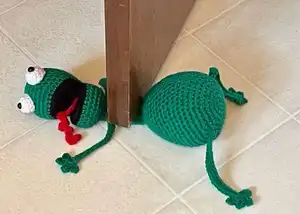
This pattern makes a playful crochet frog door-stopper with a weighted body and expressive head, complete with eyes, tongue, arms, legs and a neck. The design uses worsted weight yarn and simple shaping techniques to create a sturdy, decorative frog that holds doors open. Clear round-by-round instructions and assembly steps guide you from crocheting each part to sewing everything together.

Crochet Frog Door-Stopper Pattern crochet pattern - detailed view of completed project

Includes guidance for inserting bean bag weight and finishing tips for a neat, long-lasting result. Suitable for crafters comfortable with basic increases, decreases and simple sewing.

Why You'll Love This Crochet Frog Door-Stopper Pattern

I absolutely love this pattern because the frog has so much personality with very little extra effort. I enjoy how the simple shaping transforms basic rounds into a weighted, functional piece that also looks adorable. I love adding a bean bag for weight and seeing how the body holds shape while still feeling squishy and handcrafted. I also enjoy the playful details like the tongue and little toes β€” they make finishing satisfying and fun.

Crochet Frog Door-Stopper Pattern step 1 - construction progress Crochet Frog Door-Stopper Pattern step 2 - assembly progress Crochet Frog Door-Stopper Pattern step 3 - details and accessories Crochet Frog Door-Stopper Pattern step 4 - final assembly and finishing

Switch Things Up

I love customizing this pattern by changing colors to create different frog personalities; try variegated greens or even bright non-traditional colors.

I sometimes make a mini keychain version by using fingering weight yarn and a smaller hook for a tiny, portable frog.

I like to swap the bead weight amount to make a lighter or heavier door-stopper depending on your door's weight and wind drafts.

I often add embroidery details around the eyes or mouth for extra expressionβ€”simple surface stitches work great.

I also replace safety eyes with embroidered eyes for a child-safe version suitable for family homes.

I enjoy experimenting with different tongue styles: a straight tongue, a curled spiral, or a tiny felt tongue for more texture.

For a plushier neck, I fold and sew the neck as instructed; you can add an inner fabric strip for extra durability if needed.

Try using recycled yarn for a more sustainable projectβ€”texture and gauge will vary but look charming.

I sometimes make matching accessories like a tiny crocheted lily pad or a small scarf to personalize each frog.

If you want a set, vary the yarn colors and weights to create a family of frogs in different sizes and weights.

Common Mistakes & How to Fix Them

βœ— Skipping the magic ring or using an inconsistent start can leave a visible hole at the top; use a tight magic ring or secure chain method to close the center. βœ— Not inserting the bead bag before the opening gets too small makes it hard to add weight later; add the bean bag when noted so you can place it comfortably. βœ— Failing to stuff gradually causes lumps or overfilled sections; stuff in small amounts while decreasing to maintain a smooth shape. βœ— Forgetting to sew the tongue into the bottom of the head first can make assembly awkward; attach the tongue before sewing top and bottom of the head together. βœ— Using loose tension will show stuffing through the stitches; maintain a consistent, slightly tight tension or use the same color yarn to fill gaps.

Crochet Frog Door-Stopper Pattern

Make a whimsical crochet frog door-stopper that doubles as a charming home accent. This pattern guides you through crocheting a weighted body, expressive head, eyes, tongue, arms and legs with clear step-by-step rounds. You will enjoy a mix of shaping, simple increases/decreases, and fun assembly to create a functional, handmade frog. Perfect for gifting or brightening your own home with a playful crochet project.

Intermediate 5-7 Hours

Materials Needed for Crochet Frog Door-Stopper Pattern

β€” Main Fabric

  • 01
    Worsted weight yarn (#4) - Green: one skein is plenty
  • 02
    Worsted weight yarn (#4) - Black: very little amount for mouth
  • 03
    Worsted weight yarn (#4) - White: small amount for eyes
  • 04
    Worsted weight yarn (#4) - Red: small amount for tongue
  • 05
    Safety eyes - 10 mm (2 pieces)
  • 06
    Polyester stuffing - enough to fill head and body
  • 07
    Stuffing beads / bean bag pellets for weight (quantity depends on desired weight)
  • 08
    Nylon stocking or mesh bag for holding beads (one small piece)
  • 09
    2 round buttons, size 2 1/4" OR thick cardboard cut to that size for mouth support

β€” Tools Required

  • 01
    G crochet hook (G size as indicated by pattern)
  • 02
    Scissors
  • 03
    Darning / yarn needle for sewing pieces and weaving ends
  • 04
    Measuring tape
  • 05
    Stitch markers
  • 06
    Safety eyes 10mm (2 pieces)
  • 07
    Pins for assembly (optional)
  • 08
    Nylon stocking or small mesh bag to hold bead pellets

Progress Tracker

0% Complete

β€” Top of Head :

Round 1 :

With black yarn, use the magic circle method if you choose OR chain 2 and single crochet 6 in first chain space (6)

Round 2 :

(increase row) sc 2x in each stitch from row one *inc x 6* around (12)

Round 3 :

(increase row) sc 2x in first stitch then (once) 1sc in next stitch, *inc then 1sc* around (18)

Round 4 :

(increase row) sc 2x in first stitch then 1sc in next 2 stitches *inc, 1sc, 1sc* around (24)

Round 5 :

(increase row) sc 2x in first stitch then 1sc in next 3 stitches *inc, 1sc, 1sc, 1sc * around (30)

Info :

CHANGE TO GREEN YARN

Round 6 :

BACK LOOP for this row only sc around each stitch (no increasing) (30)

Round 7 :

sc around each stitch (no increasing) (30)

Round 8 :

sc around each stitch (no increasing) (30)

Round 9 :

sc around each stitch (no increasing) (30)

Round 10 :

sc around each stitch (no increasing) (30)

Round 11 :

sc around each stitch (no increasing) (30)

Info :

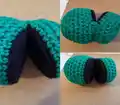
insert button here or cutout cardboard piece to keep flat – secure it if you choose, I secured my button by sewing it on with the final knot inside so you can't see it from the outside

Round 12 :

(decrease row) 1sc in next 2 stitches then decrease *1sc, 1sc, dec * x 7 sc in last 2 stitches (23)

Round 13 :

(decrease row) 1sc in next 2 stitches then decrease *1sc, 1sc, dec * x 5 dec and 1sc in last 3 stitches (17)

Round 14 :

sc around each stitch (no dec / inc) (17)

Info :

insert bead bag here for weight before it gets too small of an opening **you will be putting regular stuffing to finish off the β€œstuffing of the head” after the bean bag. Keep stuffing as we decrease. If your stitching is loose and you see the white stuffing or bean bag, you can also use the same colour green yarn to stuff it. We are not using too much yarn so it's not a big expense to use yarn to stuff the head**

Round 15 :

(decrease row) decrease then 1sc *dec and 1sc * x 5 then one more decrease (11)

Round 16 :

(decrease row) decrease x 5 then sc in last stitch *dec x5 * then 1sc (6)

Round 17 :

cinch last 6 stitches together tightly and finish off

β€” Bottom of Head :

Round 1 :

With black yarn, use the magic circle method if you choose OR chain 2 and single crochet 6 in first chain space (6)

Round 2 :

(increase row) sc 2x in each stitch from row one *inc x 6* around (12)

Round 3 :

(increase row) sc 2x in first stitch then (once) 1sc in next stitch, *inc then 1sc* around (18)

Round 4 :

(increase row) sc 2x in first stitch then 1sc in next 2 stitches *inc, 1sc, 1sc* around (24)

Round 5 :

(increase row) sc 2x in first stitch then 1sc in next 3 stitches *inc, 1sc, 1sc, 1sc * around (30)

Info :

CHANGE TO GREEN YARN

Round 6 :

BACK LOOP for this row only sc around each stitch (no increasing) (30)

Round 7 :

sc around each stitch (no increasing) (30)

Round 8 :

sc around each stitch (no increasing) (30)

Round 9 :

sc around each stitch (no increasing) (30)

Info :

insert button / cardboard piece **I recommend using green yarn to stuff the remainder of the bottom of the head**

Round 10 :

(decrease row) *dec, 1sc * x 10 (20)

Round 11 :

(decrease row) *dec, 1sc * x 10 (10)

Round 12 :

cinch the remainder 10 stitches tightly, finish off

β€” Tongue :

Item Name (P1) :

using RED yarn Chain 25, turn, 3sc in first chain from hook, sc in next chain, repeat until there is 5 chains remaining. SC in last 5 chains. Finish off

β€” Eyes :

Info :

using WHITE yarn, make 2

Round 1 :

using the magic circle OR chain 2 and sc x5 in first chain space

Round 2 :

(increase row) 2sc in each stitch (10)

Round 3 :

sc around (10)

Round 4 :

sc around (10)

Info :

finish off

Info :

INSERT safety eyes in the top of the eyes made. When using the chain 2 method you end up with a tiny "hole" in the top of the eyes perfect for inserting the safety eyes. No they are not too big for the safety eyes to fall out if secured properly

β€” Body of Frog :

Round 1 :

Using the magic circle method if you choose OR chain 2 and single crochet 6 in first chain space (6)

Round 2 :

(increase row) sc 2x in each stitch from row one *inc x 6* around (12)

Round 3 :

(increase row) sc 2x in first stitch then (once) 1sc in next stitch, *inc then 1sc* around (18)

Round 4 :

(increase row) sc 2x in first stitch then 1sc in next 2 stitches *inc, 1sc, 1sc* around (24)

Round 5 :

(increase row) sc 2x in first stitch then 1sc in next 3 stitches *inc, 1sc, 1sc, 1sc * around (30)

Round 6 :

(increase row) sc 2x in first stitch then 1sc in next 4 stitches *inc, 1sc, 1sc, 1sc, 1sc * around (36)

Round 7 :

(increase row) sc 2x in first stitch then 1sc in next 5 stitches *inc, 1sc, 1sc, 1sc, 1sc, 1sc * around (42)

Round 8 :

(increase row) sc 2x in first stitch then 1sc in next 6 stitches *inc, 1sc, 1sc, 1sc, 1sc, 1sc, 1sc * around (48)

Round 9 :

sc around (48)

Round 10 :

sc around (48)

Round 11 :

sc around (48)

Round 12 :

(decrease row) dec then 1sc in next 6 stitches *dec, 1sc, 1sc, 1sc, 1sc, 1sc, 1sc * 6x (42)

Round 13 :

sc around (42)

Round 14 :

(decrease row) dec then 1sc in next 5 stitches *dec, 1sc, 1sc, 1sc, 1sc, 1sc * 6x (36)

Round 15 :

sc around (36)

Round 16 :

sc around (36)

Round 17 :

sc around (36)

Round 18 :

(decrease row) dec then 1sc in next 4 stitches *dec, 1sc, 1sc, 1sc, 1sc * 6x (30)

Round 19 :

sc around (30)

Round 20 :

sc around (30)

Info :

** start stuffing body as we'll be decreasing more and more. You can also insert another bean bag here for weight as well. My stitching is on the tighter side so I didn't need to use yarn to stuff the body here. You can – it's ok **

Round 21 :

(decrease row) dec then 1sc in next 3 stitches *dec, 1sc, 1sc, 1sc * 6x (24)

Round 22 :

(decrease row) dec then 1sc in next 2 stitches *dec, 1sc, 1sc * 6x (18)

Round 23 :

(decrease row) dec then 1sc *dec, 1sc * 6x (12)

Round 24 :

decrease around x 6 (6)

Round 25 :

cinch around last 6 stitches and finish off

β€” Arms and Legs :

Info :

make 2 of each – green yarn

Item Name (P1) :

Chain 21, turn

Item Name (P2) :

sc in chain closest to hook (20)

Info :

once at the end – do not finish off – chain 6 and slip stitch to the first chain, repeat that 3 more times to end up with 4 "finger / toes"

Info :

finish off after the 4th slip stitch. Sometimes there will be a small hole where you did you slip stitches, sew up with the yarn tails once you have finished off

β€” Neck :

Info :

green yarn (works out to approx 6" before folding)

Item Name (P1) :

Chain 27, turn

Item Name (P2) :

HDC starting in 2nd chain from hook (25)

Item Name (P3) :

HDC 4 more rows

Info :

Since the neck is constantly on the floor, I have made it this long so that I can fold over to make it thicker – sew up the sides; sewing up the bottom not so important as we will be attaching this to the body.

β€” Assembly :

Info :

NOW THAT YOU ALL THE PARTS MADE – LETS PUT TOGETHER !!

Item Name (P1) :

FIRST Sew the tongue to the back of the bottom of head. Sew it up to the centre of the black circle so it doesn't move that much

Item Name (P2) :

SECOND you will now be sewing the top and bottom parts of the head together. You will only sew it over 10 stitches as you want to make sure the, now mouth, works. Shown without the tongue attached as I was crazy before I put the head together and didn't sew the tongue in first – that's why I know you should and I've instructed you to do this :)

Item Name (P3) :

THIRD step Attach eyes to top of head

Item Name (P4) :

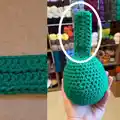
FORTH step Lets sew the legs onto the frog body. Place them on the bottom of the larger part of the body. As well, lets sew the neck onto the top of the body.

Item Name (P5) :

FIFTH step Sew the arms onto the neck. Place them about a half inch from the top of the neck as we still have to sew the neck and head together

Item Name (P6) :

SIXTH step We're here – lets sew the neck onto the bottom of the head – in the middle

Info :

WE ARE DONE !!

Assembly Instructions

  • Sew the tongue to the back of the bottom of the head and secure it up to the centre of the black mouth circle so it stays in place.
  • Sew the top and bottom parts of the head together across approximately 10 stitches so the mouth can open and close cleanly, ensuring the tongue placement is correct before closing.
  • Attach the two white eyes to the top of the head and insert the 10mm safety eyes into the tiny hole at the top of each eye, securing them properly.
  • Sew the legs onto the bottom of the larger part of the body and then sew the neck to the top of the body, positioning the legs for balance and symmetry.
  • Sew the arms onto the neck about a half inch from the top of the neck so they are correctly positioned once the neck and head are joined.
  • Sew the folded neck to the bottom centre of the head to join head and body, checking alignment so the frog lies flat as a door-stopper.

Important Notes

  • πŸ’‘Use stitch markers to mark the start of each round to keep track of increases and decreases for accurate shaping.
  • πŸ’‘Insert bean bag pellets inside a small nylon stocking or mesh bag before adding to the head or body to prevent beads from leaking into stuffing.
  • πŸ’‘Stuff gradually as you decrease to maintain smooth shaping and avoid lumps; add the bead bag for weight before closing small openings.
  • πŸ’‘Pin parts in place and check alignment before sewing to ensure symmetrical placement of legs, arms, eyes and neck.
  • πŸ’‘Weave in ends and secure buttons or cardboard pieces inside the mouth area to keep the mouth flat and tidy.

This playful Crochet Frog Door-Stopper is a fun and functional piece to brighten any room and keep doors in place. It combines simple amigurumi-style shaping with added weight for real door-stopping power. Make one as a gift or a whimsical home accent and enjoy the smiles it brings. 🧢🐸🧡

You ask,

we answer.

FAQs

What size will the finished piece be?

The finished frog measures roughly the size shown in photos when using worsted weight yarn and a G hook; exact size will vary with tension but expect a body about 6-8 inches long plus neck.

Can I use different yarn weights for this pattern?

Yes, you can adjust yarn weight and hook size, but this will change the final size; heavier yarn with a larger hook gives a chunkier door-stopper, while lighter yarn makes a smaller, less heavy piece.

Do I need prior crochet experience for this pattern?

This pattern is rated intermediate; familiarity with single crochet, increases, decreases, working in rounds and basic sewing is recommended for best results.

How long does this project typically take to complete?

Most crocheters complete this project in 5-7 hours, though time can vary depending on experience and how long you spend on assembly and finishing.