🧢 Beautiful ✨ Detailed πŸ’ Adorable

Flower bouquet C crochet Pattern

Flower bouquet C crochet Pattern
4.0β˜… Rating
5-7 Hours Time Needed
1.4K Made This
βœ‚οΈ

Beginner Friendly Level

Perfect for those just starting their crochet journey, with clear instructions and simple techniques

⏱️

Weekend Treat

Takes 5-7 hours, making it an enjoyable project to finish over a couple of days.

🏑

Cozy Accent

A warm touch for your space that transforms ordinary corners into inviting nooks filled with handmade charm.

About This Flower bouquet C crochet Pattern

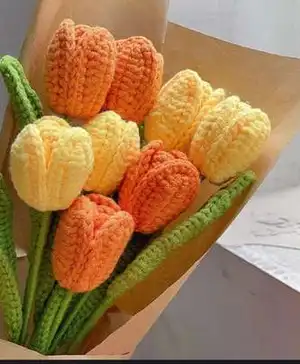
This pattern pack teaches you how to crochet a complete bouquet with tulips, daisies, baby daisies and two types of roses. Each flower section includes petal, leaf and bottom pieces plus assembly notes so you can make realistic stems and arrange the bouquet. I designed the instructions to be beginner friendly while offering shaping techniques for natural-looking petals and leaves.

Flower bouquet C crochet Pattern crochet pattern - detailed view of completed project

Choose any colors you like β€” cotton, milk or acrylic yarn all work well with a 4ply weight. The pattern also describes wire and stem options so you can make moldable, long-lasting stems for arranging.

Why You'll Love This Flower bouquet C crochet Pattern

I absolutely love this pattern because it turns simple stitches into beautiful, realistic flowers you can arrange and gift. I enjoy how flexible the pattern is β€” you can mix colors and yarn types to create very different bouquets. The techniques are gentle on beginners but still give satisfying shaping results that feel advanced. It feels wonderful to hand someone a bouquet that will last forever, and I hope you feel the same joy making them.

Flower bouquet C crochet Pattern step 1 - construction progress Flower bouquet C crochet Pattern step 2 - assembly progress Flower bouquet C crochet Pattern step 3 - details and accessories Flower bouquet C crochet Pattern step 4 - final assembly and finishing

Switch Things Up

I love how easy it is to customize these flowers by swapping colors β€” try pastel shades for a soft vintage bouquet or bold, contrasting hues for a modern look.

Want a miniature bouquet? Use a thinner yarn and smaller hook to create tiny posable flowers for keychains or jewelry.

To make larger, statement blooms use a thicker yarn and a larger hook and adjust stitch counts slightly for proportion.

I often add embroidery to petal edges or use a slightly darker shade for the center to create depth and a painted effect.

Try mixing yarn textures: pair cotton petals with a slightly fuzzy acrylic center for a tactile contrast that photographs beautifully.

If you want removable blooms, I make stems with a wrap that can be undone and re-arranged so the bouquet can be refreshed over time.

I sometimes add tiny beads or French knots in the daisy centers to give a more decorative finish and sparkle.

For gifting, wrap the stems in ribbon or lace and add a small crocheted tag with a message for a personal touch.

To make a wreath rather than a bouquet, stitch several stems to a circular base or wire frame and bend the leaves to create dimension.

Try making a set of matching buttonholes or brooches by fastening a small pin to the back of a single bloom for wearable crochet decor.

Common Mistakes & How to Fix Them

βœ— Skipping the wire support when needed can make petals droop and stems look floppy; add thin wire inside petals or leaves and a stronger wire or wooden stick for the main stem to keep shape. βœ— Using a yarn weight much thicker than 4ply without adjusting hook size will make pieces oversized and lose detail; if you change yarn weight, adjust the hook and expect different finished sizes. βœ— Forgetting to secure and glue pieces firmly before wrapping the stem can cause petals to shift; pin or glue each petal in place and roll yarn tightly around the stem to lock parts together. βœ— Not blocking or steaming leaves and petals can make them look uneven; lightly shape and press pieces when needed and use a moldable wire so they hold their final shape.

Flower bouquet C crochet Pattern

Create a charming handmade bouquet of crochet flowers with this versatile pattern pack. You'll find clear, step-by-step instructions for tulips, daisies, baby daisies, and two styles of roses so you can assemble a full bouquet. The pattern uses 4ply yarn and small hooks to achieve delicate petals and realistic leaves. Perfect for gifting, decor, or practicing new crochet shaping techniques.

Beginner Friendly 5-7 Hours

Materials Needed for Flower bouquet C crochet Pattern

β€” Main Fabric

  • 01
    Cotton yarn (4 ply) - recommended for petals and leaves (colors shown: white, yellow, pink, green)
  • 02
    Milk yarn or acrylic yarn (4 ply) may be used as alternatives depending on preference
  • 03
    Small amounts of contrast colors for centers (yellow) and accents
  • 04
    Note: pattern images and instructions are sized for 4ply yarn (use 2-2.5mm hook for similar results)

β€” Tools Required

  • 01
    Crochet hook size 2-2.5mm
  • 02
    Thin moldable wire for leaves and petals (~0.6 mm)
  • 03
    Thicker wire or wooden stick for stems (~2 mm or floral wire)
  • 04
    Hot glue (glue gun)
  • 05
    Scissors
  • 06
    Yarn needle for sewing and weaving ends
  • 07
    Stitch markers (optional)
  • 08
    Small amount of polyester stuffing or fibrefill for flower centers
  • 09
    Pliers for cutting/bending wire (optional)

Progress Tracker

0% Complete

β€” Materials :

Info :

crochet hook size 2-2.5mm. cotton yarn of your preference (4 ply). thin wire for every petal or leaf that will need it. wood stick or a thick wire for the flower stem it (to make moldable stems to be able to wrap it like the first picture around a bucket, use moldable metallic wires as stem). glue (hot glue). The color of the yarn used for each part is up to you, in the document i'll show some options but there are plenty more combinations that will look great.

β€” Yarn size specifications :

Info :

For this pattern I used a 4ply yarn from my local store. Milk yarn, cotton yarn, acrylic yarn, all can be used, will depend on what are you more comfortable with. As per instructions you can select the yarn you prefer, depending on the size of your yarn, adjust the hook used, if the yarn is thicker, the product will turn out bigger, if it is an amigurumi, with a thicker yarn and a bigger crochet hook you can make up a plushie. For the exact size of my images it will be 4ply.

β€” Abbreviations :

Infos :

DISCLAIMER: US crochet terms used. BLO - back loop only: When working in the back loop only, insert your hook into only the back loop of the stitch. Ch - chain: To make a chain stitch, yarn over (YO) your hook and then pull it through the loop on your hook. Dc - double crochet: YO, insert hook into stitch, YO, pull up a loop (3 loops on hook). YO, pull through 2 loops (2 loops on hook). YO, pull through remaining 2 loops. 1 double crochet completed. Dec - decrease: Yarn over (yo), insert hook into stitch, yo, pull up a loop (3 loops on hook). Yo, pull through 2 loops (2 loops on hook). Yo, insert hook into next st, yo, pull up a loop (4 loops on hook). Yo, pull through 2 loops (3 loops on hook). Yo, pull through remaining 3 loops. Dc2tog completed. FLO - front loop only: When working in the front loop only, insert your hook into only the front loop of the stitch. Hdc - half double crochet: Yarn over (yo), insert hook into stitch, yo, pull up a loop (3 loops on hook). Yo, pull through all loops. Half crochet completed. Inc - increase: Add one or more stitches to the current round or row. To increase with a single crochet, work two single crochet stitches into the same stitch. MR - magic ring: A technique used to begin crocheting in the round, create a circle with the yarn, insert your hook into the circle, and then work the desired number of stitches into the center of the circle. Rep - repeat. Sc - single crochet: Insert hook into stitch, yarn over (yo), pull up a loop (2 loops on hook). Yo, pull through both loops on hook. 1 single crochet completed. Sk - skip stitch. Sl st - slip stitch. St - stitch. Tr - treble crochet: YO twice, then insert your hook into the next stitch. YO again and pull up a loop (4 loops left on hook). YO and pull through the first two loops on your hook (3 loops left). YO and pull through the next two loops on your hook. YO and pull through the last two loops on your hook. w - sc3 in same st: Work three single crochet stitches into the same stitch. YO - yarn over. FO - fasten off.

β€” Tulips :

Small petals (x3) :

R1: Chain 12. R2: (add wire) sk, sc, hdc, 7dc, hdc, w, hdc, 7dc, hdc, sc R3: 23 sc, sl, FO

Big petals (x3) :

R1: chain 13 R2: sk, 11 sc, w, 11 sc R3: (add wire) sc, hdc, 9dc, hdc, w, hdc, 9dc, hdc, sc R4: 27sc, sl, FO

Big leaf :

R1: chain 31 R2: (add wire) sk, 3 sc, 3 hdc, 18 dc, 3 hdc, 2 sc, w, 2sc, 3 hdc, 18 dc, 3hdc, 3 sc, sl, FO

Info :

Start sticking with glue around the stick the small petals, and then add the bigger ones, in a circular way. Add the leaf in the down part of the stick, and roll yarn around the stick to secure the leaf and make the stem look more natural.

β€” Daisy flower :

Center of the flower :

R1: 6 sc magic ring R2: 6 inc R3: 12 sc and FO (Make one yellow and with the same steps make a green one for the back of the flower, to connect with the stem.)

Info :

You will have to connect both and stitch it together, before completely closing the stitch add some fibrefill or cotton to fill the inside of the center. And then start with the petals:

Petals :

(3 ch, dc, 3 ch, sl st) Rep 12. There will be 12 petals in total.

Info :

Connect the wire or wooden stick to the flower, depending on how you want to put the daisies it will be better to put the stem right in the middle of the center in the back of the flower or as the other flowers in between the two centers. Both ways will look good. Don't forget to roll yarn over so the stem looks more realistic.

β€” Baby daisy flower :

Baby daisy :

R1: 5 sc magic ring R2: (2 ch, 3 dc, 2 ch) Rep 5 times

Info :

The center of the flower just pass the yarn making some stitches in the center. You can make a few baby daisies and connect them to a wire o wooden stick rolling green yarn to make the stem. If you use a light color, there is also the option to add some blush on the edges to make some gradient in the color.

β€” Rose flower type 1 :

Flower petals :

R1: chain 53 R2: 52 sc R3: chain 5, dc, sk2, to begin with. The rest rep (dc, 2ch, dc) sk2 until the end. The part inside of the parenthesis has to be worked in the same stitch R4: chain 3, in the next hole work (2dc, 2ch, 2dc); Work on the hole of the upper part (2dc, 2ch, 2dc) Rep until the end R5: *ch 1, and in the hole of the upper part work 8dc. In the next hole work 1 sc. And repeat from* until the end and sl, FO.

Info :

To finish the rose, roll it up starting with the first chain at the center of the rose, then stick it together with glue.

Flower bottom :

R1: (3 ch, 20 dc, sl st) magic ring R2: 8ch, ((sk, 2sc, 2hdc, 2dc, 1 tc) on chain) sk3, sl st Repeat 5 times and sl, FO, making a similar to star figure to put in the bottom of the rose.

Rose leaf :

R1: 12ch, sk, sc, hdc, 7dc, hdc; on the other side of the chain: w, hdc, 7dc, hdc, sc R2: (add wire), sc, 2ch. Rep until reached the end and sl, FO.

Info :

Stick every part together and roll yarn around a wooden stick to make the stem.

β€” Rose flower type 2 :

Small petal (x4) :

R1: 10 dc magic ring R2: 10 hdc inc R3: 6 sc, 8 hdc inc, 6 sc

Midi petal (x4) :

R1: 10 dc magic ring R2: 10 hdc inc R3: (2 sc, sc inc) rep R4: 8 sc, 9 hdc inc, 9 sc

Big petal (x5) :

R1: 10 dc magic ring R2: 10 hdc inc R3: (hdc, hdc inc) rep R4: 8 sc, 6 hdc inc, (hdc, dc in same st), 3 ch, (dc, hdc in same st), 6 hdc inc, 8 sc

Flower bottom :

R1: 6 sc magic ring R2: 6 inc R3: 6 (sc, inc) R4: 18sc R5: [9 ch, (sk1 backward, 2 sl st, 2sc, 2 hdc, dc, tc in chain), sk 2, sl st] rep 6 times.

Rose leaf :

R1: 12ch, sk, sc, hdc, 7dc, hdc; on the other side of the chain: w, hdc, 7dc, hdc, sc R2: (add wire), sc, 2ch. Rep until reached the end and sl, FO.

Info :

Start sticking and rolling the petals as the image, in order, from the small petals to the big petals. Stick every part together and roll yarn around a wooden stick to make the stem. To add gradient to the flower you can add some blush.

β€” Leafs :

Leaf :

R1: Chain 12 R2: (add metallic wire to secure the position) sk, sc, hdc, dc, 5 tc, dc, hdc, w, hdc, dc, 5 tc, dc, hdc, sc, sl, FO.

Info :

Make 5 or 7 leaves (depending if you want to make the leaves branch bigger or smaller), and connect all as the picture to the wooden stick, making leaves coming out of the stem. Don't forget to roll yarn over to wooden stick to make it more realistic.

Assembly Instructions

  • For tulips: glue the small petals around the stick first, then glue the bigger petals around them in a circular way; attach the big leaf at the lower part of the stick and roll yarn around the stick to secure and finish the stem.
  • For daisies: make a yellow center and a matching green backing center, stitch both together with a little fibrefill in the yellow center before closing, then secure a wire or wooden stick to the back center and wrap green yarn over the stem.
  • For roses: after completing the petal strip, roll the strip starting with the first chain at the center, glue or tack the rolled rose together, then attach the flower bottom/star piece into the bottom of the rose and secure with glue.
  • For baby daisies and small clusters: stitch several baby daisies onto a single wire or stick and wrap green yarn tightly around the wire to finish the stem for a natural look.
  • Attach leaves by adding metallic wire for position, then glue or sew the leaf bases to the stem and roll yarn around the stem to hide connections and make the stem look natural.
  • Always pin or temporarily position parts before final gluing to check symmetry and spacing among petals, leaves and flowers.

Important Notes

  • πŸ’‘Use 4ply yarn and a 2-2.5mm hook to achieve the same finished scale as the sample photos.
  • πŸ’‘Add thin moldable wire inside petals and leaves where indicated to keep shapes stable and poseable.
  • πŸ’‘Stuff the flower centers lightly with fibrefill before closing so the centers keep a rounded shape.
  • πŸ’‘Glue parts securely and roll yarn around stems to hide joins and make stems stronger and more realistic.
  • πŸ’‘Count stitches and follow the written repeats carefully; using stitch markers can help keep track of pattern repeats.

Thank you for choosing this Flower Bouquet C pattern β€” I hope it sparks your creativity and fills your home with everlasting blooms. Try different color palettes to make seasonal bouquets or special gifts for loved ones. Have fun stitching, arranging and gifting your handmade flowers! 🌸🌿
You ask,

we answer.

FAQs

What size will the finished piece be?

Finished flower sizes vary by yarn and hook, but using 4ply yarn with a 2-2.5mm hook will produce flowers similar to the photos; full bouquet size depends on number of stems and arrangement.

Can I use different yarn weights for this pattern?

Yes, you can use different yarn weights but this will affect final size and detail; adjust your hook and expect larger or smaller flowers accordingly.

Do I need prior crochet experience for this pattern?

This pattern is rated beginner friendly, so basic crochet experience is sufficient, but knowledge of single crochet, increases, decreases and working in rounds is helpful.

How long does this project typically take to complete?

Most crafters complete a small bouquet using these patterns in about 5-7 hours, though time will vary with experience level and number of flowers made.

What should I use for stems to make them moldable?

Use a wooden stick or thicker floral wire (~2mm) and wrap yarn around it; adding thin moldable wire inside petals and leaves will help with shaping.