🧶 Beautiful ✨ Detailed 💝 Adorable

Modern Irish Lace Floral Dress Pattern

Modern Irish Lace Floral Dress Pattern
4.5★ Rating
12-15 Hours Time Needed
3.1K Made This
✂️

Advanced Level

Designed for experienced crocheters, these patterns involve intricate designs and complex techniques to challenge and inspire.

⏱️

Multi-Day Project

A rewarding 12+ hour journey—perfect for dedicated crafters who love detailed work.

🌟

Elegant Drape

Soft flow with graceful movement, designed to flatter all body types with sophisticated comfort.

About This Modern Irish Lace Floral Dress Pattern

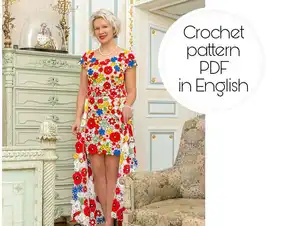
This pattern shows how to create a full Irish-lace floral dress built from many crocheted motifs arranged into a flowing garment. You will learn yarn selections, motif finishing, washing and blocking, and how to join motifs using netting techniques. The instructions focus on creating beautiful, stable joins and shaping pieces on a tablet and a sliding tailor's mannequin.

Modern Irish Lace Floral Dress Pattern crochet pattern - detailed view of completed project

Includes guidance for making irregular mesh, press-steaming motifs, and assembling sleeves with a styrofoam tablet. Ideal for experienced crocheters ready to create a dramatic floral lace dress.

Why You'll Love This Modern Irish Lace Floral Dress Pattern

I absolutely love this pattern because it celebrates the joy of combining many small motifs into one breathtaking garment. I love the tactile process of blocking and press-steaming each motif to get perfect shapes before assembling. I enjoy the creative freedom when arranging motifs — no two dresses will ever be identical, and that uniqueness excites me. Working with the tablet and tailor's dummy gives such professional results; it makes the handwork feel like couture.

Modern Irish Lace Floral Dress Pattern step 1 - construction progress Modern Irish Lace Floral Dress Pattern step 2 - assembly progress Modern Irish Lace Floral Dress Pattern step 3 - details and accessories Modern Irish Lace Floral Dress Pattern step 4 - final assembly and finishing

Switch Things Up

I love customizing this dress by changing color palettes—switch the reds and whites for pastels or tonal neutrals to create a softer look.

You can make a mini or maxi version by altering the number of motifs and spacing; using finer thread with a smaller hook will give you a delicate smaller-scale garment.

I often experiment with adding small beads or embroidered centers to motifs for sparkle and texture; try contrasting bead colors for dramatic detail.

Try substituting some flower motifs with leaves or geometric motifs to change the composition rhythm and overall silhouette.

For a more wearable day dress, sew the motifs onto a full cotton lining rather than leaving them fully open—this gives coverage and structure.

I sometimes make detachable elements like a removable overskirt, sleeves or a belt made from joined motifs so the dress can change looks.

If you want more drape, use a mercerized silk-cotton blend for motifs; for stiffer lace, use 100% mercerized cotton and a smaller hook.

I recommend practicing netting techniques on a small sampler before working the main garment so you can decide how open or dense you want the background to be.

Consider adding a corset-style lining or lacing at the back (as shown on the mannequin) to allow size adjustment and a flattering fit.

I also like to mix texture by combining flat motifs with raised petals and spiral motifs for a richer surface; feel free to invent your own motif shapes.

Common Mistakes & How to Fix Them

✗ Crocheting motifs too loosely can make joins look sloppy and cause shape distortion; work motifs tightly and use a smaller hook if a motif feels loose. ✗ Cutting thread tips too short leaves no tail for hiding and weak joins; leave 10-12 cm and hide tips by needle stitching from the bottom several times. ✗ Skipping wet-steaming and blocking causes motifs to shrink unpredictably after assembly; always wash and press-steam motifs before fitting to the pattern. ✗ Joining motifs without pinning to the pattern leads to uneven composition; lay motifs wrong-side-up on the pattern and pin them tightly before netting and filling gaps.

Modern Irish Lace Floral Dress Pattern

Create a stunning floral Irish-lace dress made from hundreds of crocheted motifs. This pattern guides you through yarn choices, motif preparation, joining techniques and finishing so you can assemble a show-stopping garment. Perfect for makers who love detailed handwork and designer-level results. Follow the step-by-step guidance for motif washing, blocking, netting and attaching onto a mannequin.

Advanced 12-15 Hours

Materials Needed for Modern Irish Lace Floral Dress Pattern

— Main Fabric

  • 01
    Iris Kutnor (Italy) - 100% mercerized cotton, 450 m per 50 g
  • 02
    Pelican (India) - 100% double mercerized cotton, 330 m per 50 g
  • 03
    Violet Melange YarnArt - 282 m per 50 g
  • 04
    Iris (Vita Cotton) - 100% double mercerized cotton, 125 m per 20 g
  • 05
    Yarn Canarias (Turkey) - 203 m per 20 g, 100% mercerized cotton
  • 06
    Egypto 16 (Mafil) (Italy) - 100% mercerized cotton, 453 m per 50 g
  • 07
    Iris Altin - Altin Basak brand (Iris Altin Basak Beyaz) thread
  • 08
    Filo di Scozia No8 (Italy) - 100% mercerized cotton, 453 m per 50 g
  • 09
    Madame Tricote (Turkey) - 340-350 m per 20 g, 100% Egyptian cotton
  • 10
    Sewing thread, number 40 - for hiding tips and joining on the back side
  • 11
    Fine motif thread (cotton crochet thread) for motifs - choose colors as needed

— Tools Required

  • 01
    Crochet hook size 1 (recommended for motif work)
  • 02
    Crochet hook 0.35mm (Tulip No.25) for very fine mesh details
  • 03
    Sewing thread number 40 and sewing needle for hiding tips
  • 04
    Tailor pins for pinning motifs to pattern and tablet
  • 05
    Styrofoam tablet (polystyrene foam plate) approx. 5 cm (2 inch) thick
  • 06
    Stationery knife for cutting the tablet
  • 07
    Iron for steam-pressing and blocking motifs
  • 08
    Bath towels or cloths for drying motifs after washing
  • 09
    Yarn needle for sewing and weaving in ends
  • 10
    Scissors
  • 11
    Sliding tailor's dummy (mannequin) for fitting and final assembly
  • 12
    Stitch markers (optional) to mark positions while netting

Progress Tracker

0% Complete

— Materials & Yarn :

Info :

Use mercerized cotton threads of various brands and weights. Examples listed in this pattern: Iris Kutnor (Italy) 100% mercerized cotton 450m/50g; Pelican 100% double mercerized cotton 330m/50g; Violet Melange Yarn Art 282m/50g; Iris (Vita Cotton) 125m/20g; Yarn Canarias 203m/20g; Egypto 16 (Mafil) 453m/50g; Filo di Scozia No8 453m/50g; Madame Tricote 340-350m/20g; sewing thread number 40 for netting and hiding tips.

Info :

Choose colors and quantities according to your design: reds, whites, blues, yellows and greens were used in the pictured garment. But choose the colour of thread you need.

— Tools & Preparation :

Info :

Recommended hooks: hook number 1 for motifs, a very fine hook (0.35mm) for irregular mesh and sewing details. Use a sewing needle and number 40 sewing thread to hide tips. Use tailor pins, scissors, yarn needle, iron, towels and a styrofoam tablet for working sleeves and flat elements.

— The principle of ready motifs in Irish lace :

Info :

1. Crochet motif very tightly. If the motif is loose, try to work with a smaller number of the crochet hook.

Info :

2. Leave all the tips in the motif 10-12 centimeters, thoroughly hide them with a needle stitching from the bottom 3-4 times, moving the needle along dense sections of the motif, without nodules and knots. TRY TO MAKE YOUR WORK HIGH-QUALITY ON BOTH SIDES WRONG AND ON THE FRONT SIDE.

Info :

3. I prefer to hide the tips right after I finished crocheting motif.

Info :

4. WASHING: After I hide the tips, I always wash all motifs of any color before putting out a draft of the product. I add liquid detergent to the warm water 40-50 ° C (100-122 ° Fahrenheit). This is the first stage of wet-steaming processing, which gives shrinkage of motifs, and avoids distortion of finished product size.

Info :

5. DRYING: After washing, spread the motifs on a bulk (bath) towel or fabric, roll together with the elements into a tube so that the fabric absorbs moisture. I do this several times, each time changing the towel to dry.

Info :

6. Then spread the motifs on a horizontal flat surface onto a dry cloth or towel, spreading the elements with your hands, giving them the desired shape. Flip heavy and voluminous motives in 3 hours. If necessary, change the fabric base to dry. Avoid direct sunlight during the drying. Leave them for a day.

Info :

7. Next day I do the second stage of wet-steaming processing (block steaming). I do press-steaming of motifs from both sides through moist tissue. Then leave them to dry for another day.

Info :

8. MAKING THE COMPOSITION: You can start creating a work composition. Lay out the motifs wrong side up in the desire sequence. Pin all the motifs tightly. Fill the background between motifs using chain and double crochet.

Info :

9. For beginners I recommend to start with first small works and use a large number of motifs and smaller voids. As you get more experience in netting, strengthening the hand muscles in the right position, you can spread the motifs, increasing the space for the background.

Info :

10. SLEEVE: The pattern of the sleeve is always flat; design on a paper and make on a tablet. Ready sleeves need to wash. Then make press-steaming both sides through wet tissue. Put ready sleeve on the pattern, check it and make corrections if it is necessary to get the right size.

Info :

11. Connect the joint along the seam (stitch). Crochet into the fabric. More details about how to attach a sleeve into a fabric and about working with the mannequin and its kinds on page 8 of the source.

— Handmade Tablet (Plate) :

Info :

HANDMADE TABLET (PLATE) - YOU CAN DO A TABLET YOURSELF: 1. Buy a building polystyrene foam (Styrofoam) plate 5cm thickness (2 inch), 25 kg/m3 density. The higher the density, the better! Usually it is sold 1x2 m panels (24 in. * 48 in. or 48 in. * 8 feet).

Info :

2. Cut the tablet desired size with a stationery knife.

Info :

3. Wrap with food plastic wrap - and crochet with pleasure! ATTENTION - CUT THE FOAM OUTSIDE - LOTS OF FOAM CRUMBS!!!

— Crochet Symbols & Stitch Guide :

Info :

Refer to the crochet symbols chart: chain (us/uk), crochet beginning, turning chain (us/uk), 5 chain join into a ring (us/uk), slip stitch (us/uk), 6 chain arch (us/uk).

Info :

Stitch equivalences (chart): single crochet (US) = double crochet (UK); half double crochet (US) = half treble crochet (UK); double crochet (US) = treble crochet (UK); treble (triple) crochet (US) = double treble crochet (UK); double treble crochet (US) = treble treble crochet (UK).

Info :

Other charted stitches and symbols included: crossover stitches, double crochet 3 stitches together, increases by 2 stitches, puff stitch, mirror reverse sc, reverse sc, picot and more. Use the chart images to match symbols to your local terminology.

— Begin crocheting motifs & hiding tips :

Info :

But choose the colour of thread you need. Crochet the motives. Hide thread tips, use a sewing needle. Pull thread gently into motif. Wash all the motives. Spread them to dry. Steam them using an iron.

Info :

Lay out the motives face down on a right size pattern. Pin the motives to the pattern using tailor pins. Attach motives carefully and strong (motives don't have to move).

— Joining motifs and creating net :

Info :

Now join the motives, crochet net to fill the space between the motives. There is no "correct" or "incorrect" way to join the motives together. It depends on your preferences. Use a crochet hook to join the motives.

Info :

To crochet net use the same thread as for the motives but thinner one or take a sewing thread. Join the motives on the back side at a few points to each other. Don't cut thread at each point. Pull it accurately inside motif from one point to another.

Info :

Use chains, double or treble crochet to make net. Connect them to motives or each other, insert hook under the two loops. Use a styrofoam tablet for sleeves. Collecting a dress with a mesh on a sliding tailor's mannequin.

— Irregular mesh on a tablet :

Info :

Begin crocheting the irregular mesh on the tablet from the sleeves. On a tablet, you can print a grid pattern and knit on it. An example is like this napkin picture included in the source.

Info :

Where the arrow is - vosushny loops; where 2 stripes - a column with 2 yarns. (Interpretation: arrow symbols in diagrams indicate fluffy or chain loops; two stripes indicate a post/column worked with two strands.)

— Final assembly & fitting :

Info :

Lay motifs on the chosen supporting fabric or mannequin; attach motifs with crochet stitches into the fabric or by sewing where needed. Use sliding tailor's dummy to fit and make adjustments to size. Mechanisms can be regulated separately for the breast, the waist, and the hip volumes.

Info :

When assembling panels and joining edges, pin all motifs tightly, fill background areas with chain and double crochet netting, and press-steam final composition to stabilize shapes before final sewing. Use cotton single-tone fabric draft under the work if you need a strong background and to control proportions while fitting.

Assembly Instructions

  • Lay out all motifs wrong-side-up on the full-size pattern and pin each motif tightly in the desired sequence before joining to preserve the composition.
  • Join motifs from the back side at a few points using the same thread or a thinner sewing thread; do not cut the thread at each join—pull accurately from one point to another and secure.
  • Fill gaps between motifs by crocheting netting using chains and double or treble crochets, inserting the hook under the two loops when connecting the net to motifs or to each other.
  • Make sleeves on a styrofoam tablet: print or draw the sleeve pattern on the tablet, crochet onto the tablet, wash and press-steam the sleeve, then check fit and connect the joint along the seam before attaching to the garment.
  • Use a sliding tailor's dummy to check overall fit; regulate breast, waist and hip volumes and make changes to the draft fabric under the motifs before finalizing seams and closures.

Important Notes

  • 💡Always leave 10-12 cm tails when finishing motifs so you can hide tips neatly by needle stitching without knots showing on the surface.
  • 💡Wash and block (press-steam) all motifs before planning the composition to get consistent shrinkage and avoid post-assembly distortion.
  • 💡Use a styrofoam tablet covered with food plastic wrap for flat elements and sleeves to get an even, repeatable shape and easier pinning while joining motifs.

This Modern Irish Lace floral dress pattern helps you create couture-level beauty using many small crocheted motifs assembled into a flowing garment. The instructions guide you through motif finishing, wet-steaming, netting, and fitting on a mannequin, so your final piece looks professional and unique. Make it in bold colors or delicate pastels—each dress is a wearable work of art. 🧶✨👗

You ask,

we answer.

FAQs

What size will the finished piece be?

The finished dress size depends on the number of motifs and how you space them; fit and final dimensions are determined during layout on a full-size pattern and adjustments on a sliding tailor's dummy.

Can I use different yarn weights for this pattern?

Yes, but different yarn weights and threads will change motif size, drape and overall garment scale; if you change weight, adjust hook sizes and be prepared to make more or fewer motifs to achieve the desired size.

Do I need prior crochet experience for this pattern?

This pattern is rated advanced due to motif work, netting and assembly technique; prior experience with motif crochet, blocking and basic garment fitting is strongly recommended.

How long does this project typically take to complete?

This project is a multi-day commitment and typically takes 12-15 hours or more depending on the number of motifs, complexity of composition and finishing time.