🧢 Beautiful ✨ Detailed πŸ’ Adorable

Neville's Sweater Pattern

Neville's Sweater Pattern
4.6β˜… Rating
12-15 Hours Time Needed
3.1K Made This
βœ‚οΈ

Advanced Level

Designed for experienced crocheters, these patterns involve intricate designs and complex techniques to challenge and inspire.

⏱️

Multi-Day Project

A rewarding 12+ hour journeyβ€”perfect for dedicated crafters who love detailed work.

πŸ‘•

Casual Chic

Relaxed style with a modern twist, perfect for everyday wear while maintaining that handcrafted uniqueness.

About This Neville's Sweater Pattern

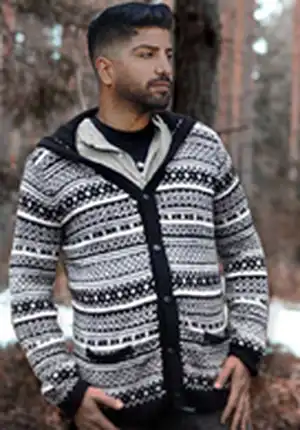
This pattern creates a hooded, button-front cardigan with traditional Fair Isle charting and a lined hood. You will work the sweater flat for the body and in the round for the sleeves with detailed shaping for armholes and shoulders. The pattern includes pocket lining instructions, guidance for a button band, and notes about steeking vs knitting flat.

Neville's Sweater Pattern crochet pattern - detailed view of completed project

Designed from photos to capture the sweater's balanced motifs, it uses three contrasting colors and clear charted repeats. Ideal for knitters comfortable with colorwork and shaping.

Why You'll Love This Neville's Sweater Pattern

I absolutely love this pattern because it merges classic Fair Isle motifs with practical details like pockets and a lined hood. I enjoyed translating photos into charted colorwork and balancing three colors for a harmonious look. The pattern is challenging in the best way β€” it pushes your colorwork and shaping skills while rewarding you with a truly wearable piece. Making the hood and pocket linings gave me a chance to refine techniques I rarely use, and I love how the finished cardigan drapes and fits.

Neville's Sweater Pattern step 1 - construction progress Neville's Sweater Pattern step 2 - assembly progress Neville's Sweater Pattern step 3 - details and accessories Neville's Sweater Pattern step 4 - final assembly and finishing

Switch Things Up

I love customizing this pattern by switching color palettes; try warm autumn tones or cool ocean hues instead of the original black, cream, and grey.

I sometimes substitute Cascade 220 with another worsted weight yarn and adjust needle size to keep the gauge consistent.

To make a smaller or larger sweater, I change the stitch count proportionally and check gauge frequently while making the first chart repeats.

I enjoy adding extra length to the ribbing or body for a more relaxed fit; just add rows before starting the chart to maintain motif placement.

For the hood, I have experimented with a single-layer hood for less bulk or a double-lined hood for extra warmth depending on the season.

I sometimes replace the button band with a zipper placket for a modern look and easier wear, picking up stitches the same way as described for the band.

Try adding decorative embroidery on top of the colorwork after blocking to personalize the sweater with initials or subtle motifs.

If you want a lighter version, use a sport-weight yarn and a smaller needle to create a finer gauge and more delicate fabric.

I often change pocket size or placement; knit the pocket lining longer for a deeper pocket, or move it closer to the edge for a different aesthetic.

Don't be afraid to mix charts: use Chart A for sleeves and Chart B for the body, or mirror charts between left and right fronts to create asymmetry that still reads balanced.

Common Mistakes & How to Fix Them

βœ— Not checking gauge before starting will change the final fit dramatically; always knit a swatch at the stated gauge (6 sts/inch, 7 rows/inch) and adjust needles if necessary. βœ— Skipping stitch markers around the beginning of rounds and front divisions can cause misplaced increases or decreases; place markers and update them when shaping to keep your counts accurate. βœ— Trying to steek without practicing can ruin a multi-color area if floats aren't secured; practice on a swatch and consider knitting the body flat if you are unsure about steeking. βœ— Leaving pocket linings too short or with short tails makes attachment difficult later on; knit the pocket lining to the specified 36 rows and leave long tails for sewing. βœ— Forgetting to note what chart row you are on when changing pieces leads to mismatched sleeves or fronts; write down or mark which chart row you ended on for accurate matching. βœ— Overstuffing or underblocking the finished piece can distort your button band and front edges; weave in ends, block lightly, and pin the button band before picking up stitches for clean edges.

Neville's Sweater Pattern

Make a cozy, patterned hooded sweater inspired by Neville's iconic look. This detailed knitting pattern guides you through Fair Isle charts, pocket linings, sleeve shaping, and a lined hood. Perfect for making a warm, wearable cardigan with classic contrast colors and a tailored fit.

Advanced 12-15 Hours

Materials Needed for Neville's Sweater Pattern

β€” Main Fabric

  • 01
    Cascade 220 Superwash (worsted weight #4) - Black (color 815) - 7 skeins (approximate for size 44")
  • 02
    Cascade 220 Superwash - Cream (color 817) - 4 skeins
  • 03
    Cascade 220 Superwash - Grey (color 900) - 2 skeins
  • 04
    Approximately 2700 yards total used for the sample size (size 44"), amounts will vary by size
  • 05
    5 black 3/4" buttons for the front closure

β€” Tools Required

  • 01
    US 6 needles (recommended gauge: 6 sts/inch, 7 rows/inch) - circular or straight as needed
  • 02
    Stitch holders for pocket linings and neck stitches
  • 03
    Stitch markers
  • 04
    Tapestry/yarn needle for sewing and weaving in ends
  • 05
    Scissors
  • 06
    Safety pin for marking buttonholes
  • 07
    Pins for blocking and assembly
  • 08
    3-needle bind-off technique (needles for 3-needle bind-off)
  • 09
    Sewing machine (optional, for sewn steeks on sleeves) or yarn for crochet steek finishing

Progress Tracker

0% Complete

β€” Directions :

Infos :

Gauge - 6 sts/inch, 7 rows/inch with size US 6 needles. See notes about yarn amounts. Finished bust size 36 (40, 44, 48) at 6 sts/inch. If your finished size is bigger or smaller than this, PM me on Ravelry and I'll send you the appropriate numbers. You'll also need 5 black 3/4" buttons.

β€” Pocket lining :

Pocket lining :

CO 28 sts and knit in stockinette for 36 rows. Move sts to stitch holder and knit a second lining. Set both linings aside for later. Leave long tails for sewing the lining to the sweater.

β€” Sleeves :

Round 1 :

With black, CO 56 (60, 60, 66). Place marker and join to knit in the round.

Round 2 :

Knit 2x2 ribbing for 18 rows.

Round 3 :

Begin working chart A on row 54, chart B on row 107 and at the same time work increases as follows.

Round 4 :

Increase 1 st on each side of the beginning of round marker every 4 rows 9 (18, 24, 23) times.

Round 5 :

Increase 1 st on each side of the beginning of round marker every 6 rows 10 (5, 2, 3) times.

Round 6 :

There will be 94 (106, 112, 118) sts.

Round 7 :

Work even until piece measures 16" (16.75", 17.5", 18.25"). Make note of what row you're on _______ (to match the second sleeve).

β€” Shape cap :

Info :

Shape cap - Working back and forth, BO 6 (6, 6, 7) sts at the beginning of the next 2 rows.

Round 1 :

At beginning of next 2 rows, BO 4 sts (all sizes).

Round 2 :

Decrease 1 st at each end of needle every RS row 4 (6, 6, 8) times.

Round 3 :

There will remain 66, 74, 80, 80 sts.

Round 4 :

48" size only - decrease 1 st at each end of needle every for rows 4 times.

Round 5 :

All sizes - decrease 1 st at each end of needle every RS row 10 (9, 9, 2) times.

Round 6 :

BO 2 sts at beginning of next 6 (10, 12, 2) rows.

Round 7 :

BO 3 sts at beginning of next 4 (4, 4, 12) rows.

Round 8 :

There will remain 22 (24, 26, 28) sts. BO all remaining sts.

β€” Body :

Round 1 :

With black, CO 216 (240, 264, 288). This is 54 (60, 66, 72) for each front and 108 (120, 132, 144) for the back.

Round 2 :

Place st markers to make shaping the armholes easier later on. Work 2 x 2 rib for 12 rows.

Round 3 :

Begin both charts on row 1 and work until piece measures 13" (13.5", 15", 15.5"). Don't forget to add your pocket lining on row 36. End with a wrong side row. Make note of what row you're on _______.

β€” Divide for fronts and back :

Infos :

Divide for fronts and back - Front (right and left, knit separately) - Shape armholes AND v-neck. (When it came time for these decreases, I put stitch markers in where I would stop decreasing as a reminder to stop.)

Round 1 :

At armhole edge of next RS row, BO 6 (6, 6, 7) sts.

Round 2 :

At armhole edge of next RS row BO 4 sts (all sizes).

Round 3 :

Decrease 1 st at armhole edge every RS row 4 (6, 6, 8) times.

β€” AT THE SAME TIME :

Info :

Decrease 1 st at neck edge every RS row 18 (18, 19, 24) times. Then decrease 1 st at neck edge every 4 rows 1 (2, 2, 0) times.

Round 1 :

There will remain 21 (24, 29, 29) sts. Work even until armhole measures 8.5" (9.5", 10", 10.5").

Round 2 :

Make note of what row you're on ________.

β€” Shape Shoulders :

Round 1 :

At beginning of next 2 rows BO 7 (8, 10, 10) sts.

Round 2 :

At beginning of next 2 rows BO 7 (8, 10, 10) sts.

Round 3 :

At beginning of next 2 rows BO 7 (8, 9, 10) sts.

β€” Back - Shape Armholes :

Round 1 :

Back - Shape Armholes: At beginning of next 2 rows, BO 6 (6, 6, 7) sts.

Round 2 :

At beginning of next 2 rows, BO 4 sts (all sizes).

Round 3 :

Decrease 1 st at each end on of needle every RS row 4 (6, 6, 8) times.

Round 4 :

There remains 80 (88, 100, 106) sts.

Round 5 :

Continue even until armholes measure 8.5" (9.5", 10", 10.5"). Make sure you're on the same row as shaping for the fronts.

β€” Shape Shoulders :

Round 1 :

At beginning of next 2 rows BO 7 (8, 10, 10) sts.

Round 2 :

At beginning of next 2 rows BO 7 (8, 10, 10) sts.

Round 3 :

At beginning of next 2 rows BO 7 (8, 9, 10) sts.

Round 4 :

Move remaining sts (neck) 38 (40, 42, 48) to a stitch holder for the hood.

Info :

At this point, I went ahead and seamed the shoulders and sleeves so the sweater could be tried on. If something doesn't fit, it's easier to fix now, before knitting the hood. On the other hand, the sweater is big and the sleeves sort of get in the way while knitting the hood. So you can make the decision to sew in the sleeves before or after doing the hood.

β€” Hood :

Round 1 :

Beginning on the right front (and continuing to work in pattern), pick up sts beginning 3 inches from the live neck sts. Knit those 3 inches, across the neck sts, and then pick up and knit 3 more inches.

Round 2 :

When you're at a good time for increasing, *k4, M1* across the row. Now just knit until your hood is tall enough. I measured my husband from shoulder to the center of the top of his head and used that as a rough estimate. It worked rather well. When your hood is tall enough, turn right sides together and work a 3 needle bind-off.

Round 3 :

Once you've done the increase round (and know how many sts you need), you can cast on the hood lining. I found that the sweater wasn't very portable at this point and having the lining to work on while out and about was really great.

Round 4 :

Knit the lining in stockinette to the same measurements as the hood. When it's long enough, turn right sides together and work a 3 needle bind-off.

Info :

Weave in the million ends. Some light blocking will make picking up the button band easier.

β€” Button band :

Round 1 :

Button band - with black, from the RS, pick up sts along the right front, hood, and left front. When you pick up sts for the hood, pin the lining inside (wrong sides together) and pick up sts by inserting your needle through both the hood and the lining.

Round 2 :

When you've picked up all the sts, purl back. Knit one row, purl one row, knit one row, purl one row. On the next row (RS), you'll need to mark your buttonholes. It's left front for boys, right front for girls.

Round 3 :

Put a safety pin on the needle about 1.5 inches from the bottom, a second pin where the v-neck starts, a third pin in the middle, a fourth pin between pins 1 and 3, and a fifth pin between pins 2 and 3. Count your sts between pins and adjust them so that they are evenly spaced. Knit to the safety pin and yo, k2tog to make a buttonhole. Exchange the safety pin for a st marker.

Round 4 :

Purl one row, knit one row, purl one row, knit one row. Knit one row on the wrong side for a turning row.

Round 5 :

Knit one row, purl one row, knit one row, purl one row. Work another buttonhole round - yo, k2tog where your st markers are. Purl one row, knit one row, purl one row, knit one row, purl one row, loosely bind off.

Round 6 :

Fold the button band in half and loosely sew it to the sweater. When you get to the hood, pull it a little so it covers the row where you picked up sts. When you get to a button hole, use your yarn to reinforce it and sew the 2 layers together. Weave in those last ends and block.

β€” Charts :

Info :

Chart A and Chart B are provided as separate charts. Chart A is the smaller chart used on the original sweater; Chart B is a larger chart that matches the movie sweater layout. Both charts have an empty column for marking increases and help match sleeves and fronts. Refer to the printed charts for row-by-row colorwork.

Assembly Instructions

  • Sew shoulder seams and set sleeves in place to check fit before finishing the hood; seam the shoulders first so the sweater can be tried on.
  • Attach pocket linings: place the knitted pocket lining inside the body at row 36 and sew the lining to the sweater using the long tails left from casting off.
  • Pick up stitches for the button band along right front, hood, and left front with the hood lining pinned inside and knit the band, then fold and sew the band closed.
  • Fold the button band and sew it loosely to the body, reinforcing buttonholes and sewing both layers together at each buttonhole.
  • Sew side seams and weave in all ends, then block the finished sweater lightly to even out colorwork and make picking up stitches for the band easier.

Important Notes

  • πŸ’‘Practice steeking on a swatch if you plan to steek rather than knitting the body flat; steeking requires securing floats and possibly sewing machine reinforcement.
  • πŸ’‘Keep careful notes of which chart row you are on when switching pieces so sleeves and fronts match the chart repeats correctly.
  • πŸ’‘Weave in ends as you go when working three-color rows to avoid hundreds of loose ends at the end of the project.
  • πŸ’‘Block lightly after completion to help the button band and edges lie flat before picking up stitches.
  • πŸ’‘Use stitch markers for increases at the beginning of rounds and for marking buttonhole positions to keep spacing even.

This hooded Fair Isle cardigan blends classic motifs with practical details like pockets and a lined hood, making it a wearable statement piece. It was designed to balance three colors for a cohesive look and includes charts for easy colorwork tracking. Whether you choose to steek or knit flat, you will enjoy the process and the beautiful finished sweater. 🧢🧡

You ask,

we answer.

FAQs

What size will the finished piece be?

The pattern sample was made as a size 44" sweater; the pattern lists finished bust sizes 36 (40, 44, 48). Your finished size depends on your gauge (6 sts/inch) and yarn choice.

Can I use different yarn weights for this pattern?

Yes, but using a different yarn weight will change gauge and final size; adjust needle size and recalculate stitch counts if you change yarn weight.

Do I need to steek the sweater or can I knit it flat?

You can choose either method; the designer decided to knit the cardigan flat to avoid steeking issues. If you decide to steek, practice and secure floats, or use a sewing machine for reinforcement where needed.

How long does this project typically take to complete?

Most knitters will spend multiple days on this detailed sweater; expect approximately 12-15 hours for an experienced knitter, though time will vary by skill level.