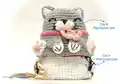
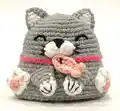
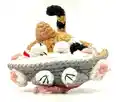
About This Reversible Cat Amigurumi Pattern
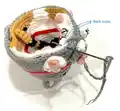
This instruction set shows how to join two finished chibiscraft reversible cat amigurumies to create a single reversible toy. It covers turning pieces inside out, tying the magic-ring tails, nesting one cat inside the other, and sewing the last rounds together through the back loops. The technique requires no extra stuffing and keeps both faces crisp and reversible.
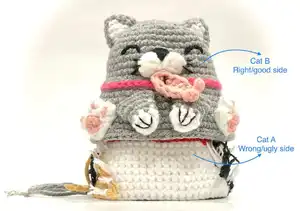
Follow each step carefully to ensure correct alignment and a neat finish. The method is adaptable to other small amigurumi pairs with magic-ring tails.
Why You'll Love This Reversible Cat Amigurumi Pattern
I absolutely love this pattern because it transforms two individual amigurumi into one playful reversible piece, doubling the charm with minimal effort. I enjoy how tidy the final join looks when you sew through the back loops, and I love that there is no need to re-stuff the pieces. I find the nesting method surprisingly sturdy and satisfying, especially when the faces are lined up well. Making reversible toys like this always delights both kids and adults, and I love gifting them.
Switch Things Up
I like to personalize the reversible cat by changing color combinations for Cat A and Cat B so each side has a distinct personality.
I often add a small bell or ribbon to one cat for extra charm, making one side more playful than the other.
I sometimes embroider different expressions (smile versus wink) on each face to make the reversible action more dramatic.
To change the size, I experiment with different yarn weights and corresponding hook sizes; a thicker yarn creates a chunkier reversible toy.
I also try adding tiny accessories like a crocheted fish or a mini scarf to one side to tell a story between the two faces.
For a safer child-friendly version, I use embroidered eyes instead of safety eyes and double the yarn tails when knotting for extra durability.
I occasionally line up faces differently—offsetting slightly—for a quirky look, just be sure to pin and check alignment before sewing.
If I want a sturdier seam, I use a second pass of whipstitch through the back loops only, which hides the stitching but reinforces the join.
I like to experiment with mixing textures: try pairing a plush chenille cat with a standard acrylic cat to see how the reversible effect changes the feel.
Finally, I create small matching sets with different color schemes as gifts—each reversible pair tells a different little story and makes a unique present.
Common Mistakes & How to Fix Them
✗ Not using matching yarn weight and hook sizes for both cats leads to uneven sizes; always use the same yarn weight, hook size, and tension for both pieces.
✗ Tying the magic-ring tails too tightly can distort the shape and prevent proper nesting; leave a 1-2 cm space between knots to allow alignment and smoothing.
✗ Forgetting to work through the back loops when sewing will make the seam bulky and visible; sew through the back loops of each piece as instructed for a neat join.
✗ Removing the wrong side or stuffing Cat A incorrectly can create lumps; leave Cat A wrong/ugly side intact and do not add fiberfill while joining to preserve the reversible function.
✗ Failing to hide and secure the yarn tail at the end can lead to unraveling over time; finish with a secure knot and weave the tail into the seam to hide it properly.