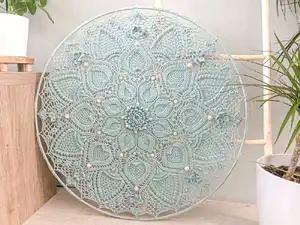
Create a delicate, lacy mandala perfect for wall display or a decorative hoop. This pattern guides you through front-post and back-post stitches, shells, clusters, and optional bead accents so you can craft a stunning textured piece. You will enjoy the step-by-step instructions, charts, and helpful tips to make your own Virelle Mandala.
Progress Tracker
0% Complete
— Mandala :
Round 1 :
Start with a magic ring. Chain 3 (counts as dc), and work 11 dc in the ring. Slst in 3rd chain.
Round 2 :
In this row: front loops only. You work in the front loops from row 1. In every stitch (so also in the slst from row 1): slst, ch 2, 2 dc, ch 2, slst. End with a slst in the first chain from this row. You have 12 leaves.
Round 3 :
In this row: back loops only. You're working in the back loops of row 1. Slst in next. Chain 3 (counts as dc), dc in same. *2 dc in every stitch.* Repeat instructions between * until the end of the row. Slst in 3rd chain from the beginning of this row. You now have a total of 24 dc.
Round 4 :
In this row: front loops only. You're working in the front loops of row 3. *In next stitch: [slst, ch 2, dcl. In the next: [dc, ch 2 and slst].* Repeat instructions between * until the end of the row. Slst in first chain from the beginning of this row. You have 12 leaves.
Round 5 :
In this row: back loops only. You're working in the back loops of row 3. Slst in next. Ch 3 (counts as dc), dc in same. 1 dc in next. *2 dc in next, 1 dc in next.* Repeat instructions between * until the end of the row. Slst in 3rd chain from the beginning of this row. You have 36 dc.
Round 6 :
In this row: work in the front loops only. You're working in the front loops of row 5. *In next: [slst, ch 2, dc]. In next: 2 tr. In next: [dc, ch 2, slst].* Repeat instructions between * until the end of the row. Slst in first chain from the beginning of this row. You have 12 leaves.
Round 7 :
In this row: back loops only. You're working in the back loops from row 5. Ch 3 (counts as dc), dc in next, 2 dc in next. *2 dc (1 in each), 2 dc in next.* Repeat instructions between * until the end of the row. You now have 48 dc.
Round 8 :
In this row: front loops only. You're working in the front loops from row 7. *In next: [slst, ch 2, dc]. In next: 2 tr. In next: 2 tr. In next: [dc, ch 2, slst].* Repeat instructions between * until the end of the row. Slst in the first chain from the beginning of this row. You have 12 leaves.
Round 9 :
In this row: back loops only. You're working in the back loops from row 7. Slst in next. Ch 3 (counts as dc). 2 dc (1 in each). In next 2 dc (so 2 dc in 1). *3 dc (1 in each), 2 dc in 1.* Repeat instructions between * until the end of the row. Slst in 3rd chain from the beginning of this row. You have a total of 60 dc.
Round 10 :
Ch 1, sc in same st. Crochet 3 more sc and then 2 sc in next (2 in 1). *4 sc, 2 sc in next st.* Repeat instructions between * until the end of the row. You now have 72 sts. Skip ch and end with slst in first sc.
Round 11 :
Ch 1, sc in same st. Crochet 3 more sc, in next: [1 sc, ch 3, 1 sc]. *8 sc, in the next: [1 sc, 3 ch, and 1 sc].* Repeat instructions between * and # until the end of the row. You have 4 sts left at the end of the row; 1 sc in each. Skip the chain from the beginning of this row, end with a slst in the first sc.
Round 12 :
2 slst, ch 3. dc in next. Then ch 1, in the chain space: [1 dc + 3 ch + 1 dc]. Ch 1, skip 1 st. *3 dc, ch 1, fp-dc in next 2 sts (insert hook in the next stitch, to the back side, and to the front again through the next), ch 1, 3 dc. Ch 1, skip 1 st, in the chain space: [1 dc + 3 ch + 1 dc]. Ch 1, skip 1 st.* Repeat instructions between * until the end of the row. Then work: 3 dc, ch 1, fp-dc in next 2 sts, ch 1, 1 dc, and end with slst in the 3rd ch.
Info :
The yellow circle shows in which sc you need to work the fp-dc.
Round 13 :
Ch 3 (counts as dc). *Ch 2, skip 1 st, fp-dc in dc. 8 dc in chain space, fp-dc in dc. Ch 2, skip 1 st. 2 dc. Chain 1, fp-dc, ch 1. 2 dc.* Repeat instructions from * until the end of the row. End with a ch 2, skip 1 st, 2 dc, chain 1, fp-dc, ch 1, dc. Then a slst in the 3rd chain from the beginning of this row.
Round 14 :
2 slst. Then fp-slst in the fp-dc from the previous row, ch 3 (counts as fp-dc). Work another fp-dc in the same st. 8 dc. 2 fp-dc in 1. Ch 1. Skip 1 st. *1 dc, ch 1, fp-dc, ch 1, 1 dc. Skip 1 st. Ch 1, 2 fp-dc in 1. 8 dc. 2 fp-dc in 1. Ch 1, skip 1 st.* Repeat instructions from * until the end of the row. End with 1 dc, ch 1, fp-dc, ch 1, 1 dc, ch 1, then work slst in the 3rd ch.
Round 15 :
Fp-slst, ch 3 (counts as fp-dc). 2 fp-dc in next. Sc between 1st and 2nd dc's. Then ch 1, and work a sc between the next two dc's. Repeat this until you have a total of 7 sc with a chain between each of the sc's. 2 fp-dc in 1, fp-dc. *ch 2, skip 1 st, fp-dc in fp-dc from previous row, skip 1 st, ch 2. Fp-dc, 2 fp-dc in 1. Work a sc between the 1st and 2nd dc's, chain 1, sc between next two stitches. You have 7 sc with a ch between each sc. 2 fp-dc in 1, fp-dc.* Repeat instructions from * until the end of the row. End with a fp-dc and ch 2, then a slst in the 3rd chain from the beginning of this row.
Round 16 :
Fp-slst, ch 3 (counts as fp-dc). Fp-dc, 2 fp-dc in 1. Sc in ch-1 space, chain 1, sc in next ch-1 space, chain 1, and repeat this until the end of the shell (so 6 sc and 5 chains in total). 2 fp-dc in 1, 2 fp-dc (1 in each). *ch 1, fp-dc in fp-dc from previous row, ch 1. 2 fp-dc, 2 fp-dc in 1. Sc in ch-1 space, chain 1, sc in ch-1 space, chain 1, sc in ch-1 space, repeat until end of the shell (so 6 sc and 5 chains in total). 2 fp-dc in 1, then 2 fp-dc (1 in each).* Repeat instructions between * until the end of the row. After the last leaf, you end with a ch 1, fp-dc, ch 1, and slst in the 3rd chain from the beginning of this row.
Round 17 :
Fp-slst, ch 3 (counts as fp-dc). Then 2 fp-dc (1 in each), 2 fp-dc in 1. 1 sc in ch-1 space, ch 1, sc in ch-1 space, ch 1, repeat (5 sc and 4 chains in total). 2 fp-dc in 1, 3 fp-dc (1 in each). *ch 1, fp-dc, ch 1. 3 fp-dc (1 in each), 2 fp-dc in 1. 1 sc in ch-1 space, ch 1, sc in next ch-1 space, ch 1, sc in ch-1 space, repeat (5 sc and 4 chains in total). 2 fp-dc in 1, 3 fp-dc (1 in each).* Repeat instructions between * until the end of the row. End with a ch 1, fp-dc, ch 1, and then a slst in the 3rd chain from the beginning of this row.
Round 18 :
Fp-slst, ch 3 (counts as fp-dc). 3 fp-dc (1 in each). 2 fp-dc in 1. Sc in ch-1 space, ch 1, repeat (4 sc and 3 chains in total). 2 fp-dc in 1, 2 fp-dc (1 in each), fp-dc2tog. *ch 2, fp-dc, ch 2. fp-dc2tog, 2 fp-dc (1 in each), 2 fp-dc in 1. Sc in ch-1 space, ch 1, sc in ch-1 space, repeat (4 sc and 3 chains in total). 2 fp-dc in 1, 2 fp-dc (1 in each), fp-dc2tog.* Repeat instructions between * until the end of the row. End with a ch 2, fp-dc, ch 2, and a slst in the 3rd chain from the beginning of this row + the next fp-dc (this way you 'crochet them together').
Round 19 :
2 slst (1 in each). Fp-slst in next, ch 3 (counts as fp-dc). Fp-dc, 2 fp-dc in 1. Sc in ch-1 space, ch 1, sc in next ch-1 space, repeat (3 sc and 2 chains in total). 2 fp-dc in 1, 2 fp-dc (1 in each), fp-dc2tog. *ch 2. In next: [fp-dc, ch 1, fp-dc]. ch 2, fp-dc2tog, 2 fp-dc (1 in each), 2 fp-dc in 1. Sc in ch-1 space, ch 1, sc in next ch-1 space, ch 1, sc in ch-1 space (so 3 sc and 2 chains in total). 2 fp-dc in 1, 2 fp-dc (1 in each), fp-dc2tog.* Repeat instructions between * until the end of the row. End with: in next [fp-dc, ch 1, fp-dc]. Ch 2, fp-dc2tog (you work in the ch 3 + the next fp-dc from the previous row, and the next fp-dc). Slst in 3rd chain from the beginning of this row.
Round 20 :
Fp-slst in next fp-dc, ch 3 (counts as fp-dc). Fp-dc in next, 2 fp-dc in 1. Sc in ch-1 space, ch 1, sc in next ch-1 space. 2 fp-dc in 1, 2 fp-dc (1 in each), fp-dc2tog. *ch 3, 2 fp-dc in 1, ch 2, 2 fp-dc in 1, ch 3. fp-dc2tog, 2 fp-dc (1 in each), 2 fp-dc in 1. Sc in ch-1 space, ch 1, sc in next ch-1 space. 2 fp-dc in 1, 2 fp-dc (1 in each), fp-dc2tog.* Repeat instructions between * until the end of the row. Repeat instructions between * until the end of the row. End with 2 fp-dc in 1, ch 2, 2 fp-dc in 1, ch 3. fp-dc2tog, slst in 3rd chain from the beginning of this row.
Round 21 :
Fp-slst in next fp-dc, ch 3 (counts as fp-dc). Fp-dc2tog (skip the space with sc's and chains). 2 fp-dc (1 in each), fp-dc2tog. *ch 3, 2 fp-dc (1 in each), ch 3, dc in chain space, ch 3, 2 fp-dc (1 in each), ch 3. fp-dc2tog, 2 fp-dc (1 in each), fp-dc2tog (skip the space with the sc's and chains), 2 fp-dc (1 in each), fp-dc2tog.* Repeat instructions between * until the end of the row. End with a ch 3, 2 fp-dc (1 in each), ch 3, dc in ch space, ch 3, 2 fp-dc (1 in each), ch 3. Fp-dc2tog, and a slst in the 3rd chain from the beginning of this row.
Round 22 :
Fp-slst in same (the beginning chain from the previous row), ch 3 (counts as fp-dc). Fp-dc in the fp-dc2tog from the previous row (you insert in the top loops as shown in the picture). Fp-dc in next. Fp-dc2tog. *ch 3, 2 fp-dc (1 in each), ch 3. Clst in first chain space, ch 4, clst in second chain space. Ch 3, 2 fp-dc (1 in each), ch 3. Fp-dc2tog, 3 fp-dc (1 in each, the second one goes in the fp-dc2tog from the previous row, where you insert through the loops in the top as shown in the picture). Then a fp-dc2tog.* Repeat instructions between * until the end of the row. End with a clst, ch 3, 2 fp-dc (1 in each), ch 3 and fp-dc2tog. Then a slst in the 3rd chain from the beginning of this row.
Round 23 :
Fp-slst in next, ch 3 (counts as fp-dc). You start in the center of the leaf. Fp-dc2tog. *ch 3, 2 fp-dc (1 in each), ch 3. 2 fp-dc in clst from previous row (you insert from front to the back side, and going behind the clst, you go to the front again). Ch 5, 2 fp-dc in next clst from previous row (same instructions as before). Ch 3, 2 fp-dc in 1, ch 3. Fp-dc2tog, fp-dc, fp-dc2tog.* Repeat instructions between * until the end of the row. End with a fp-dc2tog and a slst in the 3rd chain from the beginning of this row.
Round 24 :
Work a slst in the fp-dc2tog and the 3 chains (so 1 slst in each) and in the next fp-dc. *To make a heart shape, you follow these instructions: You have 4 fp-dc in total to work
This Virelle Mandala pattern offers a beautiful blend of textured stitches and optional bead details to create a stunning wall hanging. The step-by-step rounds and charts make following the design manageable, while blocking and beads add a polished finish. Whether you display it in a hoop or on the wall, this piece brings handcrafted elegance to any room. 🧶✨