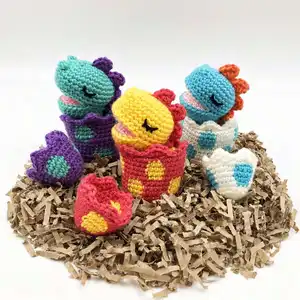
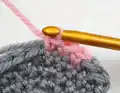
Make a set of adorable baby dinosaurs popping out of polka-dot eggshells with this detailed amigurumi crochet pattern. You will crochet small modular pieces (head, mouth, body, tail, spikes, and eggshell) and assemble them into charming hatching dinosaurs. The pattern includes step-by-step rounds, color-change guidance, diagrams, photos, and assembly instructions so you can follow along with confidence. Perfect for gifting, decoration, or tiny toy collections.
Progress Tracker
0% Complete
— Head - Top :
Info :
In color A. Ch 6. Stitches are worked around both sides of the foundation chain.
Round 1 :
Start in the second ch from hook, 4 sc, (3 sc) in the last ch. Continue on the other side of the foundation chain, 3 sc, inc [12]
Round 2 :
Inc, 3 sc, 3 inc, 3 sc, 2 inc [18]
Round 3 :
Sc, inc, 4 sc, [inc, sc] 3 times, 3 sc, inc, sc, inc [24]
Round 4 :
In this round, you will work bobble stitches as his nose. Please refer to the instructions on bobble stitch on page 3. Sc, inc, 5 sc, [inc, sc, (2-dc-bobble, sl st)] 2 times, inc, 5 sc, inc, 2 sc, inc, sc [32]
Round 5 :
11 sc, [sc in next st BLO <photo 10 to 12>, skip next sl st from the previous row <photo 13>], 3 sc <photo 14 & 15>, [sc in next st BLO, skip next sl st from the previous row], 14 sc [30] <photo 16 to 18>
Round 6 - 9 :
[Sc] around [30] <photo 19>
Info :
Fasten off. Weave in and hide yarn ends. <photo 20 to 22>
— Head - Bottom :
Info :
In color A. Ch 4. Stitches are worked around both sides of the foundation chain.
Round 1 :
Start in the second ch from hook, 2 sc, (3 sc) in the last ch. Continue on the other side of the foundation chain, sc, inc [8]
Round 2 :
Inc, sc, 3 inc, sc, 2 inc [14]
Round 3 :
Sc, inc, 2 sc, [inc, sc] 3 times, [sc, inc] 2 times [20]
Round 4 :
Sc, inc, 3 sc, [inc, 2 sc] 3 times, sc, inc, 2 sc, inc, sc [26]
Info :
Fasten off and leave a long tail for sewing. <photo 23>
— Mouth - Top :
Info :
In color C. Ch 6. Stitches are worked around both sides of the foundation chain.
Round 1 :
Start in the second ch from hook, 4 sc, (3 sc) in the last ch. Continue on the other side of the foundation chain, 3 sc, inc [12]
Round 2 :
Inc, 3 sc, 3 inc, 3 sc, 2 inc [18]
Round 3 :
Sc, inc, 4 sc, [inc, sc] 3 times, 3 sc, inc, sc, inc [24]
Round 4 :
Sc, inc, 5 sc, [inc, sc, (2-dc-bobble, sl st) ] 2 times, inc, 5 sc, inc, 2 sc, inc, sc [32]
Info :
Fasten off and leave a long tail for sewing. <photo 23>
Round 5 - 6 :
[Sc] around [26]. Fasten off. Weave in and hide yarn ends. <photo 24>
— Mouth - Bottom :
Info :
In color C. Ch 4. Stitches are worked around both sides of the foundation chain.
Round 1 :
Start in the second ch from hook, 2 sc, (3 sc) in the last ch. Continue on the other side of the foundation chain, sc, inc [8]
Round 2 :
Inc, sc, 3 inc, sc, 2 inc [14]
Round 3 :
Sc, inc, 2 sc, [inc, sc] 3 times, [sc, inc] 2 times [20]
Round 4 :
Sc, inc, 3 sc, [inc, 2 sc] 3 times, sc, inc, 2 sc, inc, sc [26]
Info :
Fasten off and leave a long tail for sewing. <photo 25>
— Body :
Round 1 :
Start 6 sc in a magic ring [6]
Round 2 :
[Inc] 6 times [12]
Round 3 :
[Sc, inc] 6 times [18]
Round 4 :
[2 sc, inc] 6 times [24]
Round 5 :
Working in BLO, sc in each sc around [24]
Info :
At this point, glue a piece of interface fabric on the bottom of the body. Cut a piece of interfacing fabric (or felt) into a circle to the size of the bottom of the body. Glue it on the wrong side of your piece. <photo 26> By gluing the interface, the bottom of the body will become stiff and flat so that the dinosaur stands by himself.
Round 6 - 7 :
[Sc] around [24]
Round 8 :
[6 sc, dec] 3 times [21]
Round 9 - 10 :
[Sc] around [21]
Round 11 :
[5 sc, dec] 3 times [18]
Round 12 - 13 :
[Sc] around [18]
Info :
Fasten off and leave a long tail for sewing. <photo 27>
— Tail :
Round 1 :
Start 4 sc in a magic ring [4]
Round 3 :
Sc, 2 inc, sc [6]
Round 5 :
2 sc, 2 inc, 2 sc [8]
Round 7 :
3 sc, 2 inc, 3 sc [10]
Round 8 :
[Sc] around [10]
Info :
Fasten off and leave a long tail for sewing. <photo 28>
— Spikes :
Info :
In color B. There is a step-by-step instruction and a diagram for spikes on the following page.
Item Name (P1) :
[Ch 3, hdc into the second ch from hook] 3 times, [ch 4, 2 dc into the 3rd ch from hook] 2 times, [ch 5, 3 dc into the 4th ch from hook] 2 times [3 small spikes, 2 medium spikes and 2 large spikes] <photo 29 to 35>
Info :
Fasten off and leave a long tail for sewing. <photo 36>
— Assembly :
Info :
Follow photo steps 1 to 18 for assembly of mouth and head pieces, sewing pieces picking up front loops and unworked half loops where instructed. Use interfacing in body bottom and pin pieces before sewing.
Step 1 :
Cut the fabric (or felt) into ovals slightly smaller than each of the top and bottom of the mouth. Glue it to the wrong side of the mouth.
Step 2 :
Sew the mouth to the head with the yarn end and a tapestry needle. Stuff it as you sew.
Step 3 :
Sew each piece together with picking up the front loops of each piece.
Step 4 :
This is how they look like when sewing completed. Make sure all the half loops of the last round remains unworked, both top and bottom of the head.
Step 5 :
Position the head two pieces together, and pin them together so that the top portion slightly overhangs the bottom portion. Use stitch markers or sewing pins to hold.
Step 6 :
Using the head color scrap yarn, sew the top and bottom of the head together along the back of the head with 12 sts equally from the center.
Step 7 :
Sew them together picking up unworked half loops.
Step 8 :
Sew the beginning and end of the stitch securely to strengthen.
Step 9 :
Make sure that his mouth is opened nicely.
Step 10 :
Place the head on top of the body, slightly angled as shown in the photo. Use pins to keep them in place.
Step 11 :
Sew them together with whipstitches.
Step 12 :
Sew the tail to the body as well.
Step 13 :
Pin the spikes on the body as shown in the photo.
Step 14 :
Sew the spikes onto the body.
Step 15 :
Cut a black felt into eyes using the template provided in the pattern and glue or sew into place.
Step 16 :
Print the eye template on a paper and cut it out with margins around it. Tape the template onto the black felt using normal sticky tape.
Step 17 :
Tape the template onto the black felt using normal sticky tape. Carefully cut around the eyes with small scissors to get neat shapes.
Step 18 :
Attach eyes and tidy all loose ends. Glue felt eyes if desired and hide yarn tails.
— Eggshell - Top :
Info :
Start in color D. Rounds alternate color D and color A to create a polka dot pattern. Brown text = color D. Blue text = color A. Please refer to the instructions on color changes on page 4.
Round 1 :
Start 6 sc in a magic ring [6]
Round 2 :
[Inc] 6 times [12]
Round 3 :
[Sc, inc] 6 times [18]
Round 4 :
[Sc] around [18]
Info :
Continue working next few rounds to make a polka dot pattern, alternating color D and color A according to the instruction and the diagram. Please refer to the instructions on color changes on page 4.
Round 5 :
Sc, (sc, sc) in same st, 2 sc, [inc, 2 sc, (sc, sc) in same st, 2 sc] 2 times, inc, sc [24]
Round 6 :
2 sc, [4 sc, 4 sc] 2 times, 4 sc, 2 sc [24]
Round 7 :
2 sc, [sc, inc, 2 sc, sc, inc, 2 sc] 2 times, sc, inc, 2 sc, sc, inc [30]
Round 8 :
3 sc, [4 sc, 6 sc] 2 times, 4 sc, 3 sc
Info :
Cut color A and weave in and hide yarn end and continue working in color D [30] <photo 37>
Round 9 :
[4 sc, inc] 6 times [36]
Round 10 :
You will crochet scalloped edge this round, [(sc, hdc, dc, hdc, sc) into same st, skip 2 st, sl st, skip 2 st] 6 times [6 shells] <photo 38 to 45>
Info :
Fasten off. Weave in and hide yarn ends.
— Eggshell - Bottom :
Info :
Start in color D. Continue alternating color D and color A as instructed to create polka dots. Follow color change instructions on page 4.
Round 1 :
Start 6 sc in a magic ring [6]
Round 2 :
[Inc] 6 times [12]
Round 3 :
[Sc, inc] 6 times [18]
Round 4 :
[2 sc, inc] 6 times [24]
Round 5 :
[3 sc, inc] 6 times [30]
Round 6 :
[4 sc, inc] 6 times [36]
Info :
Continue working next few rounds to make a polka dot pattern, alternating color D and color A according to the instruction and the diagram on page 19.
Round 7 :
Sc, 3 sc, [6 sc, 3 sc] 3 times, 5 sc [36]
Round 8 :
Sc, 4 sc, [5 sc, 4 sc] 3 times, 4 sc [36]
Round 9 :
Sc, 4 sc, [5 sc, 4 sc] 3 times, 4 sc [36]
Round 10 :
2 sc, 3 sc, [6 sc, 3 sc] 3 times, 4 sc. Change the yarn color at the last step of this round. See the step-by-step instruction on the following page. [36] <photo 46 to 48>
Round 11 :
Sc, 6 sc, [3 sc, 6 sc] 3 times, 2 sc [36]
Round 12 :
2 sc, 5 sc, [4 sc, 5 sc] 3 times, 2 sc [36]
Round 13 :
2 sc, 5 sc, [4 sc, 5 sc] 3 times, 2 sc [36]
Round 14 :
2 sc, 6 sc, [3 sc, 6 sc] 3 times, sc. Change the yarn color at the last step of this round. See the step-by-step instruction on the following page. [36] <photo 49 to 51>
Round 15 :
[Sc] around [36]. Cut the color A and weave in and hide yarn ends. <photo 52 to 54>
Round 16 :
BLO: Working this round in BLO, sc in each st around [36]
Round 17 :
[7 sc, dec] 4 times [32]
Round 18 - 25 :
[Sc] around [32]
Round 26 :
[6 sc, dec] 4 times [28]
Round 27 :
[5 sc, dec] 4 times [24]
Round 28 :
[4 sc, dec] 4 times [20]
Round 29 :
[Dec] 5 times [10] <photo 55>
Info :
Fasten off and draw the yarn end through all 10 sts and pull tight to close the opening. <photo 56 & 57> Weave in and hide yarn ends. Push the upper half of the eggshell inwards to make it cup-shaped. Row 16 should be the border. <photo 58 to 60>
Round 16 (scallop) :
Attach yarn to any st of the remaining half front loop of Rnd 15. [(sc, hdc, dc, hdc, sc) into the same st, skip 2 sts, sl st, skip 2 sts] rep 6 times [6 scallops]. <Diagram on page 20 & photo 63 to 69>
Info :
Fasten off and leave a long tail for sewing.
These little hatching dinosaurs are sweet, playful, and perfect for gifting or display. The pattern includes photos, diagrams, and clear step-by-step instructions to help you every stitch of the way. Make a set in different colorways and watch them bring personality to any shelf or nursery. 🧶✨