🧢 Beautiful ✨ Detailed πŸ’ Adorable

Christmas Embroidery Hoop Pattern

Christmas Embroidery Hoop Pattern
4.5β˜… Rating
2-3 Hours Time Needed
1.6K Made This
βœ‚οΈ

Beginner Friendly Level

Perfect for those just starting their crochet journey, with clear instructions and simple techniques

⏱️

Bite-Sized Project

Finishes in 2-4 hoursβ€”perfect for an afternoon of creative relaxation.

🏑

Cozy Accent

A warm touch for your space that transforms ordinary corners into inviting nooks filled with handmade charm.

About This Christmas Embroidery Hoop Pattern

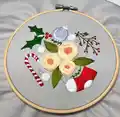
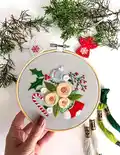
This pattern creates a 15 cm Christmas-themed embroidery hoop featuring roses, holly leaves, a candy cane and a tiny stocking. You will learn satin stitch, fishbone stitch, chain stitch, backstitch, woven wheel stitch and French knots to build layered floral and foliage details. The pattern includes a printable transfer page, detailed stitch descriptions and step-by-step photos to guide you through the process.

Christmas Embroidery Hoop Pattern crochet pattern - detailed view of completed project

Ideal for beginners and all skill levels, this design uses DMC embroidery threads and natural fabric for crisp stitch definition. The finishing instructions show how to back the hoop neatly with felt or craft cardboard for a polished final piece.

Why You'll Love This Christmas Embroidery Hoop Pattern

I absolutely love this pattern because it brings classic embroidery stitches together into a compact, festive design that looks impressive but is easy to stitch. I enjoy how the woven wheel flowers and satin-filled leaves add depth and texture with simple techniques. The printable template makes transferring the design effortless, and I find the finishing steps give a professional result every time. Stitching this hoop feels relaxing and celebratory, perfect for gifting or seasonal decor.

Christmas Embroidery Hoop Pattern step 1 - construction progress Christmas Embroidery Hoop Pattern step 2 - assembly progress Christmas Embroidery Hoop Pattern step 3 - details and accessories Christmas Embroidery Hoop Pattern step 4 - final assembly and finishing

Switch Things Up

I love to change colors to give this hoop a different mood; try pastel roses for a soft spring version or jewel tones for a rich holiday look.

I often swap DMC colors and experiment with metallic thread for small accents to add shimmer to berries or ornaments.

If you want a smaller or larger piece, simply change the hoop size; a 10 cm hoop gives a miniature ornament while 20 cm creates a statement piece.

You can replace woven wheel flowers with small bullion knots for a textured floral center if you prefer more raised detail.

I sometimes add tiny seed beads at the center of woven wheels or on berry clusters to catch the light and add contrast.

Try a dark-colored fabric background like navy or deep green to make the satin stitches pop and create a dramatic effect.

For a modern twist, use variegated floss for the satin fills so each petal has subtle color shifts without changing threads mid-stitch.

I also like framing finished hoops in shadow boxes or mounting them on card fronts to create wearable or giftable art pieces.

If you prefer less sewing on the back, glue a pre-cut felt circle after stitching instead of overstitching, but only use a thin layer to avoid lumps.

To personalize, embroider a name or year in backstitch near the edge and make a set of matching hoops in different sizes for seasonal wall displays.

Common Mistakes & How to Fix Them

βœ— Not transferring the pattern accurately can lead to misaligned elements; use carbon paper or tape the printed pattern to a window and trace carefully. βœ— Using the wrong thread thickness can flatten texture and hide details; use stranded DMC cotton and separate strands as recommended for satin and woven wheel stitches. βœ— Pulling satin stitches too tight will pucker the fabric and distort shapes; keep stitches smooth and moderate tension for an even surface. βœ— Skipping anchoring stitches or not securing thread ends can cause unraveling; always secure thread tails neatly on the back and weave ends under nearby stitches. βœ— Overfilling woven wheel stitches too quickly can bunch the center; weave gradually and adjust tension as you build up the rounds for a neat finish.
Christmas Embroidery Hoop Pattern

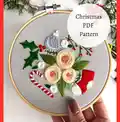
Create a charming Christmas embroidery hoop with clear step-by-step instructions and an easy-to-follow printable template. This pattern uses classic embroidery stitches like satin stitch, fishbone, woven wheel and French knots to build a festive floral arrangement. Perfect for gifting or seasonal decor, it guides you through materials, stitch techniques and finishing the hoop so you can stitch with confidence.

Beginner Friendly 2-3 Hours

Materials Needed for Christmas Embroidery Hoop Pattern

β€” Main Fabric

  • 01
    15 cm embroidery hoop (wooden recommended)
  • 02
    Cotton canvas fabric, natural, two layers (to use as base for embroidery)
  • 03
    DMC embroidery floss colors: 666 (red) - small skein
  • 04
    DMC embroidery floss color: BLANC (white) - small skein
  • 05
    DMC embroidery floss color: 700 (green) - small skein
  • 06
    DMC embroidery floss color: 3841 - small skein
  • 07
    DMC embroidery floss color: 353 - small skein
  • 08
    DMC embroidery floss color: 352 - small skein
  • 09
    DMC embroidery floss color: 954 - small skein
  • 10
    DMC embroidery floss color: 702 - small skein (optional for leaf shading)

β€” Tools Required

  • 01
    15 cm embroidery hoop (wood, plastic or bamboo)
  • 02
    Embroidery needle suitable for cotton floss
  • 03
    DMC embroidery floss in listed colors (666, BLANC, 700, 3841, 353, 352, 954, 702)
  • 04
    Scissors for handcraft
  • 05
    Marker or simple pen for transferring the pattern
  • 06
    Carbon paper for transfer pattern or printed template for window transfer
  • 07
    Felt or craft cardboard for finishing the hoop backing
  • 08
    Pins for assembly
  • 09
    Tape (scotch tape) to fix the printed scheme to window or tablet for transfer

Progress Tracker

0% Complete

β€” Materials :

Material 1 :

15 cm hoop. (You can choose wood, plastic or bamboo hoop) I prefer to use wooden hoop because its natural and aesthetic.

Material 2 :

Needle for embroidery.

Material 3 :

Threads. I recommend you to choose 100% cotton threads. For this hoop I use DMC threads

Info :

(Attention! This is just my recommendation; you can use any available colors.

Material 4 :

Fabric. I recommend you to choose natural fabrics 100 % Cotton or linen canvas. For this pattern I used cotton canvas. (I used two layers)

Material 5 :

Marker or simple pen for transferring the pattern.

Material 6 :

Felt or craft cardboard for finished the hoop. (I used to felt for my hoop.) But it’s not obligatory.

Material 7 :

Scissors for handmade. You can use any scissors that you have at home.

Material 8 :

Carbon Paper for transfer pattern

Material 9 :

And finally you need my PDF pattern.

β€” Pattern for printing :

Info :

Pattern for printing (use the provided printable circle scheme to transfer the design to your fabric; align and scale to fit a 15 cm hoop)

β€” Color and Stitch guide :

Infos :

Satin Stitch DMC 666. Satin Stitch DMC BLANC. Satin Stitch DMC 700. Chain Stitch DMC 3841. Back Stitch DMC 700. French Knot Stitch DMC BLANC. Woven wheel stitch DMC BLANC. Fishbone stitch DMC 700. Fishbone Stitch DMC 954. Woven wheel stitch DMC 353. French knot Stitch DMC 352. French Knot Stitch DMC 666. Back Stitch DMC 700. Fishbone Stitch DMC 702.

β€” Stitch Instructions :

1. Back Stitch :

Backstitch : The Backstitch is a simple stitch that can be used to create straight lines of any length or direction. Bring your needle up through the fabric. (1) Bring it down a small way behind this to create a small straight stitch (2). Bring your needle up with a gap ahead of the previous stitch taking it back down where the previous stitch started. Continue along the length of the line.

2. Satin Stitch :

Satin Stitch The satin stitch is a filler stitch that can be used to create a smooth surface and add large areas of color to your embroidery Bring your needle up through the fabric at a point on the outer edge of the shape you wish to fill (1) Insert the needle again at the point opposite the entry point on the other side of the shape (2) Repeat this stitch again, this time bringing your needle up beside the first stitch. Continue this repetition until the shape is filled.

3. Fishbone Stitch :

The fishbone stitch, made up of slanted diagonal stitches, is a filling stitch that is often used for making leaves or feathers. One of the most classic embroidery stitches. Up from the back to start (1). Down on the (2) opposite side to make a stitch. Up from the point (3) underside coming up next to the original starting point. Back down again (4) making another stitch and ready to continue in this fashion.

4. Chain Stitch :

1: Stitch up through the fabric where you want your chain to start – point A. 2: Stitch back down into the exact same hole you stitched up through. Do not pull your thread all the way through. 3: Stitch up at point B, making sure the needle goes through the loop. 4: Tighten the thread neatly, so that there’s no loose thread but so that the chain loop is still a loop. 5: Stitch down at point B, continuing the same stitch up and down through the same hole, catching each loop of thread process. The back of the work will be a line of straight stitches.

5. French Knot Stitch :

French knot Pull the needle up through the fabric. Wind the thread to make a knot. Wrap the thread around the needle two times and put the needle back at the same hole it just came through near.

6. Woven wheel embroidery stitch :

Draw a circle and make 5 straight stitches evenly spaced out around the circle. Come up through the fabric just to the side of where the stitches meet in the center. Begin weaving your needle and thread under and over the spokes of the stitches until you have filled in the entire circle. To end the stitch, simply bring your thread to the back and secure it.

β€” Making flowers :

7. And I use Woven wheel stitch + French Knot stitch for making flowers :

At first you need to print the scheme and transfer it to the fabric. You can do using carbon paper. Also you can transfer image using your window, smartphone or tablet. Just put the scheme onto your window and then put the fabric. It'll be better if you fix it on the window with scotch tape. And then transfer the image with pen or pencil. And now you can start embroidery!

Info :

Welcome to my embroidery world!

β€” Photo Captions and Stitch Labels :

Infos :

Satin Stitch DMC 666. Satin Stitch DMC BLANC. Satin Stitch DMC 700. Chain Stitch DMC 3841. Back Stitch DMC 700. French Knot Stitch DMC 666. French Knot Stitch DMC BLANC. Woven wheel stitch DMC 353. Woven wheel stitch DMC BLANC. Fishbone Stitch DMC 954. Fishbone Stitch DMC 702. Fishbone stitch DMC 700. French knot Stitch DMC 352.

β€” How to Finish :

Step 1 :

Cut a felt or craft cardboard circle according to the size of inner hoop.

Step 2 :

Pin felt to gathered fabric.

Step 3 :

Overstitch the two fabrics together.

Step 4 :

Pass the needle through the gathered fabric. Then through the felt and back out.

Step 5 :

Bring the needle back to the top of the hoop. Leaving a small gap, pass the needle back through both layers of fabric. Bring the needle out. Repeat.

β€” Congratulations :

Info :

Congratulations!☺You have now finished your embroidery!

Assembly Instructions

  • Cut a felt or craft cardboard circle to the size of the inner hoop and pin it to the gathered fabric before overstitching to finish the back cleanly.
  • Gather the fabric in the hoop evenly and then overstitch through the gathered edge and the felt to secure both layers to the hoop.
  • When overstitching, pass the needle through the gathered fabric, then through the felt and back out, tightening gradually to avoid puckering.
  • Trim excess fabric after securing the felt backing, leaving a small neat border if desired, then knot and weave in thread ends at the back.
  • If desired, glue the felt backing lightly after stitching for extra hold, but ensure glue does not show through the fabric.

Important Notes

  • πŸ’‘Use a 15 cm hoop and choose natural fabrics like 100% cotton or linen canvas for the best stitch definition.
  • πŸ’‘I recommend 100% cotton DMC threads; separate strands as needed for different stitches to control coverage and texture.
  • πŸ’‘Transfer the printed pattern using carbon paper or tape the design to a window and trace for accurate placement.
  • πŸ’‘Felt or craft cardboard for the back is optional but gives a neat finish and hides backstitching and ends.
  • πŸ’‘Fix printed template to a window with scotch tape when using a light-table or smartphone transfer method for stability.

This festive embroidery hoop pattern pairs classic stitches like satin, fishbone and woven wheel to create a joyful Christmas motif. The printable template and clear stitch instructions make this a calming and satisfying project to finish in an afternoon. Perfect for gifting or to add handmade charm to your holiday decor. πŸŽ„πŸ§΅βœ¨

You ask,

we answer.

FAQs

What size will the finished piece be?

The finished hoop fits a 15 cm embroidery hoop when using the recommended fabric and hoop size.

Can I use different threads for this pattern?

Yes, you can use other embroidery threads, but I recommend 100% cotton DMC threads for consistent texture and color; changing thread weight will alter appearance.

Do I need prior embroidery experience for this pattern?

This pattern is beginner friendly and includes step-by-step stitch instructions, making it suitable for those new to embroidery.

How long does this project typically take to complete?

Most crafters finish this hoop in 2-4 hours depending on familiarity with stitches and level of detail.

How should I transfer the pattern to my fabric?

Use carbon paper, tape the printed design to a window and trace, or display the scheme on a tablet and place the fabric over it to trace with a light source.