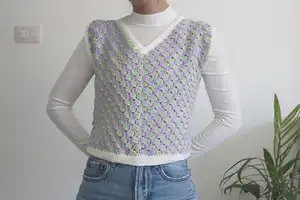
Make a stylish corner-to-corner (C2C) V-neck vest using DK weight yarn and simple color changes. This pattern uses C2C blocks to build two front panels and a single back, with clear row-by-row instructions and charts for multiple sizes. You'll love the chequered texture and the easy finishing options for ribbing and neckline detailing. Perfect for customizing colors and fits to create a wearable, handmade staple.
Progress Tracker
0% Complete
— Materials :
Info :
Yarn: About 1000y (900m) of a DK weight (3) yarn like Paintbox Yarns Simply DK (15% more for each size over S/M). Divide the yardage in half for each color if using two colors. If using 1 color for the back, you'll need 3/4ths of the yardage in one color and 1/4th in the other. A small amount of a 3rd color for ribbing/edging is optional.
— Gauge and Sizing :
Info :
C2c gauge: A square sample of c2c, 9x9 clusters will be 5in (13cm) wide/tall
Info :
Sizing: Finished bust measurement: S/M - 36in (91cm). L/XL - 42in (105cm). 2XL/3XL - 56in (142cm). When pattern differs for different sizes, instructions are written for smallest with larger in parenthesis.
— Overview :
Info :
This pattern is made using the corner to corner stitch (c2c) to diagonally make a series of 3 double crochet clusters or "blocks." The c2c stitch does not lend itself well to written instructions so there is a video tutorial which will demonstrate both the c2c stitch and how to change color every row. The pattern is made in three pieces: two front pieces which are seamed along the middle, and a large back piece seamed along the sides and shoulders. You may work ribbing along the raw edges of your work after seaming.
— How to Read C2C Graphs :
Infos :
Sample chart instructions: Row 1: Up - 1W. Row 2: Down - 2W. Row 3: 1W, 1P, 1W. Row 4: 1W, 2P, 1W. Row 5: 1W, 1P, 1G, 1P, 1W. Row 6: 1W, 1P, 2G, 1P, 1W. Row 7: 2W, 1G, 1B, 1G, 2W. Row 8: 3W, 2B, 3W. C2c double crochet blocks are indicated by a number (# of blocks) and a color (W=white, P=purple and so on). In my c2c graphs, odd number rows will be "Up" rows and even numbered rows will be "Down" rows. "Up" instructions are reading the graph left to right, low to high. "Down" instructions are the reverse, reading the graph from right to left, high to low.
— Short hand instructions :
Info :
Front panel (make 2). Alternating colors each row, increase in c2c until you're piece has 16 (18, 20) blocks along one side. On the next row, decrease at the end of the row by slip stitching into the last ch3 space, ch1, and slip stitch back along the 3dcs of the block you just made (underarm corner).
Item Name (P1) :
For the S/M size only: Decrease at the end of the next row. Then, increase at the end of odd numbered rows and decrease at the end of even numbered rows until you have 11 blocks above the underarm corner. Then, decrease at the end of each row until 11 blocks remain in the row. Fasten off.
Item Name (P1) :
For the L/XL size only: Then, work 18 blocks. Decrease at the beginning of row 21 and increase at the end of row 21. Then, continue, increasing at the end of odd numbered rows and decreasing at the end of even numbered rows until you have 13 blocks above the underarm corner. Then, decrease at the end of each row until 11 blocks remain in the row. Fasten off.
Item Name (P1) :
For the 2X/3X size only: Then, continue increasing at the end of each row until the long side of your work has 27 blocks. Then, increase at the end of odd numbered rows and decrease at the end of even numbered rows until you have 15 blocks above the underarm corner. Then, decrease at the end of each row until 12 blocks remain in the row. Fasten off.
Info :
Repeat the front panel instructions for the 2nd panel, starting with the opposite color from the first panel. Then, complete the back panel in one piece with double the number of blocks along the bottom edge and the same number of sleeve/side seam blocks along the vertical edge.
— S/M Front Panel :
Info :
S/M Front Panel chart provided (ignore white squares). Use the chart for visual block placement and row counts; follow written row-by-row instructions below for exact block counts per row.
— L/XL Front Panel :
Info :
L/XL Front Panel chart provided (ignore white squares). Use the chart for visual block placement and row counts; follow written row-by-row instructions below for exact block counts per row.
— 2X/3X Front Panel :
Info :
2X/3X Front Panel chart provided (ignore white squares). Use the chart for visual block placement and row counts; follow written row-by-row instructions below for exact block counts per row.
— Row by row instructions :
Row 1 :
(Up) 1 block in color A
Row 2 :
(Down) 2 blocks in color B
Row 3 :
3 blocks in color A
Row 4 :
4 blocks in color B
Row 5 :
5 blocks in color A
Row 6 :
6 blocks in color B
Row 7 :
7 blocks in color A
Row 8 :
8 blocks in color B
Row 9 :
9 blocks in color A
Row 10 :
10 blocks in color B
Row 11 :
11 blocks in color A
Row 12 :
12 blocks in color B
Row 13 :
13 blocks in color A
Row 14 :
14 blocks in color B
Row 15 :
15 blocks in color A
Row 16 :
16 blocks in color B
Row 17 :
16 (17, 17) blocks in color A *first decrease at end of row for S/M
Row 18 :
15 (18, 18) blocks in color B
Row 19 :
15 (18, 19) blocks in color A *first decrease at end of row for L/XL
Row 20 :
15 (18, 20) blocks in color B
Row 21 :
15 (18, 20) blocks in color A *first decrease at end of row for 2/3X
Row 22 :
15 (18, 20) blocks in color B
Row 23 :
15 (18, 21) blocks in color A
Row 24 :
15 (18, 22) blocks in color B
Row 25 :
15 (18, 23) blocks in color A
Row 26 :
15 (18, 24) blocks in color B
Row 27 :
15 (18, 25) blocks in color A
Row 28 :
15 (18, 25) blocks in color B
Row 29 :
15 (18, 25) blocks in color A
Row 30 :
14 (18, 25) blocks in color B
Row 31 :
13 (18, 25) blocks in color A
Row 32 :
12 (18, 25) blocks in color B
Row 33 :
11 (18, 25) blocks in color A
Row 34 :
(Large-3XL only) (17, 25) blocks in color B
Row 35 :
(16, 25) blocks in color A
Row 36 :
(15, 25) blocks in color B
Row 37 :
(14, 25) blocks in color A
Row 38 :
(13, 24) blocks in color B
Row 39 :
(12, 23) blocks in color A
Row 40 :
(11, 23) blocks in color B
Row 41 :
(2X/3X only) 21 blocks in color A
Row 42 :
20 blocks in color B
Row 43 :
19 blocks in color A
Row 44 :
18 blocks in color B
Row 45 :
17 blocks in color A
Row 46 :
16 blocks in color B
Row 47 :
15 blocks in color A
Row 48 :
14 blocks in color B
Row 49 :
13 blocks in color A
Row 50 :
12 blocks in color B
— Back Panels :
Info :
S/M Back Panel: Double the number of horizontal blocks from the front panel. Underarm seam and arm hole block count remains the same. Continue decreasing to the other side (no v-neck). Rotate the chart to landscape to read.
Info :
L/XL Back Panel: Double the number of horizontal blocks from the front panel. Underarm seam and arm hole block count remains the same. Continue decreasing to the other side (no v-neck).
Info :
2X/3X Back Panel: Double the number of horizontal blocks from the front panel. Underarm seam and arm hole block count remains the same. Continue decreasing to the other side (no v-neck).
— Seaming :
Info :
Seam the two front panels together up the middle, leaving the final rows unseamed for the V-neck opening. Seam back panel to front panels up the sides and along the shoulders.
— Finishing off the raw edges :
Info :
Attach a new yarn at one shoulder. Heading towards the center point of the V neck, work 1dc, 1hdc, 1sc along the first block. Sl st into the next ch3 space. Again work 1dc, 1hdc, 1sc, and sl st into next ch3 sp to level off the scalloped edge of the V neck. Continue, 1dc, 1hdc, 1sc, 1 sl st into the ch3 space along the raw edge.
Info :
When you reach the center two blocks and begin working up the opposite side, work 1sc, 1hdc, 1dc and slip stitch. *1sc, 1hdc, 1dc, sl st* to even out the c2c edge on the other side.
— Adding Ribbing :
Info :
Add ribbing of your choice along the bottom edge, sleeve openings and neckline. While adding stitches along the c2c edges, alternate 3sts and 2sts along the edge of each c2c block. On the bottom edge, work 2sts for each block for a more sinched in look.
Info :
I worked "camel stitch" by working half double crochet into the "back bar" of the stitch in the round.
— Extra Photos And Video Tutorial :
Info :
Click the thumbnail in the PDF for a video tutorial demonstrating the C2C technique and color changes and additional photos of the finished vest for reference.
— Thank You :
Info :
I hope you enjoyed it as much as I enjoyed making it for you all. Before you ask, yes, you can sell any items you craft using this pattern! I also encourage you to contact me anytime with questions. Happy Stitching! - Michelle
This Corner To Corner Vest is designed to be customizable, comfortable, and stylish — perfect for everyday wear or gifting. 🧶 Choose your favorite DK yarn colors to create a unique checked look and add a contrasting rib for a polished finish. Happy crocheting and enjoy making something cozy and handmade! ✨