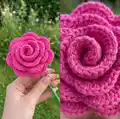
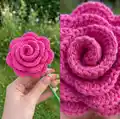
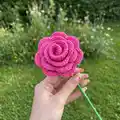
🧶 Beautiful ✨ Detailed 💝 Adorable

Crochet Flower Bouquet Pattern

Crochet Flower Bouquet Pattern
4.2★ Rating
12-15 Hours Time Needed
4.0K Made This
✂️

Intermediate Level

Ideal for those with basic crochet experience, featuring slightly more advanced stitches and techniques to expand your skills.

⏱️

Multi-Day Project

A rewarding 12+ hour journey—perfect for dedicated crafters who love detailed work.

🏡

Cozy Accent

A warm touch for your space that transforms ordinary corners into inviting nooks filled with handmade charm.

About This Crochet Flower Bouquet Pattern

This pattern creates a beautiful bouquet of 25 crochet flowers including roses, daisies, blue flowers, buds and carnations. It uses cotton thread and a 2 mm hook to create delicate, realistic floral elements. Step-by-step photos explain each element—leaves, sepals, petals and the stem-wrapping technique—for a polished finish. The pattern is versatile so you can change yarn thickness and colors to customize your bouquet.

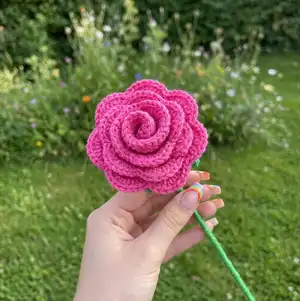
Crochet Flower Bouquet Pattern crochet pattern - detailed view of completed project

The pattern features clear photo tutorials and chart diagrams for leaves, sepals and petals for visual guidance. Detailed assembly photos show how to glue and wind the petals and attach leaves for a stable, professional-looking stem.

Why You'll Love This Crochet Flower Bouquet Pattern

I absolutely love this pattern because it transforms simple cotton yarn into a lifelike bouquet full of texture and charm. I enjoy the combination of crochet stitches that create petals with beautiful volume and movement. The stem-wrapping technique gives each flower a finished, florist-quality look which I find endlessly satisfying. I also love how customizable it is—changing yarn thickness or colors yields a completely different result every time. Working through the detailed photo steps feels calming and rewarding, and I always end up making more than one bouquet!

Crochet Flower Bouquet Pattern step 1 - construction progress Crochet Flower Bouquet Pattern step 2 - assembly progress Crochet Flower Bouquet Pattern step 3 - details and accessories Crochet Flower Bouquet Pattern step 4 - final assembly and finishing

Switch Things Up

I love how versatile this bouquet is to customize; you can easily change yarn colors to create seasonal arrangements or themed bouquets.

For a larger, more dramatic bouquet use a thicker cotton or mercerized yarn and a larger hook; the petals will grow in size and the flowers will look lush.

To create miniature keychain flowers try a thinner thread or single strands with a 1.5 mm hook and shorten the stem for portability.

I often add embroidered veins or a tiny bead to the center for extra detail—try sewing a small bead or button into the central part for sparkle.

Switch up the stem finish by wrapping florist tape over the yarn for a more professional florist-style look, or use green floral tape for a muted natural finish.

If you want posable stems, insert thin craft wire inside the floral wire before winding; this gives a bit more flexibility for arranging the bouquet.

Try mixing yarn textures—pair cotton petals with a fuzzy yarn bud for a modern mixed-media bouquet.

I like to make sets: five roses plus five small five-petal flowers tied together makes a lovely gift set, or create a matching corsage with one bloom and small leaves.

Experiment with petal edge finishes—use picot edges, small ruffles, or alternate stitch heights to create different petal shapes and silhouettes.

Finally, don't be afraid to change the number of petals or rows; adding one extra row of petals makes a fuller rose, while fewer rows creates a simple, dainty flower perfect for garlands.

Common Mistakes & How to Fix Them

✗ Not securing the yarn end to the wire before winding can make the stem unravel; apply glue to the wire tip and press the yarn firmly before winding to secure it. ✗ Skipping stitch counts on leaves and petals can cause uneven shapes and mismatched parts; count stitches carefully at the end of each row and use markers if needed. ✗ Pulling yarn too tight when wrapping the stem creates visible lumps and uneven coverage; maintain even tension and wind in small, consistent turns applying glue gradually. ✗ Forgetting to check the sepal or flower hole size against the stem can mean the piece won't fit; always test the magic ring hole on the stem and tighten or loosen the ring to adjust. ✗ Overstuffing or under-shaping petals when finishing the rose edges leads to odd shape; shape and curl petals as you go and iron cotton pieces lightly if needed to smooth them. ✗ Skipping the tip where you press stray yarn edges into each subsequent chain on leaves results in loose edges; press and secure the edge yarn to the middle part as shown to keep the leaf solid.

Crochet Flower Bouquet Pattern

Create a charming handmade bouquet of 25 crochet flowers to brighten any room or give as a heartfelt gift. This pattern walks you through roses, daisies, small five-petal flowers, buds and carnations with detailed photo-step instructions. You will learn stem wrapping, leaf and sepal construction, and how to assemble each flower on a wired stem for a professional finish. Perfect for gifting or home decor, the finished stems are approximately 25 cm (10 in) long.

Intermediate 12-15 Hours

Materials Needed for Crochet Flower Bouquet Pattern

— Main Fabric

  • 01
    Cotton yarn, Brand YarnArt 'Begonia' 169m/50g (recommended)
  • 02
    Color - green: for leaves, stems and sepals (use thin yarn in two folds for leaves if yarn is thin)
  • 03
    Color - bright pink: for roses (photo tutorial uses bright pink)
  • 04
    Color - white and yellow: for daisies (white petals with yellow center)
  • 05
    Color - two shades of blue: for blue flowers
  • 06
    Color - soft pink: for buds
  • 07
    Color - purple: for carnations (cloves)
  • 08
    Note: If using thinner yarn (eg No.10) flowers will be smaller; choose hook size according to yarn thickness

— Tools Required

  • 01
    Crochet hook size 2.0 mm
  • 02
    Scissors
  • 03
    Yarn needle for sewing and finishing
  • 04
    Floral wire 1.1 mm thick, 25 cm (10 inches) long for stems (0.8-0.9 mm can also be used)
  • 05
    Measuring tape
  • 06
    Pliers (to cut and shape wire)
  • 07
    Universal glue / silicone or hobby glue
  • 08
    Pins for assembly (optional)

Progress Tracker

0% Complete

— General Info :

Info :

The bouquet includes 25 flowers: 5 roses, 5 daisies, 5 blue flowers, 5 buds and 5 carnations

Info :

Colors used: for leaves, stems and sepals - green. For roses - bright pink. For daisies - white and yellow. For blue flowers - two shades of blue. For buds - soft pink. For cloves - purple.

Info :

Necessary materials: yarn (two colors are used for photo tutorial - yellow and green), hook, scissors, a needle, floral wire, measuring tape, pliers, glue

Info :

This bouquet is made of cotton yarn, brand YarnArt 'Begonia' 169m/50g. The hook used is 2 mm in size. Stems 10 inches (25 cm) tall. Flower sizes vary approx 1.7 inches (4.5 cm) to 2.3 inches (6 cm). Use yarn thickness to adjust flower size.

— Stem :

Item Name (P1) :

I will make each flower 25 cm (10 inches) long. The length of the stem is selected according to the size of the flowers that will be planted on the stem. If the flowers are small, a stem length of 25 cm (10 inches) is fine, my flower heads are between 6 cm (2.3 inches). If the volume of your flowers is larger, you can make the stem length 30 cm (12 inches). Using pliers, cut the required length of wire for the stem.

Info :

For the stem, use a flower wire 1.1 mm thick and 10 inch (25cm) long. Can also use flower wire 0.8 or 0.9 mm thick. Keep in mind the larger the volume of your flower, the thicker the flower wire you need.

Item Name (P2) :

apply glue to the edge of the wire and fasten the yarn firmly

Item Name (P3) :

gradually apply glue to the wire and wind the yarn

Item Name (P4) :

firmly fix the yarn on the edge of the wire, cut the yarn

Item Name (P5) :

gradually apply glue to the wire and wind the yarn to cover the stem until the desired length

— Leaf :

Row 1 :

CH 7

Row 2 :

CH 1, SC 1 in the first chain (I perform the second row in the back side of the chains, it's just more convenient for me, you perform as convenient for you)

Row 2 :

HDC 1 in the second chain

Row 2 :

DC 1 in the third chain

Row 2 :

DC 2 in the fourth chain

Row 2 :

TR 2 in the fifth chain

Row 2 :

DTR 3 in the sixth chain

Row 2 :

DTR 7 in the seventh chain

Info :

then we perform stitches in the same chains, according to the stitches that have already been made

Row 2 continued :

DTR 3 in the same chain where DTR 3 have already been made

Row 2 continued :

TR 2 in the same chain where TR 2 have already been made

Row 2 continued :

DC 2 in the same chain where DC 2 have already been made

Row 2 continued :

DC 1 in the same chain where DC 1 have already been made, HDC 1 in the next chain, SC 1 in last chain

Row 2 finish :

CH 1

Row 2 finish :

ST in the first SC of this row

Row 3 :

CH 1

Row 3 :

SC 1 in the same SC

Row 3 :

SC 1 in HDC

Row 3 continued :

SC 1 in the first DC of three, SC 1 in the second DC, SC 1 in the third DC, SC 1 in the first TR of two, SC 1 in the second TR

Row 3 continued :

SC 2 in the first DTR of thirteen

Row 3 continued :

SC 3 in the sixth DTR

Row 3 continued :

SC 1 in the seventh DTR

Row 3 continued :

CH 2

Row 3 continued :

SC 1 in the seventh DTR

Row 3 continued :

SC 3 in the eight DTR

Row 3 continued :

SC 2 in the ninth DTR

Row 3 continued :

SC 2 in the tenth DTR, SC 2 the eleventh DTR, SC 2 in the twelfth DTR, SC 2 in the thirteenth DTR

Row 3 continued :

SC 1 in the first TR of two, SC 1 in the second TR, SC 1 in the first DC of two, SC 1 in the second DC, and repeat, SC 1 in the next each stitches

Row 3 finish :

CH 2

Row 3 finish :

ST in the first SC of this row

Finish :

done

Info :

fasten and trim the ends of the yarn (the same leaves are made for each type of flower)

Info :

If cotton yarn is used, the leaf can be easily ironed

— Sepal :

Row 1 :

magic ring

Row 1 :

CH 1, SC 14 in the magic ring

Row 1 :

tighten the magic ring, ST in the first SC

Row 2 :

CH 3 from the first SC

Row 2 :

DC 1 in the first SC

Row 2 :

DC 2 in the second SC, repeat DC 2 in each SC around

Row 2 :

ST in the third chain

Row 3 :

CH 4

Row 3 :

TR 3-cluster in the next DC 3 (make 6 leaves by repeating same leaves)

Row 3 continued :

CH 4, ST in the next DC, repeat to make 5 more of the same leaves

Finish :

ST in the beginning of this row, done

Info :

fasten and trim the ends of the yarn

Info :

check whether the size of the hole of the sepal is suitable for the thickness of the stem, if not, then the magic ring can be slightly expanded or, on the contrary, tightened

Info :

if cotton yarn is used, the sepal can be easily ironed

— Rose :

Row 1 :

CH 41

Row 2 :

CH 2, HDC 1 in the second chain

Row 2 :

HDC 1 in the third chain, HDC 1 in the fourth chain, continue HDC 1 in each chain

Row 3 :

repeat until the end of the row, HDC 1 in each chain

Row 3 :

CH 2 from the first HDC

Row 4 :

since the second row began with CH 2, so the last (forty-fifth) HDC of the third row should be performed in the second chain of the beginning of the second row

Row 4 :

repeat until the end of the row, HDC 1 in each HDC

Row 4 continued :

DC 1 in the first HDC, CH 3, DC 1 in the first HDC

Row 4 continued :

CH 1, skip the second HDC 1, DC 1 in the third HDC

Row 4 continue :

DC 1 in the third HDC, CH 1, skip the fourth HDC, DC 1 in the fifth HDC, CH 3, DC 1 in the fifth HDC (creating arches for petals)

Row 5 :

CH 1

Row 5 :

SC 1 in the first DC

Row 5 :

DC 9 under the first arch of CH 3 (I call a chain of three chains an arch)

Row 5 :

SC 1 in the next chain

Row 5 :

DC 9 under the second arch of CH 3

Row 5 finish :

SC 1 in the next chain, repeat until the end of the row, turn out a twisted ribbon

Finish :

done. Fasten and trim the ends of the yarn

Info :

The same ribbon-type petals are used to wind the rose onto the stem

— Assembling the Rose onto Stem :

Item Name (P1) :

All parts + glue: prepare the rose ribbon, sepals and a leaf

Item Name (P2) :

determine the edge of the wire on which the yarn began to be wound (usually this edge looks worse than the edge where the thread ended), it is on this edge that I recommend winding the rose

Item Name (P3) :

apply glue to the first petal and on the areas shown here, start winding the ribbon on the stem, with the first petal, close the stem well so that it is not visible

Item Name (P4) :

then gradually wind the ribbon on the stem, apply glue and wind further

Item Name (P5) :

with the side where the edges of the yarn are fast, put the sepal on the stem, apply glue and stick to the flower

Item Name (P6) :

apply glue to the narrow edge of the leaf and glue to the stem

Finish :

done. make roses in the colors you like; for the sample bouquet 5 pink roses were made

— Flower (five-petal small flower) :

Row 1 :

magic ring

Row 1 :

CH 1, SC 10 in the magic ring

Row 1 :

tighten the magic ring, ST in the first SC of this row

Row 2 (the first layer of the flower) :

CH 3 from the first SC

Row 2 :

TR 2 in the second SC

Row 2 :

CH 2, TR 2 in the second SC, CH 2

Row 2 continued :

TR 2 in the next SC forming small petal arches, CH 2, repeat until you have 5 small arches (five petals)

Row 3 :

CH 1, pull yarn through first SC to other side, make second layer of petals: CH 4, TR and clusters as shown to form the second layer of petals

Row 3 continued :

Make 3 more petals in the same way, ST in the beginning of this row, done

Info :

Fasten and trim the edges of the yarn. Check whether the size of the hole of the flower is suitable for the thickness of the stem and adjust magic ring if needed.

— The central part of the flower :

Row 1 :

magic ring

Row 1 :

CH 1, SC 6 in the magic ring

Row 1 :

tighten the magic ring, ST in first SC of this row

Row 2 :

CH 1, SC 2 in the first SC, repeat SC 2 in each SC around (SC 12)

Finish :

repeat and finish, center is used as flower core and glued to middle of petals

— The central part for small flower (green center) :

Row 1 :

CH 1, SC 6 in the magic ring (SC6)

Row 2 :

tighten the magic ring, CH 1, SC 2 in the first SC, repeat SC 2 in each SC (SC12)

Finish :

fasten and trim, sew or glue to center of upper petals

— Assembly Instructions Overview :

Info :

Glue the small flower center to the petals, then check hole for stem and attach sepal and leaves as required.

Assembly Instructions

  • Wind the yarn ribbon rose onto the prepared floral wire stem by applying glue to the edge of the wire, then press the yarn edge and start winding the rose ribbon so the stem is hidden and petals are secure.
  • Attach the sepal below each flower by applying glue to the sepal hole edge, slide onto the stem and press the sepal against the flower head until secure.
  • Glue narrow edge of the leaf to the stem; position leaves below the flower head and press firmly so the leaf edge sits flat against the stem.
  • Trim loose yarn ends and fasten all edges after gluing; if using cotton yarn you may lightly iron leaves and sepals to smooth them before final assembly.
  • Make multiple flowers of each type (five of each in the sample bouquet) and stagger them when arranging into a bouquet for variety and fullness.

Important Notes

  • 💡Use a 2.0 mm hook with the recommended YarnArt Begonia cotton thread for the same proportions; if you change yarn, adjust the hook accordingly.
  • 💡Apply glue gradually when winding stems so the yarn adheres cleanly without lumps; pressing the yarn edge into each subsequent chain on leaves will secure loose fibers.
  • 💡Check the size of the magic ring hole against your stem before finishing; tighten or expand the ring as needed for a snug fit.

This crochet bouquet pattern helps you create a long-lasting, handmade floral arrangement perfect for gifts or home decor.🧶 The detailed photo steps make complex shapes like roses, leaves and sepals approachable and satisfying to make.✨ Enjoy customizing colors and sizes to create your perfect bouquet—happy crocheting!🌸
You ask,

we answer.

FAQs

What size will the finished piece be?

Each finished stem measures approximately 25 cm (10 inches) long using the recommended wire and yarn; flower diameters range from about 4.5 cm to 6 cm depending on yarn thickness.

Can I use different yarn weights for this pattern?

Yes, you can use different yarn weights, but this will affect the final size; if you use thinner yarn (e.g., No.10), consider using two strands together for leaves or making more flowers for a fuller bouquet.

Do I need prior crochet experience for this pattern?

This pattern is rated intermediate and uses stitches like double treble and clusters, so basic crochet experience and familiarity with stitch abbreviations is recommended.

How long does this project typically take to complete?

Most crafters will take 12-15 hours to complete the full bouquet of 25 flowers; time varies greatly with experience, yarn thickness and how many flowers you make.