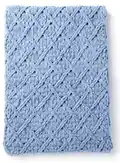
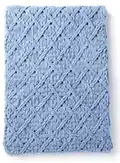
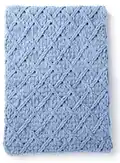
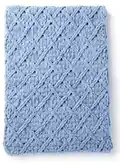
About This EZ Diamond Lattice Blanket Pattern
This pattern creates a plush diamond lattice blanket worked with Bernat Alize Blanket-EZ for a dense, cozy texture. The design uses a loop-and-cross technique to form raised lattice diamonds across the blanket surface. It is an advanced project that focuses on stitch control and consistent tension to achieve even, sculpted diamonds.
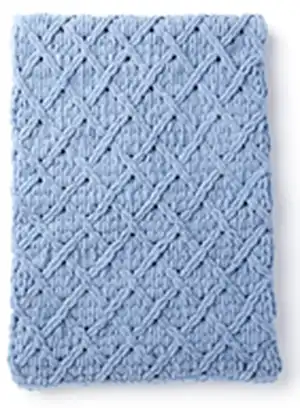
The finished blanket measures approximately 56" x 60" and uses 7 balls of Blanket-EZ yarn in the sample color. A video tutorial is available to help you master the loop technique used throughout the pattern.
Why You'll Love This EZ Diamond Lattice Blanket Pattern
I absolutely love this pattern because the diamond lattice texture transforms bulky yarn into an elegant, sculpted surface that feels luxurious to the touch. I enjoy how the loop technique creates depth without complicated stitch counts — it feels meditative once you get into the rhythm. The finished blanket is wonderfully warm and heavy, perfect for cozying up on the sofa. I also love that the pattern is versatile and can be adjusted in size or color to suit your home or gift needs.
Switch Things Up
I love customizing this blanket by changing yarn colors to create subtle or bold lattice effects.
I sometimes work the pattern using two contrasting colors, alternating every few repeats to make striped diamonds.
To make a larger blanket I add more foundation loops in multiples that keep the pattern repeats aligned across the width.
If you want a smaller throw, reduce the number of foundation loops and shorten the length by stopping when the blanket reaches your desired size.
I also experiment with different yarn textures and weights; a slightly fuzzier yarn softens the lattice edges, while a smooth yarn emphasizes definition.
Try adding a simple crochet border in single crochet or a decorative scallop to frame the lattice and give a finished look.
I sometimes substitute a complementary color for the foundation loops to create a subtle contrast along the edges of the blanket.
For gifts, I change the yarn color to match the recipient's decor and add a sewn ribbon or tag for presentation.
Consider making matching pillow covers using a smaller number of foundation loops and the same row repeats to create a coordinated set.
I always recommend practicing the loop-and-cross technique on a small swatch to find the perfect loop tension before starting the full blanket.
Common Mistakes & How to Fix Them
✗ Not counting 68 loops accurately for the foundation row can throw off the entire pattern; recount and adjust the foundation loops before starting the first row.
✗ Turning the work when instructed not to can reverse the lattice direction and ruin the texture; follow the 'Do not turn' notes exactly for the rows specified.
✗ Pulling loops inconsistently creates uneven diamonds and tension; practice pulling loops with the same height and tension across several stitches before proceeding.
✗ Skipping the instruction to keep the working yarn behind stitches will change the look of the crossings; keep the working yarn held behind stitches throughout as directed.
✗ Not finishing the bind off correctly can allow the edge to unravel; follow the bind off row step sequence, cut the thread at the base of the loop and tie securely before weaving in the tail.