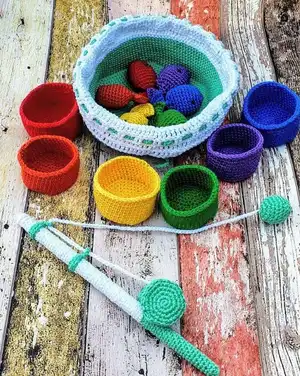
Create a playful crochet fishing set with colorful fish, stacking bowls, a storage basket, and a working rod with reel. This pattern guides you step-by-step through each piece so you can make a complete toy set for kids or as a cheerful gift. The pattern uses simple amigurumi techniques with clear shaping and assembly instructions to help you finish a polished set.
Progress Tracker
0% Complete
— Fish :
Info :
Make 6 identical fish — one for each color of the rainbow.
R1 :
MR + 6sc => 6 - work over the leftover yarn
R2 :
inc X 6 => 12 - pull the leftover yarn firmly (without breaking it) to close the MR
R3 :
(1 sc + 1 inc) X 6 => 18
R5 :
(2 sc + 1 inc) X 6 => 24
R6 - R7 - R8 - R9 - R10 - R11 :
sc X 24 => 24
Info :
Now you can add the safety eyes and the magnet: Place the eyes between rows 5 and 6, in the 3rd and the 6th increases; Establish a front side for the magnet and always place the magnet with that side on the exterior; The magnet goes inside the fish all the way to the mouth of the fish. To test that the magnet is in the correct position always keep a magnet close to you and check if it connects to all your fish on the same side; if your magnets are not strong enough placing two magnets inside the fish might help; Stuff your fish (don't overdo it - it will make it heavy and the magnets from the fishing rod won't help to lift it up); form the fish with your hands by pressing the thumb and the index against the eyes of the fish; continue crocheting the fish.
Now we will start decreasing :
Try to work as tight as possible to avoid having wholes in your fish.
R12 :
(2 sc + 1 dec) X 6 => 18
R13 :
(1 sc + 1 dec) X 6 => 12
Info :
Add fiberfill to the fish until you are satisfied with the stuffing; Keep forming the fish by pressing the fingers on its eyes.
R17 :
(1 sc + 1 inc) X 6 => 18
R18 :
(2 sc + 1 inc) X 6 => 24
R19 :
fold the two parts of the tail together and crochet 12sc (insert the hook in every 2 stitches which are in front of each other; Cut the yarn and hide it with the hook or with a needle;)
— Bowls :
Info :
I made six bowls, one for each fish. The bowls are split in two sizes - so that we can group the fish two by two: a. Bigger bowls: we need to make 3 bigger bowls with the colors: red, yellow, blue. b. Smaller bowls: we need to make 3 smaller bowls with the colors: orange, green, purple.
— Smaller Bowl (A) :
Make 3 smaller bowls.
R1 :
MR + 6sc => 6 - work over the leftover yarn
R2 :
inc X 6 => 12 - pull the leftover yarn firmly (without breaking it) to close the MR
R3 :
(1 sc + 1 inc) X 6 => 18
R4 :
(2 sc + 1 inc) X 6 => 24
R5 :
(3 sc + 1 inc) X 6 => 30
R6 :
(4 sc + 1 inc) X 6 => 36
R7 :
(5 sc + 1 inc) X 6 => 42
R9 - R10 - R11 - R12 - R13 - R14 - R15 :
sc X 42 => 42
Close Info :
Close by doing a slip stitch in the first slip stitch of row 16. Hide the thread and the bowl is finished.
— Bigger Bowl (B) :
Make 3 bigger bowls.
R1 :
MR + 6sc => 6 - work over the leftover yarn
R2 :
inc X 6 => 12 - pull the leftover yarn firmly (without breaking it) to close the MR
R3 :
(1 sc + 1 inc) X 6 => 18
R4 :
(2 sc + 1 inc) X 6 => 24
R5 :
(3 sc + 1 inc) X 6 => 30
R6 :
(4 sc + 1 inc) X 6 => 36
R7 :
(5 sc + 1 inc) X 6 => 42
R8 :
(6 sc + 1 inc) X 6 => 48
R10 - R11 - R12 - R13 - R14 - R15 - R16 :
sc X 48 => 48
Close Info :
Close by doing a slip stitch in the first slip stitch of row 17. Hide the thread and the bowl is finished.
— Storage Basket :
Info :
I used the same yarn color for this basket and the fishing rod to make sure they are a set; go ahead and use which color you like;
R1 :
MR + 6sc => 6 - work over the leftover yarn
R2 :
inc X 6 => 12 - pull the leftover yarn firmly (without breaking it) to close the MR
R3 :
(1 sc + 1 inc) X 6 => 18
R4 :
(2 sc + 1 inc) X 6 => 24
R5 :
(3 sc + 1 inc) X 6 => 30
R6 :
(4 sc + 1 inc) X 6 => 36
R7 :
(5 sc + 1 inc) X 6 => 42
R8 :
(6 sc + 1 inc) X 6 => 48
R9 :
(7 sc + 1 inc) X 6 => 54
R10 :
(8 sc + 1 inc) X 6 => 60
R11 :
(9 sc + 1 inc) X 6 => 66
R12 :
(10 sc + 1 inc) X 6 => 72
R13 :
(11 sc + 1 inc) X 6 => 78
R14 :
(12 sc + 1 inc) X 6 => 84
R15 :
(13 sc + 1 inc) X 6 => 90
R16 :
(14 sc + 1 inc) X 6 => 96
R17 :
(15 sc + 1 inc) X 6 => 102
R18 :
(16 sc + 1 inc) X 6 => 108
R19 :
(17 sc + 1 inc) X 6 => 114
R20 :
(18 sc + 1 inc) X 6 => 120
R22 - R23 - R24 - R25 - R26 - R27 - R28 - R29 - R30 - R31 :
sc X 120 => 120
Change yarn to white :
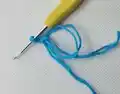
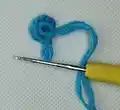
To change the color, leave the last single crochet unfinished just like in picture 1 bellow, then take the white yarn and pull it through to finish the sc like in picture 2. Cut the green yarn but leave a 5 cm tail. In the next row work over both the green and the white leftover yarn.
Now you will need to switch to treble crochet (double treble for UK) :
Switching instructions for decorative rows.
R33 :
chain 3 + tr X 120 + sc in chain 3 in the beginning of the row: 120
R34 - R35 - R36 - R37 :
chain 3, tr X 120, sc in chain 3 from the beginning of the row => 120
Change yarn to green :
Change back to green for finishing rounds.
R38 :
chain 3, tr X 120, sc in chain 3 from the beginning of the row => 120
Info :
Close by doing a slip stitch in the first slip stitch of row 39. Hide the thread. To close the basket, we need to make it a string. To do that just chain 200 with the main color (in my case green), then cut the yarn even at ends. Insert the string in row 35 - go over 2 trebles, then under 2 trebles until you finish the row. To make this part easier you can use a needle.
— Rod :
Info :
You need to make the rod around the stick. The stick used is 25 mm / 1 inch diameter, so the author made 6 sc to work the way up. For the length the author needed 90 rows to get to the top (27 cm / 10.6 inch), making 30 rows in green (one third) and 60 in white (two thirds).
A. The Rod - Start with green :
As you work your way up test the stick every 10 rows. A common mistake when working with 6sc rows is to accidentally crochet some of the yarn of the opposite row, making it impossible for the stick to be inserted in the sleeve.
R1 :
MR + 6sc => 6 - work over the leftover yarn
R2 - R3 - R4... - R30 :
sc X 6 = 6
Switch to white :
Continue the rod covering until you reach desired length switch colors as noted.
R32 - R33 - R34... - R90 :
sc X 6 = 6
Info :
Make a slip stitch in the first stitch of row 90, cut the yarn leaving a tail for sewing. Take a needle and go through each front loop of the 6 sc from down to up (insert the needle with the wrong side to make sure you take only the front loop). Pull firmly and then hide the yarn inside.
B. The Guides :
Make 2 guides; chain 12 so that the guides fit over the rod; you might need to chain more if your rod is larger.
R1 :
chain X 12; slip stitch in the first stitch; stop and test that you can place it over your rod. Continue in circle, working over the yarn left from the MR
R2 :
sc X 12; make a slip stitch in the first sc and then make one more in the middle going through sc 1 and 12; from there chain X 8 and slip stitch the last chain to the first one. Cut the yarn long enough for you to sew the guide over the rod (sew the guides to the rod at rows 65 and 85)
C. The Reel :
The reel has sides and a middle part. You will make 4 side circles (sew 2 by 2) and one middle tubular part.
i. The sides :
Make 4 (you will need to sew them 2 by 2)
R1 :
MR + 6sc => 6 - work over the leftover yarn
R2 :
inc X 6 => 12 - pull the leftover yarn firmly (without breaking it) to close the MR
R3 :
(1 sc + 1 inc) X 6 => 18
R4 :
(2 sc + 1 inc) X 6 => 24
R5 :
(3 sc + 1 inc) X 6 => 30
Close Info :
Close by doing a slip stitch in the first sc of row 5. Leave at least 2 long threads for sewing. Place the sides 2 by 2. Make sure you have the front parts on the exterior and the end of the rows joined together. Sew each pair together.
ii. The middle part :
Make the middle tubular part to join the sides.
R1 :
chain X 18 => 18; continue working in circle
R2 - R3 - R4 :
sc X 18 => 18
Info :
Now we need to attach the side parts. Start sewing the first side. It should fit perfectly in between rows 3 and 4 of the side part (just sew the interior part of the side so the sewing is not visible on the exterior part). Cut the yarn. Stuff the middle part and proceed in the same way with the second side. The reel should be ready. You can now sew the reel to the rod just where you change the colors (row 30).
D. The String :
Chain X 60 (this is twice my rod length). Sew the string to the reel, on the middle part down, just where the reel meets the rod so it's less visible. Pass the string over the reel once from down up and sew again at the joining point to secure. Insert the string in each of the guides.
E. The Hook :
Make the hook piece that holds the magnet and matches to the string of the rod.
Info :
Insert the string in the middle of the magic ring and make a node connecting the two. In this way we don't need to worry about sewing them together later.
R2 :
inc X 6 => 12 - pull the leftover yarn firmly (without breaking it) to close the MR
R3 :
(1 sc + 1 inc) X 6 => 18
R5 :
(2 sc + 1 inc) X 6 => 24
R7 :
(2 sc + 1 dec) X 6 => 18
Start stuffing :
Start stuffing the hook piece here.
R9 :
(2 sc + 1 dec) X 6 => 12; sl stitch in the first sc leaving a long tail to sew the magnets
Info :
Stuff firmly, but leave enough place for the magnet. The author places 3 magnets inside because their magnets were not strong; if your magnets are stronger one may be enough. Do not crochet over the magnets; when you place the magnet(s) test with a fish to ensure correct polarity; sew over the magnet a couple of times, cut the yarn and hide it.
— Final Assembly & Notes :
Info :
Sew guides to the rod at rows 65 and 85; sew the reel to the rod at row 30; insert string through guides and hook; position fish magnets and safety eyes; hide all tails and test the magnet connection with the fish before finishing. Supervise children while playing with magnets and small parts.
This colorful Fishing Set is a playful project that makes a thoughtful handmade gift for kids or as decor. The set includes six rainbow fish, stacking bowls, a roomy storage basket, and a functional rod with a reel for hours of fun. Make one set or customize each piece with your favorite colors and textures to create a unique toy. 🧶🎣