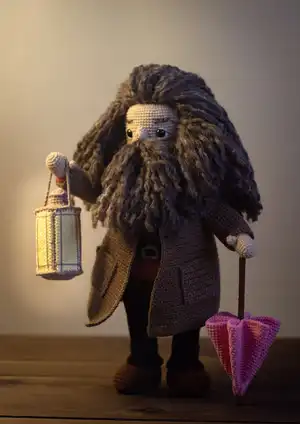
Make a charming Giant Forester amigurumi with this detailed crochet pattern. You will create a 36 cm (14 in) tall character complete with textured hair, beard, coat and accessories. The pattern includes step-by-step rounds, photos, and finishing tips so you can follow along with confidence. Perfect for crafters who love character dolls and textured hair techniques.
Progress Tracker
0% Complete
— Arms :
Info :
Make two identical pieces. The arms are crocheted separately and then joined as we crochet the body. Stuff the arms as you go and not very tight. Start crocheting with the yarn of skin color in a spiral, use a 2 mm crochet hook Clover (or 1.75 mm of any other brand).
Info :
Prepare a wireframe for arms. The length of each piece of wire should be about 22 cm. Bend one of the piece ends, forming a loop (about 1 cm). Wrap with masking tape or with adhesive tape (photos 1-2).
Item Name (Thumb) :
1 round: 6sc in MR (6)
Round 2-3 :
6sc (6) - 2 rounds
Info :
Cut the thread and fasten off.
— Arms (Main piece) :
Round 3 :
(inc, 1sc)*6 (18)
Round 4-8 :
18sc (18) - 5 rounds
Round 9 :
3sc along the thumb and the main piece at the same time, 15sc along the main piece (18)
Round 10 :
3sc along the rest stitches of the thumb, 15sc along the main piece (18)
Round 11 :
(4sc, dec)*3 (15)
Info :
Stuff slightly. Insert the wire and continue crocheting around it, stuff as you go.
Round 12-13 :
15sc (15) - 2 rounds
Info :
Change the thread color to terracotta. Cut the thread of skin color and fasten off.
Round 14 :
(4sc, inc)*3 (18)
Round 15 :
into back loops only 18sc (18)
Round 16-41 :
18sc (18) - 26 rounds
Info :
Fold the arm in half and work several additional sc needed to shift the thumb to the arm side (for the right and for the left arm). Cut the thread and fasten off.
Info :
Return to round 14, attach the thread of terracotta color to the front loop and crochet the cuffs. Hold the arm with the hand facing down. Make ch and crochet according to the instructions:
Round 1-5 (Cuffs) :
18sc (18) - 5 rounds
Info :
Work several additional sc to finish the work right above the thumb. Fold the cuffs down towards the hand. Cut the thread and fasten off. Weave in the thread tails inside of the piece.
— Legs :
Info :
Start crocheting the first leg with the yarn of tabacco color (it will be the left leg for the doll). Make ch13, from the second ch from the hook:
Round 1 :
inc, 10sc, 4sc into 1 stitch, 10sc, inc (into the first stitch, where we have already worked the first increase in the round) (28)
Round 2 :
2inc, 10sc, 4inc, 10sc, 2inc (36)
Round 3 :
(1sc, inc)*2, 10sc, (inc, 1sc)*2, (1sc, inc)*2, 10sc, (inc, 1sc)*2 (44)
Round 4 :
(2sc, inc)*2, 10sc, (inc, 2sc)*2, (2sc, inc)*2, 10sc, (inc, 2sc)*2 (52) - photo 8
Info :
Take a piece of cardboard or plastic sheet, place the sole on it and draw an outline around. Cut two pieces. We will use these two insoles to strengthen the legs. Cut about 2 mm from the piece edge, so that we are able to insert them into the feet (photo 9).
Round 5-6 :
into back loops only 52sc (52) - 2 rounds
Round 7-9 :
13sc, 26hdc, 13sc (52) - 3 rounds
Info :
Check for the marker location. It should be located exactly in the middle of the heel. In the next rounds we will make decreases to form the foot. If the marker isn't located at the necessary point, then the foot won't get the right shape. Insert the cardboard insole.
Round 10 :
13sc, (dc dec, 2hdc)*6, dc dec, 13sc (45)
Round 11 :
13sc, (1hdc, dc dec)*6, 1hdc, 13sc (39)
Round 12 :
13sc, 7dc dec, 12sc (32)
Info :
Advice: hold the tight tension when working hdc and dc stitches! Otherwise there will be holes formed between the stitches, and the fiberfill will be seen through them.
Round 13 :
(2sc, dec)*8 (24) - when crocheting the last stitch change the thread color to dark brown
Info :
Cut the thread of tabacco brown color and fasten off.
Round 14 :
into back loops only 24sc (24)
Info :
Prepare the frame for the legs. Take a copper wire and measure two pieces with the length of about 36 cm (the doll size). These pieces will be placed into the feet, will go across the whole length of the legs, across the body and the neck, and a part of them will be located inside of the doll's head. Bend one end on both pieces forming a loop (about 1 cm).
Info :
Wrap about 15 cm of each piece with a masking tape or with adhesive tape. This part will be located inside of the legs till the point where the wire pieces will be joined and twisted inside of the body. Now bend the wire end with the loop at the right angle (about 2 cm). Insert the wire into the foot and stuff it, continue crocheting and stuff as you go.
Round 15-18 :
24sc (24) - 4 rounds
Round 19 :
(5sc, inc)*4 (28)
Round 20-21 :
28sc (28) - 2 rounds
Info :
Cut the thread and fasten off. Now we are going to crochet the trouser leg. Take the thread of dark brown color and attach it to the front loop of round 13 exactly in the middle (photo 12). Hold the leg with the wire facing out from you. Make ch and crochet according to the pattern. The next round will be the first round of the trouser leg.
Round 1 (Trouser) :
(2sc, inc)*8 (32)
Round 2-3 :
32sc (32) - 2 rounds
Info :
After the third round make sl st into the next stitch. Make ch and turn the work. Crochet in the opposite direction, skipping ch:
Round 4 :
into front loops only 32sc, sl st into ch, make ch, turn the work (32)
Round 5 :
into back loops only 32sc (32)
Info :
There should be a fold of the trouser leg formed, like in the photo 13.
Round 6 :
(15sc, inc)*2 (34)
Round 8 :
(15sc, dec)*2 (32)
Round 9 :
(dec, 6sc)*4 (28)
Round 10-13 :
28sc (28) - 4 rounds
Round 14 :
crochet through the outer and inner layers of the leg at the same time, joining the pieces (photo 15): 28sc (28)
Round 15-27 :
28sc (28) - 13 rounds
Info :
Crochet several sc additionally to finish crocheting at the needed point on the inner side of the leg (at the point where the leg will be joined with the other one). I shifted this point closer to the heel, so that the toes are facing to the sides after joining.
Info :
Crochet the second leg according to the same pattern, but don't cut the thread. Place both legs near each other and compare their length. If the first leg is longer, then add one more round. If both legs have the same length, then start joining them.
— Body :
Info :
Now we are going to join the legs and crochet the body. Stuff firmly as you go. Make ch7 and insert the hook into the next stitch on the first leg. Crochet 14sc and place marker. The next round will be the first round of the body.
Round 1 :
14sc, 7sc along the chain, 28sc, 7sc along the chain, 14sc (70)
Round 2 :
14sc, inc, 5sc, inc, 28sc, inc, 5sc, inc, 14sc (74)
Round 3 :
5sc, inc, 8sc, inc, 7sc, inc, 8sc, inc, 10sc, inc, 8sc, inc, 7sc, inc, 8sc, inc, 5sc (82)
Round 4-8 :
82sc (82) - 5 rounds
Round 9 :
15sc, inc, 9sc, inc, 56sc (84)
Round 10-21 :
84sc (84) - 12 rounds - when crocheting the last stitch change the thread color to terracotta
Round 22-23 :
84sc (84) - 2 rounds
Round 24 :
into back loops only 84sc (84)
Round 25-28 :
84sc (84) - 4 rounds
Info :
Stuff the brown part of the body tight enough. Pay special attention to the lower part the body, to the sides and to the belly.
Info :
Check the marker location. It should be located exactly in the middle of the body side. In the next round we will form decreases to form the belly.
Round 29 :
7sc, dec, (11sc, dec)*2, 49sc (81)
Round 30-34 :
81sc (81) - 5 rounds
Round 35 :
(8sc, dec)*3, 51sc (78)
Round 36-46 :
78sc (78) - 11 rounds
Info :
Unravel or crochet a couple of stitches additionally so that the arms are located symmetrically at the body sides, according to the pattern: 7 stitches - for the first arm, 34 stitches - for the front side, 7 stitches - for the second arm, 30 stitches - for the back side. Place marker. Pay attention, that the thumb should be facing forward.
Round 47 :
7sc along the body and the inner side of the first arm, 34sc along the front side of the body, 7sc along the body and the inner side of the second arm, 30sc along the back side (78)
Round 48 :
11sc along the outer side of the first arm, 34sc along the front side of the body, 11sc along the outer side of the second arm, 30sc along the back side (86)
Round 49-50 :
86sc (86) - 2 rounds
Info :
Form the wire frame. Bend both wire ends towards each other and then twist them around the main frame.
Info :
Wrap the part of the wireframe with a masking tape or adhesive tape (the part which will be located inside of the neck).
Round 51 :
(10sc, dec, 9sc, dec)*2, 10sc, dec, 7sc, dec, 8sc, dec, 7sc, dec (78)
Round 52 :
(4sc, dec)*13 (65)
Round 54 :
4sc, dec, 21sc, dec, 8sc, dec, (9sc, dec)*2, 4sc (60)
Round 55 :
(2sc, dec, 2sc)*10 (50)
Round 57 :
(3sc, dec)*10 (40)
Round 59 :
(2sc, dec)*10 (30)
Round 61 :
(1sc, dec)*10 (20) - when crocheting the last stitch change the thread color to skin
Round 62 :
into back loops only 20sc (20)
Round 63 :
(dec, 8sc)*2 (18)
Round 64-66 :
18sc (18) - 3 rounds
Info :
Cut the thread and fasten off, leaving a tail for sewing.
Info :
Return to round 23 and attach the thread of terracotta color to the front loop exactly in the middle of the back side of the body. Make ch and crochet holding the body with the legs facing out from you.
Round 1 (Upper Body) :
84sc (84)
Round 2 :
20sc, inc, 41sc, inc, 21sc (86)
Round 3-8 :
86sc (86) - 6 rounds
Info :
Finish crocheting making sl st into the next stitch. Cut the thread and fasten off. Weave in the thread tail.
— Head :
Info :
Crochet with the yarn of skin color.
Round 3 :
(1sc, inc)*6 (18)
Round 4 :
(2sc, inc)*6 (24)
Round 5 :
(3sc, inc)*6 (30)
Round 6 :
(2sc, inc, 2sc)*6 (36)
Round 7 :
(5sc, inc)*6 (42)
Round 8 :
(3sc, inc, 3sc)*6 (48)
Round 9 :
(7sc, inc)*6 (54)
Round 10 :
(4sc, inc, 4sc)*6 (60)
Round 11 :
(9sc, inc)*6 (66)
Round 12 :
(5sc, inc, 5sc)*6 (72)
Round 13-28 :
72sc (72) - 16 rounds
Info :
Insert the safety eyes between rounds 20 and 21, the distance between these points where the eye stems are inserted is 14 stitches.
Round 29 :
(5sc, dec, 5sc)*6 (66)
Round 30 :
(9sc, dec)*6 (60)
Round 31 :
(4sc, dec, 4sc)*6 (54)
Round 32 :
(7sc, dec)*6 (48)
Round 33 :
(3sc, dec, 3sc)*6 (42)
Round 34 :
(5sc, dec)*6 (36)
Round 35 :
(2sc, dec, 2sc)*6 (30)
Round 36 :
(3sc, dec)*6 (24)
Round 37 :
(2sc, dec)*6 (18)
Info :
Cut the thread and fasten off, add fiberfill.
— Needle Sculpting :
Info :
For needle sculpting use the thread of the same color which was used for the body. Thread the needle and insert it into point 1 (at the lower part of the head under the chin). This point is located between the last and the second-to-last rounds on the head. Pull the thread out from point 2 (near the eye), leaving a thread tail to tie a knot later (photo 35).
Info :
Then insert the needle into point 3, leaving 3 rounds up from point 2, and run it inside of the piece to the point 4 (near the other eye). Pull the thread (photo 36). Now insert the needle into point 5 (leaving 3 rounds down) and pull the thread out from point 6 (point 6 is located leaving one stitch to the right from point 1).
Info :
Pull thread tails carefully, so that the eyes were slightly pushed into the head fabric.
Info :
After this tie the thread tails with 1-2 tigh knots. Thread the needle with tails and weave in them inside of the doll's head. Our needle sculpting is finished.
— Face Details :
Info (Eye whites) :
Take a piece of the white yarn and embroider three stitches around the outer side of each eye, like in photo 38. Fasten off the white thread and weave in inside of the head.
Info (Eyelids) :
Pull the thread of skin color close to the eye above it, make a diagonal stitch with the length of 4 stitches, insert the needle, skipping 1 stitch from the white stitch somewhere in the middle of the eye. The eyelid should cover the top edge of the eye slightly and touch the white stitches. Make one more stitch to make the eyelid wider. Embroider 2-3 horizontal stitches under the eye, like in photo 40, to form the lower eyelid.
Info (Eyelashes) :
Now take the black sewing thread or divide a piece of black yarn into separate threads. Embroider a thin line of eyelashes under the eyelid (photo 42).
Info (Eyebrows) :
Take the thread of YarnArt Denim Washed yarn of dark brown color or use the yarn you prepared for hair. At first embroider the thick part of the eyebrow, leaving 2 rounds up from the eyes and making three horizontal stitches with the length of 4 stitches. Then embroider two more stitches, like in photo 43. And make one more stitch from the wide part of the eyebrow to the corner, marked with the arrow in the photo. Photo 44 shows what we should have got.
— Nose :
Info :
Crochet with the yarn of skin color.
Info :
Crochet 2sc more additionally and place marker.
Round 3 :
inc, 1sc, 2hdc inc, 1sc, inc, 3sc (13)
Info :
Cut the thread and fasten off, leaving a tail for sewing.
Info :
Place a nose between the eyes in the way that the upper point (the first hdc inc) is located one round higher from the upper lid. Sew, adding some fiberfill. Weave in the thread tail inside of the piece.
— Ears :
Info :
Ears are not necessary to make, they are optional. They will be hidden after the hair attaching. Crochet in skin color.
Item Name (Right ear) :
Form a MR and crochet starting from it, make ch3, crochet into the magic ring: 2dc, 2hdc, 2sc, pull the ring closed, cut the thread, leaving a tail for sewing.
Item Name (Left ear) :
Form a MR and crochet mirrored: 2sc, 2hdc, 2dc, ch3, join with MR with sl st, pull the ring closed, cut the thread, leaving a tail for sewing.
Info :
Fix the ears on the head, leaving 7 stitches from the eyes. Sew. Weave in the thread tails inside of the head.
— Hair Attaching :
Info :
You can attach the hair at this stage or when all the clothes are ready and the head is sewn. For hair attachment you will need a strong thin thread, a needle (I use Iris yarn), and a thick yarn of dark melange color, you have prepared for hair.
Info :
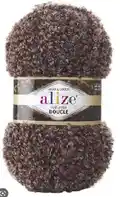
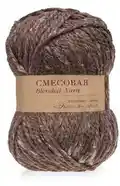
I use Pehorka Smesovaya yarn, dividing it into separate threads. You should divide this yarn very carefully, trying not to damage the fibres. Cut the yarn into pieces. The length should be equal to the hair length, multiplied by two (about 40 cm). I got each piece with the length of about 20 cm*2. You can make the pieces a bit longer, so that you can trim them after attachment.
Info :
Take a strong thread and attach it to the head top. Form a loop, inserting a needle again into the same point, where the thread goes from (photo 49). Skip 3 stitches and run the needle out, pull the thread. We have formed a loop (photo 50). Take one piece of yarn, insert it into the loop, like in the photo (photo 51), and pull the thread in the way that the thread is hidden between the stitches (photos 52-53).
Info :
Attach each hair strand, leaving 3 stitches from the previous one. Continue attaching in rounds. As I use the yarn which is thick enough, I leave the distance between the hair strands - 2 rounds on the top and 3 rounds on the head back (the hair on the head back is attached only if desired).
Info :
If you use a thinner yarn, then I recommend to leave 1-2 stitches between the hair strands on the top and to attach the hair to each round or to every second round. Just look how voluminous you want to get your hair. After finishing each round, divide the hair strands into separate threads (photo 54).
Info :
Attach the hair to 4 rounds on the head top. The width of the forehead from the eyebrows to the hairline should equal 7 rounds. Now continue attaching the hair around the face, leaving 2 stitches to the side from the eyebrows and the eyes (photo 55). You can mark the hairline with pins so you can be guided with them. Attach the hair for the beard, leaving 7 rounds down from the nose. I got 2 rounds with the hair strands on the head sides and 1 rounds along the chin.
Info :
After this attach several hair strands more under the nose forming a moustache. Spread the hair and look if you are satisfied with the volume. If you want you can continue attaching the hair on the head back, leaving a bigger distance than on the head top. I didn't do it, because my hairstyle is already too voluminous. Trim the hair and make a hairstyle. Now the head is fully finished, but we will sew it only when all the clothes are ready.
Thank you for choosing the Giant Forester pattern — a cozy, characterful doll full of personality and textured charm. This pattern combines precise shaping, needle sculpting and a creative hair attachment method to make a truly unique heirloom toy. Have fun stitching every detail and styling the beard to give your giant its own voice and personality. 🧶✂️😊