🧢 Beautiful ✨ Detailed πŸ’ Adorable

Patchwork Sweater Pattern

Patchwork Sweater Pattern
4.0β˜… Rating
12-15 Hours Time Needed
1.4K Made This
βœ‚οΈ

Intermediate Level

Ideal for those with basic crochet experience, featuring slightly more advanced stitches and techniques to expand your skills.

⏱️

Multi-Day Project

A rewarding 12+ hour journeyβ€”perfect for dedicated crafters who love detailed work.

πŸ§₯

Layered Comfort

Perfect for cozy, stylish layering through changing seasons with versatile, mix-and-match potential.

About This Patchwork Sweater Pattern

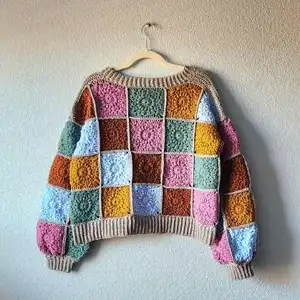
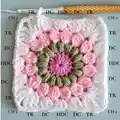
This pattern creates an oversized patchwork sweater built from Sunburst Granny Squares arranged into four panels. Youll make individual textured squares, join them into front, back and sleeve panels, then add contrasting ribbing for collar, cuffs, and hem. The design is slightly cropped and intentionally oversized for a relaxed fit.

Patchwork Sweater Pattern crochet pattern - detailed view of completed project

Includes full instructions for the Sunburst Granny Square motif, assembly layout, seaming technique, and ribbing. Customization notes and size adjustments are provided so you can adapt the sweater to your preferred fit.

Why You'll Love This Patchwork Sweater Pattern

I absolutely love this pattern because it celebrates color and texture in such a joyful way. I enjoy how modular the design is β€” making squares feels like small wins and lets me mix colors freely. The Sunburst Granny Square gives beautiful dimensional stitches that look handmade and artisanal. I also love that the assembly allows for easy customization of width, length, and sleeve sizing. Sewing the panels together and adding ribbed edges always makes the sweater feel finished and professional.

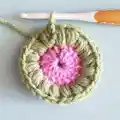
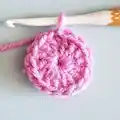
Patchwork Sweater Pattern step 1 - construction progress Patchwork Sweater Pattern step 2 - assembly progress Patchwork Sweater Pattern step 3 - details and accessories Patchwork Sweater Pattern step 4 - final assembly and finishing

Switch Things Up

I love playing with color order when I make this sweater β€” I often group three complementary colors together for a subtle gradient effect.

For a chunkier look I switch to a bulkier yarn and a larger hook, which gives me a cozy, oversized pullover in fewer squares.

To make a lightweight version, I choose a finer DK or light sport yarn and a smaller hook so the sweater drapes more fluidly.

I sometimes add a contrasting border around each square before assembly to make the gridwork pop and give a more graphic finish.

If you want a cropped look, reduce the number of square rows at the bottom or use a shorter ribbing height to keep the body higher on the waist.

Try different sleeve styles by changing the sleeve panel layout β€” make them wider for a balloon sleeve or narrower for a more fitted look.

I often personalize cuffs and collars by using 2-color ribbing or adding a button detail at the collar for interest.

Consider alternating textured squares (like bobble or cluster motifs) with smooth squares to create an interesting tactile contrast.

I sometimes sew in a lightweight lining for extra warmth and to prevent stretching if I use acrylic blends.

You can convert this into a cardigan by leaving a center opening and adding buttonbands worked in sc and ribbing instead of seaming the front center.

If you want a subtle change, switch only the collar and cuffs to a neutral color for a more understated patchwork look.

Another idea is to make matching accessories β€” a hat or mittens using the sunburst motif β€” to complete the set and make a coordinated handmade gift.

Common Mistakes & How to Fix Them

βœ— Skipping stitch counts when making squares leads to inconsistent square sizes; count each round and compare against the pattern stitch totals for every square. βœ— Using inconsistent hook sizes between squares will create mismatched dimensions; use the same hook and tension for all squares intended for the same size, and switch hooks only when instructed. βœ— Neglecting to block natural fiber squares can make assembly uneven and bumpy; block squares before joining when using natural fibers to flatten and even out stitch tension. βœ— Joining panels without pinning or aligning can result in crooked seams; lay panels flat, pin or clip them in place, and check rows and columns before seaming with single crochet. βœ— Pulling yarn too tightly when working ribbing can make openings too small; maintain relaxed tension and try the ribbing on the body before finishing to ensure proper fit.

Patchwork Sweater Pattern

Create a cozy oversized patchwork sweater made from sunburst granny squares. This pattern guides you through making individual squares, assembling four panels, and adding neat ribbing for a polished finish. Youll love the bright, textured motif and the customizable layout to fit your size. Perfect for makers who enjoy colorful, modular crochet projects.

Intermediate 12-15 Hours

Materials Needed for Patchwork Sweater Pattern

β€” Main Fabric

  • 01
    DK / Light Worsted Weight Acrylic Yarn (Weight 3 Medium), suggested: Hobbii Kind Feather Yarn (100% premium acrylic, 257 yd / 235 m per 100 g)
  • 02
    Approximate 1850 yd for the body (total for main colors)
  • 03
    Approximately 25 yd per square (estimate per Sunburst Granny Square)
  • 04
    Approximately 400 yd contrasting yarn for ribbing and trim
  • 05
    Contrast colors as desired for squares and ribbing (quantities above include estimates)

β€” Tools Required

  • 01
    Crochet hook 4.0 mm (for default squares, produces ~4-inch square)
  • 02
    Crochet hook 5.0 mm (for larger squares, produces ~5-inch square)
  • 03
    Crochet hook 3.5 mm (for ribbing with 4-inch square option)
  • 04
    Crochet hook 4.5 mm (for ribbing with 5-inch square option)
  • 05
    Yarn needle for weaving and seaming
  • 06
    Scissors
  • 07
    Measuring tape

Progress Tracker

0% Complete

β€” Gauge :

Info :

Each square rounds 1-4 with respective hooks measure: 4mm hook = 4 x 4" square. 5mm hook = 4.5 x 4.5" square.

β€” Sizes (Flatlay) :

Infos :

This pattern is written as one size with notes for alterations. Body: 20". Length: 22". Sleeves: 8". Bottom Ribbing: 4".

β€” Materials :

Info :

Yarn: DK/Light Worsted Weight Acrylic Yarn. Suggested: Hobbii Kind Feather Yarn, Weight 3 Medium (100% premium acrylic, 257yd/235m, 3.5oz/100g).

Info :

1850 yd (Body). 25 yd per square. 400 yd (Contrasting yarn & Ribbing).

Info :

Hook: varies based on size to be created. 4mm hook for default squares & 3.5mm hook for ribbing (4-inch square). 5mm hook for larger sizes & 4.5mm hook for ribbing (5-inch square).

Info :

Yarn Needle, Scissors, Measuring Tape.

β€” Stitch Key :

Infos :

Blo = Back Loop Only. Dc = Double Crochet. Ch = Chain. Ch-sp = Chain Space. Cluster = Cluster Stitch. Hdc = Half Double Crochet. Puff st = Puff Stitch. Sc = Single Crochet. Sc2tog = Single Crochet 2 Together. St = Stitch. Sl st = Slip Stitch. Sk = Skip. Tr = Treble Crochet. Yo = Yarn Over. *..* = Repeat Instructions.

β€” Specialty Stitch & Technique Key :

Info :

Puff st: (Yo, insert hook in indicated st and pull up a long loop) 3 times, yo and pull through all 7 remaining loops on hook, ch 1 to lock. Round after puff sts will be worked into these ch-sps.

Info :

Cluster st: (Yo, insert hook in indicated st and pull up a loop, yo and pull through 2 loops) 4 times, yo and pull through all 5 remaining loops on hook.

β€” Notes :

Infos :

This pattern is written as a one size fit. Other notes will be provided to adjust size. The granny square motif used is the Sunburst Granny Square. This pattern is worked into 4 panels. Granny squares are connected through sc, then ribbing is added. All panel assembly is done with sc.

β€” Sizing :

Info :

The design is an oversized fit and slightly cropped. Note the Assembly page for different sizings.

β€” Instructions :

Begin :

Using larger hook, form a Magic Loop. (Alternative: ch 4, sl st into first ch to make a loop)

Round 1 :

Ch 3 (counts as a dc), work 15 more dc in the ring; join with a sl st to the top of the beginning ch-3. (16 dc)

Round 2 :

Ch 1, puff st in the same st and in each dc around; join with a sl st to the first puff st. (16 puff sts)

Round 3 :

Ch 2, (cluster st, ch 2) in the first ch-1 sp and in each ch-1 sp around; join with a sl st to the first cluster st of the round. (16 cluster sts)

Round 4 :

Entire round is worked into ch-2 sps between clusters. Ch 3, 2 dc in same sp, *(3 tr, ch 2, 3 tr), 3 dc, 3 hdc, 3 dc; rep from * around omitting last 3 dc at the end, join to top of beg ch-3. 15 sts on each side between each ch-2 sp. Fasten off.

β€” Size Adjustments :

Infos :

To make the sweater wider, add 5 squares to each side to the back and front panels. To make the sweater longer, add 7 more squares at the bottom of the front and back panels. To make the sleeves wider, add 4 more squares to each side.

β€” Assembly :

Info :

Switch to contrast color yarn. Front & Back panel: Lay out 20 (wider: 35) squares in a grid. 5 (wider: 7) squares across by 4 (longer: 5) squares long.

Seaming :

Work horizontal seams first in one direction. Insert hook into 2 corners, sl st corners together, ch 1, 2 sc in corner. Cont 1 sc in each st to next corner. 2 sc at each of the corners to end.

β€” Shoulder :

Info :

Switch to contrast color yarn. Front & Back panel: In the 2nd square inside the body, sl st in between the 2nd and 3 cluster, ch 1, sc in the same sp.

Row 1 :

Working towards corner, Sc 24 sts. Ch 1 turn. Repeat for 3 more rows.

Info :

Repeat for the opposite shoulder.

β€” Whole Body Assembly :

Info :

Work assembly to join front, back and sleeve panels following the layout diagram. Continue to Ribbing after body assembly.

Row 1 :

Sc in the second ch from hook and each ch to body, sc in the next 2 sts of body, turn.

Row 2 :

Sk 2 sts in the body, sc blo each st across ribbing, ch 1, turn.

Row 3 :

Sc blo in each st to body, sc in next 2 sts of body, turn. (15 sts). Repeat Rows 2-3 until all body sts are used around bottom of sweater.

β€” Ribbing for Bottom :

Info :

Switch to smaller hook & contrast color yarn.

Row 1 :

Sl st into bottom corner of front panel, ch 1. Sc into each st around the whole body opening sl st into first sc. Ch 16.

Ribbing Row 1 :

Sc in the second ch from hook and each ch to body, sc in the next 2 sts of body, turn.

Ribbing Row 2 :

Sk 2 sts in the body, sc blo each st across ribbing, ch 1, turn.

β€” Ribbing for Collar :

Info :

Switch to smaller hook & contrast color yarn.

Row 1 :

Sl st into the color sp, ch 1. Sc into each st around the whole body opening sl st into first sc. Ch 8.

Row 1 (collar ribbing) :

Sc in the second ch from hook and each ch to body, sc in the next 2 sts of body, turn.

Row 2 :

Sk 2 sts in the body, sc blo each st across ribbing, ch 1, turn.

Row 3 :

Sc blo in each st to body, sc in next 2 sts of body, turn. (7 sts). Repeat Rows 2-3 until all body sts are used around the neck opening.

β€” Ribbing for Sleeves :

Info :

Foundation for Ribbing: Switch to smaller hook.

Sleeve Cinching Round 1 :

Insert hook into bottom of sleeve. Ch 1, sc in each st and each ch-sp, sl st to first sc.

Sleeve Cinching Round 2 :

Ch 1, sc2tog around, sl st in first st.

Making the Cuff :

Ch 11.

Row 1 :

Sc in the second ch from hook and each ch to body, sc in the next 2 sts of body, turn. (10 sts)

Row 2 :

Sk 2 sts in the body, sc blo each st across ribbing, ch 1, turn.

Row 3 :

Sc blo in each st to body, sc st in next 2 sts of body, turn. Repeat Rib Rows 2-3 as for other sections until all sleeve sts are used. Fasten off leaving a tail to sew edges of ribbing together (through blo of last row).

β€” Finishing :

Info :

Fasten off, sew in ends.

Assembly Instructions

  • Switch to contrast color yarn before beginning seaming and ribbing so trims are a consistent color across hem, collar, and cuffs.
  • Front & Back panel layout: Lay out 20 (wider: 35) squares in a grid: 5 (wider: 7) squares across by 4 (longer: 5) squares long to create each panel before seaming.
  • Seaming: Work horizontal seams first in one direction. Insert hook into 2 corners, sl st corners together, ch 1, 2 sc in corner; continue 1 sc in each st to next corner and place 2 sc at each corner to finish.
  • Attach sleeves by aligning sleeve panels into the arm openings, then seam using single crochet through corresponding stitches for an even connection.
  • When adding ribbing, join at the corner and work rib rows evenly around openings checking fit as you go; finish by sewing the ribbing edges together at the cuff using the tail through BLO of last row.

Important Notes

  • πŸ’‘If using natural fibers, block squares before assembly to ensure even squares and easier seaming.
  • πŸ’‘Make 40 squares for the body and 32 squares for sleeves as a default; adjust quantity according to provided size adjustments.
  • πŸ’‘Pin all panels and shoulder seams in place before seaming to ensure correct alignment and symmetric placement.
  • πŸ’‘Work horizontal seams first then vertical seams for a cleaner assembly process and easier shaping.
  • πŸ’‘Fasten off and weave in ends as you go to make finishing quicker and neater.

This Patchwork Sweater pattern is a colorful, modular crochet project that mixes Sunburst Granny Squares with thoughtful ribbed finishing for a cozy, handmade wardrobe staple. Customize the color layout and sizing to match your style and enjoy the process of assembling the panels into a unique sweater. Whether you gift it or wear it yourself, this sweater brings handmade warmth and joyful texture to your closet. 🧢✨

You ask,

we answer.

FAQs

What size will the finished piece be?

The pattern as written creates an oversized sweater with a flatlay body measurement of approximately 20" wide and 22" long with 8" sleeves and a 4" bottom ribbing.

Can I use different yarn weights for this pattern?

Yes, you can use different yarn weights but this will change the final size; adjust hook size and make a gauge square to determine how many squares youll need for the desired dimensions.

Do I need prior crochet experience for this pattern?

This pattern is rated intermediate and uses puff and cluster stitches plus panel assembly and ribbing, so basic crochet experience and familiarity with pattern reading are recommended.

How long does this project typically take to complete?

Most crafters will spend around 12-15 hours to make all squares, assemble panels, and add ribbing, though time will vary depending on experience and customization.

How many squares do I need to make?

Make 40 squares for the body and 32 squares for the sleeves as the default; follow size adjustment notes to add or remove squares for different fits.