🧢 Beautiful ✨ Detailed πŸ’ Adorable

WRN Race Track Mat Pattern

WRN Race Track Mat Pattern
4.7β˜… Rating
5-7 Hours Time Needed
1.2K Made This
βœ‚οΈ

Intermediate Level

Ideal for those with basic crochet experience, featuring slightly more advanced stitches and techniques to expand your skills.

⏱️

Weekend Treat

Takes 5-7 hours, making it an enjoyable project to finish over a couple of days.

🏑

Cozy Accent

A warm touch for your space that transforms ordinary corners into inviting nooks filled with handmade charm.

About This WRN Race Track Mat Pattern

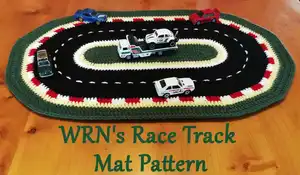
This pattern creates a charming oval race track mat using worsted weight yarn and basic crochet stitches. You'll shape the oval with increases at the ends, add contrasting color rounds, and finish with a decorative edge. Color changes create an alternating red and white border and a dashed center lane for a realistic track look.

WRN Race Track Mat Pattern crochet pattern - detailed view of completed project

Clear step-by-step rounds and helpful photos make the construction straightforward. A perfect project to customize with colors and size adjustments.

Why You'll Love This WRN Race Track Mat Pattern

I absolutely love this pattern because it transforms simple stitches into a playful, useful piece that kids and collectors both enjoy. I find the oval shaping technique satisfying β€” watching the track grow round by round is so rewarding. The colorwork for the border and the dashed lane detail always draws compliments and makes each mat feel unique. I also enjoy how easy it is to customize the size and colors to match a room or favorite toy cars.

WRN Race Track Mat Pattern step 1 - construction progress WRN Race Track Mat Pattern step 2 - assembly progress WRN Race Track Mat Pattern step 3 - details and accessories WRN Race Track Mat Pattern step 4 - final assembly and finishing

Switch Things Up

I love changing the color palette to match a nursery or playroom; try pastel shades for a softer, vintage look or bold primaries for high-energy play.

You can easily make the mat larger by using a bulkier yarn and larger hooks as suggestedβ€”this gives you a chunky floor rug perfect for bigger spaces.

I often add a non-slip backing or a thin sheet of rug gripper to the underside for added safety on hardwood floors.

If you prefer fewer colour joins, work solid rounds longer and add decorative stripes only at the edge for a simpler look.

I sometimes embroider numbers or tiny flags in the border to create a themed racetrack for imaginative play sessions.

Try substituting the yellow inner rounds with a contrasting variegated yarn for a playful marble effect in the center track.

For a portable version, make a mini mat with finer yarn and a smaller hook to create an on-the-go car playpad for travel.

Experiment with the dashed lane by using embroidery floss or thicker yarn for a bolder, more visible lane divider.

I also like to crochet little matching accessories like tiny parking spots or pit-stop mats to complement the main track and extend play possibilities.

When I make multiples as gifts, I vary the border colors to personalize each mat, which always makes recipients smile.

Common Mistakes & How to Fix Them

βœ— Missing stitches in the starting chain can leave you short for later colour rounds; recount your chain before joining and lay it flat to ensure you have the correct number. βœ— Forgetting to add increases evenly on the ends will distort the oval shape; place a stitch marker at the first stitch of each increase to keep track of placement and repeat counts. βœ— Carrying unused colour incorrectly causes bulky bumps or loose floats; carry the unused colour neatly at the base of the stitches and catch it every few stitches if needed. βœ— Changing colour at the wrong time can leave gaps in the round; always bring the new colour in on the last yarn over of the last dc of the sequence as directed. βœ— Using inconsistent tension will make rounds look wavy or uneven; maintain a steady tension and switch hook sizes if you need a looser or tighter fabric.

WRN Race Track Mat Pattern

Create a fun, handmade race track mat perfect for playtime, nursery decor, or a unique display for toy cars. This pattern guides you through shaping an oval track with clear round-by-round instructions and helpful photos. Youll work with simple stitches and color changes to create lane markers and a decorative edge. Ideal for gifting or a cozy play nook, this pattern is designed to be enjoyable and satisfying to make.

Intermediate 5-7 Hours

Materials Needed for WRN Race Track Mat Pattern

β€” Main Fabric

  • 01
    Worsted/Medium weight yarn (US #4) in Green (main inner track)
  • 02
    Worsted/Medium weight yarn (US #4) in Black (outer track rounds)
  • 03
    Worsted/Medium weight yarn (US #4) in White (lane and border details)
  • 04
    Worsted/Medium weight yarn (US #4) in Red (alternating border)
  • 05
    For a larger mat: bulky weight yarn (5) as suggested in notes

β€” Tools Required

  • 01
    Crochet hook size 3.5 mm (for main work where indicated)
  • 02
    Crochet hook size 4 mm (for final edge and single crochet round)
  • 03
    Stitch markers
  • 04
    Darning needle (for weaving in ends and sewing lane dashes)
  • 05
    Approx. 3 feet of white yarn for lane dividing dash
  • 06
    Scissors

Progress Tracker

0% Complete

β€” Mat :

Info :

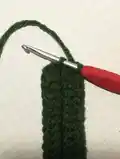
Starting with GREEN yarn, Chain 43.

Round 1 :

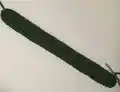
dc in second chain from hook, dc in each stitch along the chain until the last chain. In the last chain place 4 dc, then place a dc in each stitch along the other side of the chain, on the end turning chain (shown below) place 4 dc, join with a slip stitch to the first dc.

Round 2 :

Chain 2, dc in the same stitch as the chain and in each stitch until you reach the 4 end dc. Place 2 dc in each of the four end stitches, dc in each stitch until you reach the other end with 4 dc, place 2 dc in each of the four end stitches, slip stitch to the first dc of the round.

Info :

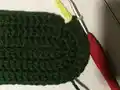
When adding additional rounds, increases will be added at each end of the oval (dcINC = 2 dc in the same stitch to make an increase) The same pattern repeats along the sides, but the bolded sections increase on the ends. ***Placing a stitch marker in the first stitch of each increase helps in seeing where the next round of increases will be.

Round 3 :

Chain 2, dc in the same stitch as the chain. dc in each stitch across straight stretch, (dcINC, dc) x4, dc in each stitch across, (dcINC, dc) x4, ***on the last yo, of the last dc of the round, change your yarn to YELLOW***, sl st to the first dc of the round.

Info :

From Round 4 onwards, 5 increases are added to each end of the oval to ensure the mat lays flat.

Round 4 :

Chain 2, dc in the same stitch as the chain. dc in each stitch across straight stretch, (dcINC, 2dc) x4, dcINC, dc across straight stretch, (dcINC, 2dc) x4, dcINC, ***on the last yo, of the last dc of the round, change your yarn to WHITE***, sl st to the first dc of the round.

Round 5 :

Chain 2, dc in the same stitch as the chain. dc in each stitch across straight stretch, (dcINC, 3dc) x4, dcINC, dc across straight stretch, (dcINC, 3dc) x4, dcINC, dc in each st until end of round, ***on the last yo, of the last dc of the round, change your yarn to BLACK*** sl st to the first dc of the round.

Round 6 :

Chain 2, dc in the same stitch as the chain. dc in each stitch across straight stretch, (dcINC, 4dc) x4, dcINC, dc across straight stretch, (dcINC, 4dc) x4, dcINC, dc in each st until end of round, sl st to the first dc of the round.

Round 7 :

Chain 2, dc in the same stitch as the chain. dc in each stitch across straight stretch, (dcINC, 5dc) x4, dcINC, dc across straight stretch, (dcINC, 5dc) x4, dcINC, dc in each st until end of round, sl st to the first dc of the round.

Round 8 :

Chain 2, dc in the same stitch as the chain. dc in each stitch across straight stretch, (dcINC, 6dc) x4, dcINC, dc across straight stretch, (dcINC, 6dc) x4, dcINC, dc in each st until end of round, sl st to the first dc of the round.

Round 9 :

Chain 2, dc in the same stitch as the chain and in each stitch across straight stretch, (dcINC, 7dc) x4, dcINC, dc across straight stretch, (dcINC, 7dc) x4, dcINC, dc in each st until end of round, sl st to the first dc of the round.

Round 10 :

Chain 2, dc in the same stitch as the chain and in each stitch across straight stretch, (dcINC, 8dc) x4, dcINC, dc across straight stretch, (dcINC, 8dc) x4, dcINC, dc in each st until end of round, sl st to the first dc of the round.

Round 11 :

Chain 2, dc in the same stitch as the chain and in each stitch across straight stretch, (dcINC, 9dc) x4, dcINC, dc across straight stretch, (dcINC, 9dc) x4, dcINC, dc in each st until end of round, sl st to the first dc of the round.

Round 12 :

Chain 2, dc in the same stitch as the chain and in each stitch across straight stretch, (dcINC, 10dc) x4, dcINC, dc across straight stretch, (dcINC, 10dc) x4, dcINC, dc in each st until end of round, sl st to the first dc of the round.

Round 13 :

Chain 2, dc in the same stitch as the chain and in each stitch across straight stretch, (dcINC, 11dc) x4, dcINC, dc across straight stretch, (dcINC, 11dc) x4, dcINC, dc in each st until end of round, ***on the last yo, of the last dc of the round, change your yarn to RED or WHITE***, sl st to the first dc of the round.

Round 14 :

Use alternating red and white yarn every four stitches, carrying the unused colour along the round at the base of the stitches. Same as all the other colour changes, youll want to bring in the new colour on the last yo of the last dc of the sequence. Chain 2, dc in the same stitch as the chain and in each stitch across straight stretch, (dcINC, 12dc) x4, dcINC, dc across straight stretch, (dcINC, 12dc) x4, dcINC, dc in each st until end of round, ***on the last yo, of the last dc of the round, change your yarn to YELLOW***, sl st to the first dc of the round.

Infos :

***In sample shown above a stitch was missed in the beginning chain, leaving me two stitches short for the alternating colour round. Double checking stitch counts and using stitch markers will avoid this issue ;)

Round 15 :

Chain 2, dc in the same stitch as the chain and in each stitch across straight stretch, (dcINC, 13dc) x4, dcINC, dc across straight stretch, (dcINC, 13dc) x4, dcINC, dc in each st until end of round, ***on the last yo, of the last dc of the round, change your yarn to GREEN*** sl st to the first dc of the round.

Round 16 :

Chain 2, dc in the same stitch as the chain and in each stitch across straight stretch, (dcINC, 14dc) x4, dcINC, dc across straight stretch, (dcINC, 14dc) x4, dcINC, dc in each st until end of round, sl st to the first dc of the round.

Round 17 :

Chain 2, dc in the same stitch as the chain and in each stitch across straight stretch, (dcINC, 15dc) x4, dcINC, dc across straight stretch, (dcINC, 15dc) x4, dcINC, dc in each st until end of round, sl st to the first dc of the round.

Round 18 :

with a 4mm hook, Chain 1, sc in each st, slip stitch to the first stitch in the round.

Info :

Using a darning needle weave in all ends.

Info :

Using a darning needle and approx. 3 feet of white yarn, create the lane dividing dash using the line between the fourth and fifth rounds of black as a guide. Dashes on the sample shown are woven through the space every two stitches from the front to the back, repeating this process until you meet the start and tie off. Weave in ends.

Info :

For a larger version, switch the yarn to a bulky weight(5) and use a 5mm hook for the main mat and 5.5mm or 6mm for the final edge single crochet round.

Assembly Instructions

  • Weave in all yarn ends neatly using a darning needle after completing the final round to secure colour changes and prevent unraveling.
  • Create the lane dividing dash with approx. 3 feet of white yarn using a darning needle: use the line between the fourth and fifth black rounds as a guide and weave dashes through the space every two stitches from front to back until you meet the start; tie off and weave in ends.
  • When joining rounds and changing colours, bring the new colour in on the last yarn over (yo) of the last dc of the sequence to create a clean colour change and avoid gaps.
  • Use stitch markers to mark the first stitch of each increase round and to keep track of the start of each round for accurate shaping and consistent increases.

Important Notes

  • πŸ’‘Place stitch markers in the first stitch of each increase to clearly identify where increases begin and to maintain symmetry at each oval end.
  • πŸ’‘Carry unused colour along the base of the stitches during alternating colour rounds to keep a neat backside and avoid cutting too many ends.
  • πŸ’‘Always bring in new colours on the last yarn over of the last dc of the sequence to create a smooth colour join and reduce visible gaps.

VROOM! Ready for some wheels to hit the track! This race track mat pattern brings playful charm to your home and makes a delightful handmade gift. Customize colors and size for a personalized touch and enjoy the satisfaction of a finished play-ready mat. πŸ§ΆπŸš—

You ask,

we answer.

FAQs

What size will the finished piece be?

The completed mat measures approximately 56 cm x 35 cm (22" x 14") when using the recommended worsted weight yarn and hook sizes.

Can I use different yarn weights for this pattern?

Yes, you can use different yarn weights; switching to a bulky weight (5) and using a 5mm hook for the main rounds (and 5.5mm or 6mm for the final edge) will create a larger mat.

Do I need prior crochet experience for this pattern?

This pattern is rated intermediate, so basic knowledge of double crochet, increases, and working in rounds is recommended for best results.

How do I add the lane dividing dashes?

Use a darning needle and approx. 3 feet of white yarn; follow the guide between the fourth and fifth black rounds and weave dashes through the space every two stitches from front to back until you reach the start, then tie off and weave in ends.

How long will this project typically take?

Most crocheters complete this project in 5-7 hours, though time may vary depending on experience and how quickly you work through colour changes and finishing.