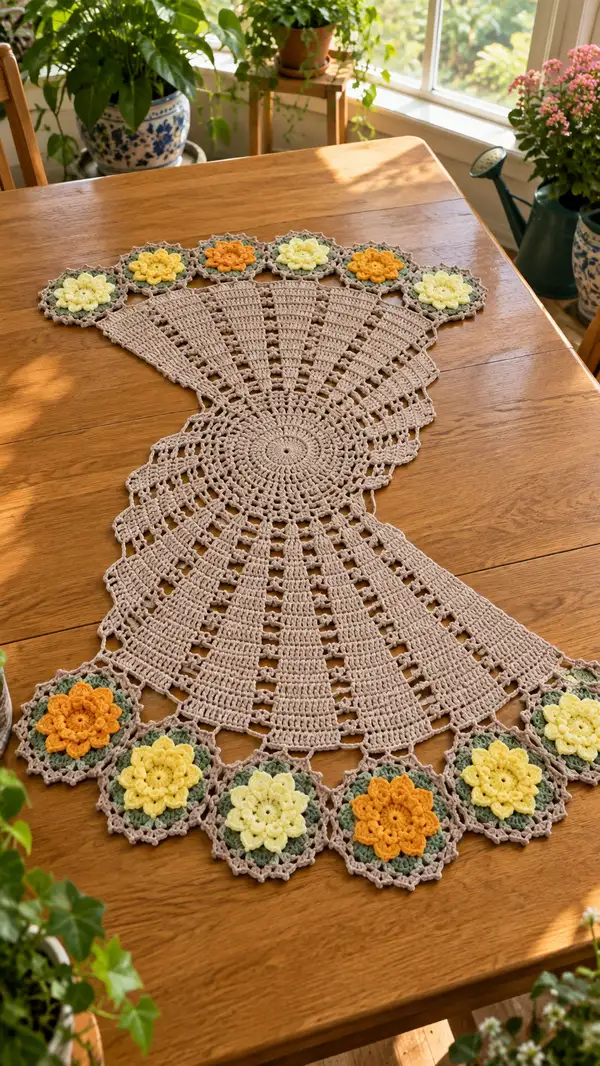
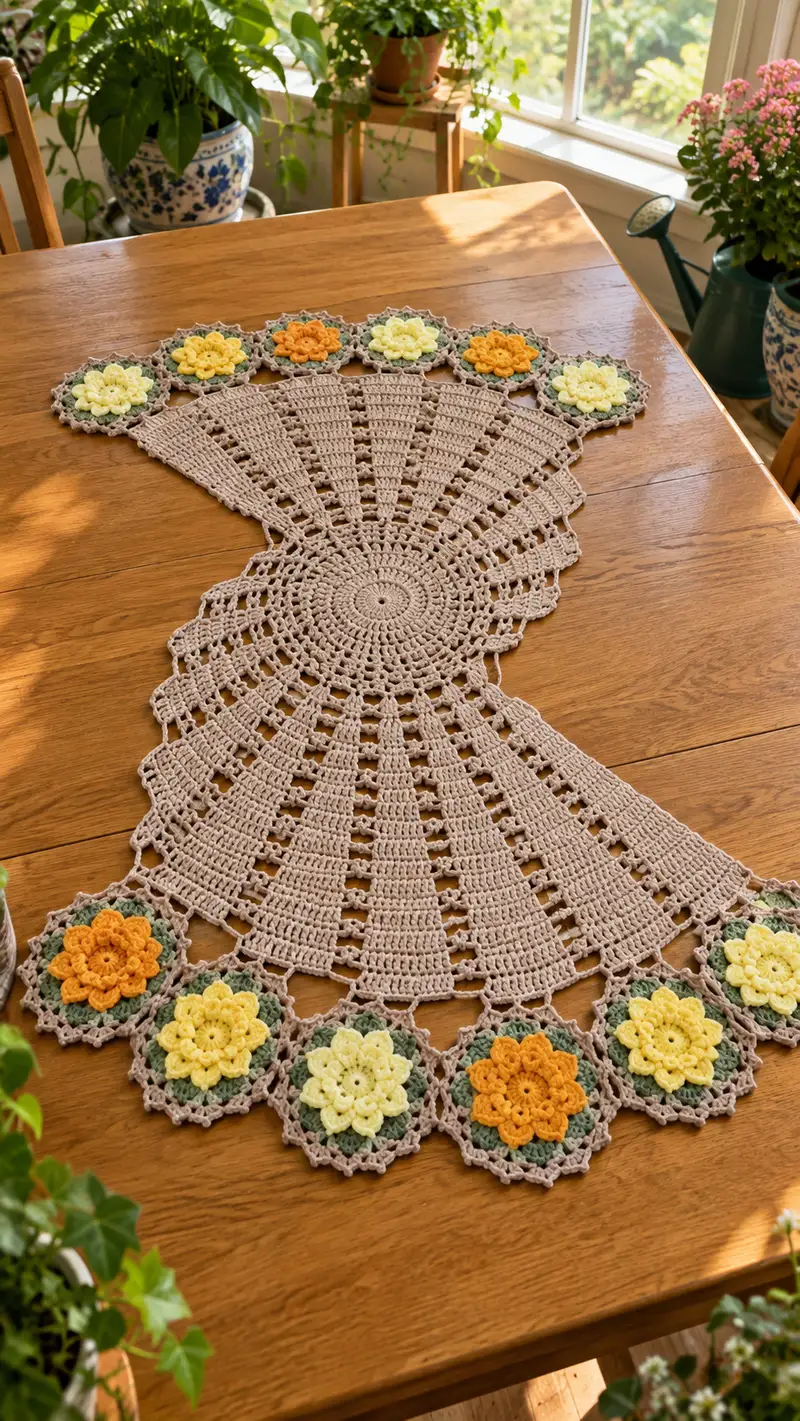
A beautifully detailed table runner featuring a central sunburst medallion that fans out into radiating panels, finished with a ring of cheerful 3D floral hexagons. Worked in a soft neutral for the body with sunny yellow and warm orange flowers framed by a leafy green round — this runner adds a handmade vintage-modern charm to any table.
Progress Tracker
0% Complete
— Materials & Gauge :
Info :
Gauge is not critical for this decorative runner but consistent tension matters. Using worsted weight cotton and 4.0mm hook, a 10cm (4in) swatch of dc in rows should measure approximately 16 dc across. Adjust hook if your fabric is too tight or too loose.
Info :
All rounds are worked in joined rounds unless otherwise stated. Use a stitch marker to mark the beginning of each round. For sections that form wedges, each wedge is worked into a specific group of center stitches — keep stitch counts exact for symmetry.
— Central Sunburst Medallion (work in main neutral) :
Round 1 :
6 sc in magic ring (6)
Round 3 :
(1 sc, inc) x 6 (18)
Round 4 :
(2 sc, inc) x 6 (24)
Round 5 :
(3 sc, inc) x 6 (30)
Round 6 :
(4 sc, inc) x 6 (36)
Round 7 :
(5 sc, inc) x 6 (42)
Round 8 :
(6 sc, inc) x 6 (48)
Info :
Place your stitch marker at the start of each round. Because the runner fans out from this center, you will divide the final stitch count into equal groups for wedge bases; for this pattern we divide into 12 equal groups. Continue increasing to reach 120 sts so each group will be 10 sts.
Round 9 :
(7 sc, inc) x 6 (54)
Round 10 :
(8 sc, inc) x 6 (60)
Round 11 :
(9 sc, inc) x 6 (66)
Round 12 :
(10 sc, inc) x 6 (72)
Round 13 :
(11 sc, inc) x 6 (78)
Round 14 :
(12 sc, inc) x 6 (84)
Round 15 :
(13 sc, inc) x 6 (90)
Round 16 :
(14 sc, inc) x 6 (96)
Round 17 :
(15 sc, inc) x 6 (102)
Round 18 :
(16 sc, inc) x 6 (108)
Round 19 :
(17 sc, inc) x 6 (114)
Round 20 :
(18 sc, inc) x 6 (120)
Info :
Final center round yields 120 sc. This divides cleanly into twelve groups of 10 stitches each which become the bases for twelve fan wedges. Use 12 stitch markers to mark each group of 10 sts, or mark each tenth stitch with a contrasting yarn tail to make joining wedges easier.
— Wedge Template (Make 12) :
Info :
Each wedge is worked separately and joined to a group of 10 marked stitches on the outermost round of the center medallion. Work wedges one at a time; the rounds below represent Wedge 1. Wedges 2-12 repeat the same rounds but are numbered individually in the pattern for clarity. Use the same main neutral yarn for all wedge panels.
Wedge 1 - Round 21 :
Join with sl st to the first marked stitch of group 1 (counts refer to the center round). Ch 1, 1 sc in same st and 1 sc in each of the next 9 sts of this group (10 sc) (10)
Wedge 1 - Round 22 :
(1 sc, inc) x 5 (15)
Wedge 1 - Round 23 :
(2 sc, inc) x 5 (20)
Wedge 1 - Round 24 :
(3 sc, inc) x 5 (25)
Wedge 1 - Round 25 :
(4 sc, inc) x 5 (30)
Wedge 1 - Round 26 :
(5 sc, inc) x 5 (35)
Wedge 1 - Round 27 :
(6 sc, inc) x 5 (40)
Wedge 1 - Round 28 :
Edging round: ch2 (counts as hdc), 1 hdc in next 2 sts, *ch2, sk 1, 1 hdc in each of next 3 sts; rep from * across to end; join with sl st to top of beginning ch2 (40 + ch spaces)
Info :
At the end of Wedge 1, fasten off and leave a long tail for joining if you prefer to sew wedges together. Alternatively, continue to Wedge 2 and join it directly to the next marked group on the center. Repeat the Wedge rounds for each group. Each wedge starts with 10 sc and increases to 40 sts after Round 27, providing a consistent fan width across the runner.
Wedge 2 - Round 29 :
Join with sl st to the first marked stitch of group 2. Ch 1, 1 sc in same st and 1 sc in each of the next 9 sts of this group (10 sc) (10)
Wedge 2 - Round 30 :
(1 sc, inc) x 5 (15)
Wedge 2 - Round 31 :
(2 sc, inc) x 5 (20)
Wedge 2 - Round 32 :
(3 sc, inc) x 5 (25)
Wedge 2 - Round 33 :
(4 sc, inc) x 5 (30)
Wedge 2 - Round 34 :
(5 sc, inc) x 5 (35)
Wedge 2 - Round 35 :
(6 sc, inc) x 5 (40)
Wedge 2 - Round 36 :
Edging round: ch2, 1 hdc in next 2 sts, *ch2, sk 1, 1 hdc in each of next 3 sts; rep from * across; join with sl st to beginning ch2 (40 + ch spaces)
Info :
Repeat the same 8-round wedge sequence for Wedges 3 through 12. For clarity the pattern below lists each wedge as a block of 8 rounds. Maintain the same increase math so every wedge ends at 40 sts on the last structural round before edging.
Wedge 3 - Round 37 :
Join to group 3: ch1, 10 sc (10)
Wedge 3 - Round 38 :
(1 sc, inc) x 5 (15)
Wedge 3 - Round 39 :
(2 sc, inc) x 5 (20)
Wedge 3 - Round 40 :
(3 sc, inc) x 5 (25)
Wedge 3 - Round 41 :
(4 sc, inc) x 5 (30)
Wedge 3 - Round 42 :
(5 sc, inc) x 5 (35)
Wedge 3 - Round 43 :
(6 sc, inc) x 5 (40)
Wedge 3 - Round 44 :
Edging round: ch2, 1 hdc in next 2 sts, *ch2, sk 1, 1 hdc in next 3 sts; rep; join (40 + ch)
Info :
Wedges 4-12 follow the identical eight-round progression. To save time you may keep the same wedge on your hook and slip-join to the next group without fastening off, but pin each wedge into place as you go so the outer edges form an even curve. Blocking wedges lightly before final joining helps keep edges consistent.
Wedge 4 - Round 45 :
Join to group 4: ch1, 10 sc (10)
Wedge 4 - Round 46 :
(1 sc, inc) x 5 (15)
Wedge 4 - Round 47 :
(2 sc, inc) x 5 (20)
Wedge 4 - Round 48 :
(3 sc, inc) x 5 (25)
Wedge 4 - Round 49 :
(4 sc, inc) x 5 (30)
Wedge 4 - Round 50 :
(5 sc, inc) x 5 (35)
Wedge 4 - Round 51 :
(6 sc, inc) x 5 (40)
Wedge 4 - Round 52 :
Edging round: ch2, 1 hdc in next 2 sts, *ch2, sk 1, 1 hdc in next 3 sts; rep; join (40 + ch)
Wedge 5 - Round 53 :
Join to group 5: ch1, 10 sc (10)
Wedge 5 - Round 54 :
(1 sc, inc) x 5 (15)
Wedge 5 - Round 55 :
(2 sc, inc) x 5 (20)
Wedge 5 - Round 56 :
(3 sc, inc) x 5 (25)
Wedge 5 - Round 57 :
(4 sc, inc) x 5 (30)
Wedge 5 - Round 58 :
(5 sc, inc) x 5 (35)
Wedge 5 - Round 59 :
(6 sc, inc) x 5 (40)
Wedge 5 - Round 60 :
Edging round: ch2, 1 hdc in next 2 sts, *ch2, sk 1, 1 hdc in next 3 sts; rep; join (40 + ch)
Wedge 6 - Round 61 :
Join to group 6: ch1, 10 sc (10)
Wedge 6 - Round 62 :
(1 sc, inc) x 5 (15)
Wedge 6 - Round 63 :
(2 sc, inc) x 5 (20)
Wedge 6 - Round 64 :
(3 sc, inc) x 5 (25)
Wedge 6 - Round 65 :
(4 sc, inc) x 5 (30)
Wedge 6 - Round 66 :
(5 sc, inc) x 5 (35)
Wedge 6 - Round 67 :
(6 sc, inc) x 5 (40)
Wedge 6 - Round 68 :
Edging round: ch2, 1 hdc in next 2 sts, *ch2, sk 1, 1 hdc in next 3 sts; rep; join (40 + ch)
Info :
Halfway through the wedges you should have a clear fan shape forming. Keep all wedges consistent. If you notice a wedge is slightly wider or narrower, adjust the number of increases in the earlier rounds for that wedge only to match the width of the others before progressing to the edging round.
Wedge 7 - Round 69 :
Join to group 7: ch1, 10 sc (10)
Wedge 7 - Round 70 :
(1 sc, inc) x 5 (15)
Wedge 7 - Round 71 :
(2 sc, inc) x 5 (20)
Wedge 7 - Round 72 :
(3 sc, inc) x 5 (25)
Wedge 7 - Round 73 :
(4 sc, inc) x 5 (30)
Wedge 7 - Round 74 :
(5 sc, inc) x 5 (35)
Wedge 7 - Round 75 :
(6 sc, inc) x 5 (40)
Wedge 7 - Round 76 :
Edging round: ch2, 1 hdc in next 2 sts, *ch2, sk 1, 1 hdc in next 3 sts; rep; join (40 + ch)
Wedge 8 - Round 77 :
Join to group 8: ch1, 10 sc (10)
Wedge 8 - Round 78 :
(1 sc, inc) x 5 (15)
Wedge 8 - Round 79 :
(2 sc, inc) x 5 (20)
Wedge 8 - Round 80 :
(3 sc, inc) x 5 (25)
Wedge 8 - Round 81 :
(4 sc, inc) x 5 (30)
Wedge 8 - Round 82 :
(5 sc, inc) x 5 (35)
Wedge 8 - Round 83 :
(6 sc, inc) x 5 (40)
Wedge 8 - Round 84 :
Edging round: ch2, 1 hdc in next 2 sts, *ch2, sk 1, 1 hdc in next 3 sts; rep; join (40 + ch)
Wedge 9 - Round 85 :
Join to group 9: ch1, 10 sc (10)
Wedge 9 - Round 86 :
(1 sc, inc) x 5 (15)
Wedge 9 - Round 87 :
(2 sc, inc) x 5 (20)
Wedge 9 - Round 88 :
(3 sc, inc) x 5 (25)
Wedge 9 - Round 89 :
(4 sc, inc) x 5 (30)
Wedge 9 - Round 90 :
(5 sc, inc) x 5 (35)
Wedge 9 - Round 91 :
(6 sc, inc) x 5 (40)
Wedge 9 - Round 92 :
Edging round: ch2, 1 hdc in next 2 sts, *ch2, sk 1, 1 hdc in next 3 sts; rep; join (40 + ch)
Wedge 10 - Round 93 :
Join to group 10: ch1, 10 sc (10)
Wedge 10 - Round 94 :
(1 sc, inc) x 5 (15)
Wedge 10 - Round 95 :
(2 sc, inc) x 5 (20)
Wedge 10 - Round 96 :
(3 sc, inc) x 5 (25)
Wedge 10 - Round 97 :
(4 sc, inc) x 5 (30)
Wedge 10 - Round 98 :
(5 sc, inc) x 5 (35)
Wedge 10 - Round 99 :
(6 sc, inc) x 5 (40)
Wedge 10 - Round 100 :
Edging round: ch2, 1 hdc in next 2 sts, *ch2, sk 1, 1 hdc in next 3 sts; rep; join (40 + ch)
Wedge 11 - Round 101 :
Join to group 11: ch1, 10 sc (10)
Wedge 11 - Round 102 :
(1 sc, inc) x 5 (15)
Wedge 11 - Round 103 :
(2 sc, inc) x 5 (20)
Wedge 11 - Round 104 :
(3 sc, inc) x 5 (25)
Wedge 11 - Round 105 :
(4 sc, inc) x 5 (30)
Wedge 11 - Round 106 :
(5 sc, inc) x 5 (35)
Wedge 11 - Round 107 :
(6 sc, inc) x 5 (40)
Wedge 11 - Round 108 :
Edging round: ch2, 1 hdc in next 2 sts, *ch2, sk 1, 1 hdc in next 3 sts; rep; join (40 + ch)
Wedge 12 - Round 109 :
Join to group 12: ch1, 10 sc (10)
Wedge 12 - Round 110 :
(1 sc, inc) x 5 (15)
Wedge 12 - Round 111 :
(2 sc, inc) x 5 (20)
Wedge 12 - Round 112 :
(3 sc, inc) x 5 (25)
Wedge 12 - Round 113 :
(4 sc, inc) x 5 (30)
Wedge 12 - Round 114 :
(5 sc, inc) x 5 (35)
Wedge 12 - Round 115 :
(6 sc, inc) x 5 (40)
Wedge 12 - Round 116 :
Edging round: ch2, 1 hdc in next 2 sts, *ch2, sk 1, 1 hdc in next 3 sts; rep; join (40 + ch)
Info :
After finishing all twelve wedges you will have a large fan-shaped body radiating from the center. At this point take time to block the fan so the panels lie flat and even. If any wedges differ slightly, wet-block or gently steam to even them before proceeding to add the floral motifs to the narrower ends of the runner.
— 3D Floral Hexagon Motifs (Make 12 - alternating colors) :
Info :
Each floral motif is worked in the three colors: petal color (yellow/orange), leaf/green round, and a neutral outer hexagon round to match the runner. Work motifs separately and block flat before joining. The petals are worked in a layered cluster technique to produce a raised 3D look.
Motif 1 - Round 117 :
Using petal color (yellow or orange), mr, ch2, 12 hdc in mr; join with sl st to first hdc (12)
Motif 1 - Round 118 :
Ch1, *sc in next st, ch3, tr cluster (3 tr tog into ch3 sp), ch3, sc in next st; rep around to make 6 petal clusters; join (12 clusters)
Motif 1 - Round 119 :
Switch to petal highlight (pale yellow) if desired. Into each petal cluster: ch1, 7 dc in the ch3 loop of the cluster to form a raised petal, sl st to base; rep around so each petal is formed (6 petals)
Motif 1 - Round 120 :
Switch to leaf green yarn. Ch1, sc around petals into spaces between petals (12 sc evenly distributed), join (12)
Motif 1 - Round 121 :
Ch2, (2 dc, ch1, 2 dc) in every second sc to form a scalloped hexagon base; space evenly to create six sides; join (six shell clusters)
Motif 1 - Round 122 :
Switch to neutral outer color. Ch1, sc in each stitch and ch space around, adding an extra sc in the center of each shell to form corner points; total will be approx 36 sc depending on spacing; join
Motif 1 - Round 123 :
Edging: ch3, sl st into next st to create small loop; *ch3, sl st into next st; rep around to create picot-like loops to help with joining to runner; join and fasten off leaving long tail for sewing
Info :
Repeat motif rounds (117-123) for Motifs 2 through 12, alternating petal color between sunny yellow and warm orange. Block each motif so hexagon sides are even. The leaf green round should sit flat behind petals, giving a leafy frame.
Motif 2 - Round 124 :
Make motif 2 following Rounds 117-123 (alternate color)
Motif 3 - Round 125 :
Make motif 3 following Rounds 117-123
Motif 4 - Round 126 :
Make motif 4 following Rounds 117-123
Motif 5 - Round 127 :
Make motif 5 following Rounds 117-123
Motif 6 - Round 128 :
Make motif 6 following Rounds 117-123
Motif 7 - Round 129 :
Make motif 7 following Rounds 117-123
Motif 8 - Round 130 :
Make motif 8 following Rounds 117-123
Motif 9 - Round 131 :
Make motif 9 following Rounds 117-123
Motif 10 - Round 132 :
Make motif 10 following Rounds 117-123
Motif 11 - Round 133 :
Make motif 11 following Rounds 117-123
Motif 12 - Round 134 :
Make motif 12 following Rounds 117-123
Info :
If you prefer fewer motifs, you can make 8 or 10 instead of 12 depending on table length; space them evenly across the runner edge when joining. The pattern here makes twelve to match the twelve wedge panels, creating a balanced look for a medium to large table.
— Joining Motifs to Runner Edges :
Round 135 :
Position motifs along the outer scalloped edge of the runner; each motif will align with the outer point of specific wedges. Pin each motif in place so spacing is consistent; typically one motif covers two wedge outer scallops forming a repeating border pattern.
Round 136 :
Sew motifs to the runner with whip stitch using the long tail left on motifs or matching yarn. Stitch through the outer neutral hexagon round and the ch-loop points on the wedge edges; secure stitches and weave ends neatly to back.
Info :
When sewing motifs, make sure petals face outward and stay flat. Use blocked motifs pinned in place. Secure with small, even stitches; avoid pulling too tight which will pucker the runner edge.
— Final Outer Border & Decorative Picots :
Round 137 :
With neutral yarn working around entire outer edge (including wedges and motif joins): ch1, sc around each visible st and ch space, placing 3 sc in corners or points for strength. Maintain even tension (expected total approx 450-520 sc depending on joins).
Round 138 :
Picot scallop edge: *ch3, sl st into next st to form a picot loop, sc in next 4 sts; rep around to create decorative tiny loops along the border; adjust spacing if necessary to make loops even.
Round 139 :
Optional reinforcing round: sc in each st (no increase) to tidy up the edge and ensure the picot loops sit uniformly; fasten off and weave in ends.
Info :
If you want a crisper edge, steam-block lightly after completing the border. For a softer, drapier edge leave the fabric unstarched. The picot loops help the runner lay flat and add a feminine finish.
— Finishing :
Info :
Weave in all tails on the reverse side using a tapestry needle. Trim any stray fibers. Block the finished runner to the desired dimensions and allow to dry completely. If you used cotton, a gentle iron with a pressing cloth will also help flatten motifs and set edges.
Info :
Optional: Apply a light fabric stiffener to petals only if you want them to stand slightly proud. Test on a scrap first. Your runner is now ready to display!
Completing this sunburst floral table runner is such a satisfying journey — each wedge and petal builds into a graceful, handmade centerpiece that brightens your table. The combination of neutral texture with sunny, dimensional flowers gives a refined yet cozy look. Blocking and careful joining bring everything together into a polished, heirloom-worthy piece. 🧶🌼 Enjoy proudly displaying your creation or gifting it to someone special! 🍊