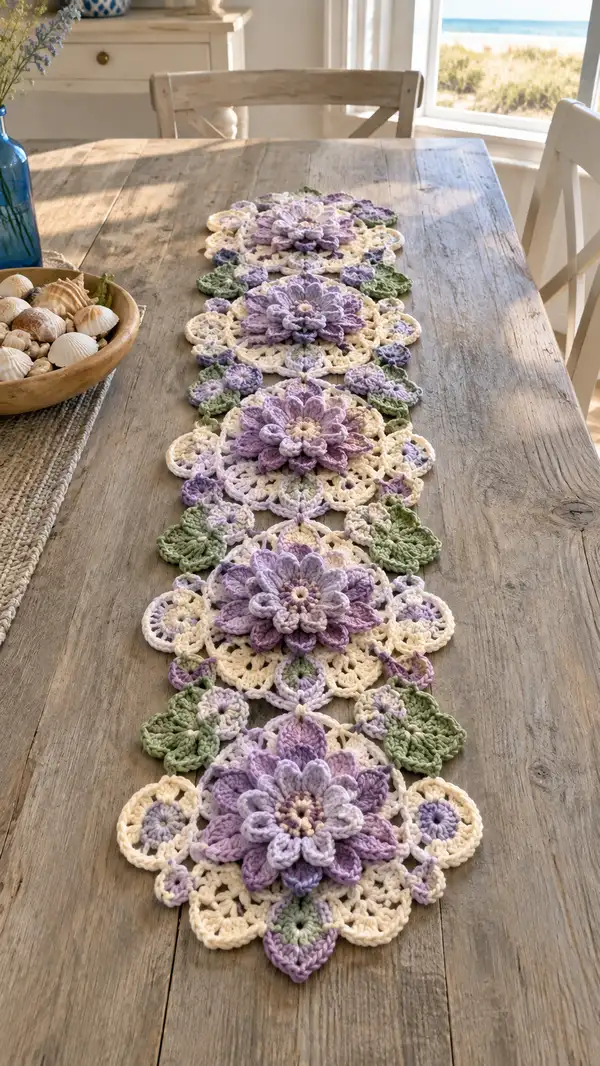
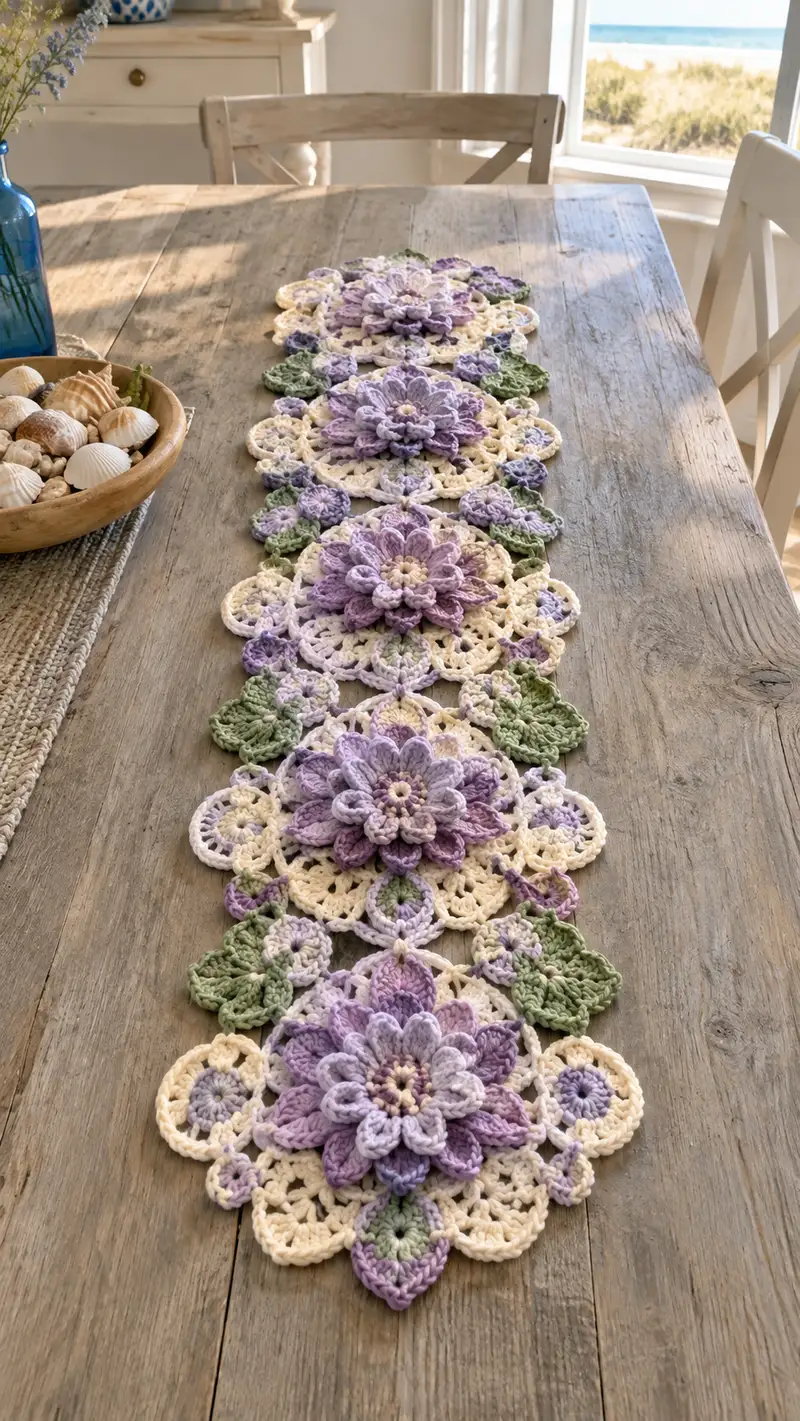
Create an elegant lavender and cream floral table runner with layered 3D petals and leafy accents. This long runner features repeating floral medallions joined with lacy rings and delicate green leaves for a cottage-chic finish. The design uses textured petals, puff stitches and open lace to sit beautifully on a dining table or console. Perfect for spring or any time you want a soft, romantic centerpiece.
Progress Tracker
0% Complete
— Overview :
Info :
This runner is constructed from repeating floral medallions. Each full medallion includes a small center circle, two layered petal rounds to create 3D petals, a larger lacy base round, and connecting filler motifs and leaves. Pattern describes work for one full medallion plus the small joining motifs and leaves. Make as many medallions as you need and join them end-to-end for desired length.
Info :
Gauge is not critical for a table runner, but using cotton worsted will give crisp stitch definition. Recommended junction: 4 medallions = approximately 95-110 cm long depending on spacing. Adjust number of medallions to your table.
— Motif Core (Center Circle) :
Round 3 :
(1 sc, 1 inc) x 6 (18)
Info :
Change to soft yellow or warm cream for the inner center on Round 4 to mimic a warm floral center. Fasten color at start of round. Carry previous yarn inside if working multiple centers consecutively.
Round 4 :
(2 sc, 1 inc) x 6 (24)
Round 5 :
1 sc in each st (24)
Round 6 :
(3 sc, 1 inc) x 6 (30)
Info :
Fasten off center color. We will build petals onto this 30-st round; place a stitch marker at the first stitch of Round 6 to help locate petal anchors.
— Layered Petal Round A (Inner Petals - smaller layer) :
Round 7 :
*(ch 2, skip next st, sc in next st)* around to make spaces (approximately 15 ch-2 spaces). End with sl st to first space
Round 8 :
In each ch-2 space: (ch 2, puff stitch x 5, ch 2, sl st) repeat around to form 15 small inner petals. Each puff = yarn over, insert hook, pull loop, repeat 4 times total then yarn over and pull through all loops, ch 1 to close puff. (15 petals)
Info :
Puff stitch technique: keep loops loose enough that the puff sits up, not flattened. After making each puff, gently tug the loops upward to form a petal shape. Use a slightly smaller hook (3.5mm) for consistent puffs if you prefer crisper petals.
Round 9 :
Sl st into base of each puff to anchor. 1 sc in each sc between spaces (30)
Round 10 :
1 sc in each st (30)
Info :
Fasten off inner petal color if you plan to change to medium lavender for outer petals. We recommend chaining in new color behind the work for cleaner joins.
— Layered Petal Round B (Outer Petals - larger layer) :
Round 11 :
Join medium lavender in back loop of Round 10. *(ch 3, skip next st, sc in next st)* around to create 15 ch-3 spaces (approx). Sl st to first ch-3.
Round 12 :
In each ch-3 space: (ch 2, puff x 7, ch 2, sl st) to create 15 larger puff petals. Each puff: yarn over, insert hook into space, pull loop, repeat to create 6 loops then yarn over and pull through all loops, ch 1 to close puff. (15 petals)
Round 13 :
Sl st to base of each puff; 1 sc in each sc between spaces (30)
Round 14 :
1 sc in each st (30)
Info :
For multi-toned petals, you can alternate rows of medium and deep lavender: make Rounds 11-13 in medium lavender and Round 14 with deep lavender worked as slip-stitch surface color to give petal tips a darker edge.
Round 15 :
Working behind the large puffs: *ch 4, sl st in base between petals* repeat around to create small connecting arches (15 arches)
Info :
Gently shape petals outward as you work the arches so petals remain three-dimensional. If petals collapse inward, adjust blocking later with a little steam or misting.
— Petal Detail and Edge (Layered Sculpting) :
Round 16 :
Join deep lavender at back of any sl st: *(ch 1, 3 hdc in next ch-4 arch, ch 1, sl st in arch base)* repeat around to create scalloped rises behind petals (15 scallops)
Round 17 :
In each scallop: (fpdc, bpdc, fpdc) all into the middle of the scallop to create vertical texture (15 textured scallops)
Round 18 :
1 sc in each st around (count will be approx 45 depending on exact stitches, keep consistent around petals)
Info :
Trim any long yarn tails and weave under petal bases. If working with variegated yarn, the inner and outer petals will pick up subtle color variations; no extra color changes required.
— Lacy Base Round (Large Open Circle) :
Round 19 :
Join cream yarn behind petal group. Ch 5, *skip next 2 sts, dc in next st, ch 3, sc in next st, ch 3, dc in next st, ch 5, sl st in next base stitch* Repeat to form 10 large loops around petal cluster (10 loops)
Round 20 :
In each ch-5 loop: (sc, hdc, 5 dc, hdc, sc) to create puffed outer lobes (10 lobes). Keep counts identical for all loops so the base remains round (approx 10*(1+1+5+1+1)=90 sts across lobes)
Round 21 :
*(ch 3, sc at base between lobes, ch 3, sl st in top of next lobe)* repeat around forming open mesh ring (10 ch-3 spaces)
Info :
The lacy base creates the visual frame for each medallion. Blocking now will open the lace nicely. If you're making multiple medallions, block each to the same diameter before joining for uniformity.
Round 22 :
1 sc in each st around to tidy the edge (count approx 90). Fasten off cream color if you will add small filler motifs between medallions using lavender.
— Small Filler Motifs (Connectors) :
Round 23 :
Make small circular filler: mr, ch 1, 8 sc in mr (8). Sl st to close and leave long tail for joining.
Round 24 :
Join light lavender: *(ch 2, 2 dc in same st, ch 2, sl st in next st)* around to create 4 little petal loops (4 clusters). Fasten off (count 4 clusters)
Round 25 :
Make two of these small fillers between medallions. They will sit between the larger lacy loops to visually bridge motifs.
Info :
When making filler motifs, maintain the same tension as medallions so connectors sit flat and even. Use stitch markers to mark where each filler will be sewn to the large medallion edge.
— Leaf Unit (Make 6 per medallion) :
Round 26 :
Use sage green. Ch 6. In 2nd ch from hook: sc, hdc, dc, tr, dc, hdc, sc in final ch (7 sts across). Turn to work along opposite side of foundation: sc, hdc in next 2 sts, dc in next, hdc in next 2, sc in last. Fasten off and weave tail. (Leaf width approx 13 sts)
Round 27 :
Optional leaf texture: Join in center stitch on leaf underside and work fpdc around center for a raised midrib: ch 1, *(fpdc around center st)* repeat 3-4 times across leaf center. Fasten off.
Info :
Shape leaves by stretching slightly while wet-blocking. Make 6 leaves for each medallion: 4 for corner accents and 2 tucked under petals for a natural look.
— Small Petal Clusters (Edge Embellishments) :
Round 28 :
In light lavender: mr, ch 1, 6 sc in mr (6). Round 2: *ch 2, puff x3 in next st, ch 2, sl st in next* x3 to create 3 tiny petals. Fasten off leaving tail for joining.
Round 29 :
Make 6 tiny clusters per medallion to fill gaps and soften transitions between medallions.
Info :
These small clusters add cohesion when joining; tuck them into the open loops of the lacy base so they appear integrated rather than sewn on top.
— Joining Motif Sequence (How to assemble medallions) :
Round 30 :
Layout: Place two medallions side-by-side. Pin them aligning the outer lacy loops so the small filler motifs will bridge between loop pairs. Use blocking pins to hold shape when joining.
Round 31 :
Join with cream yarn and tapestry needle using whip stitch through corresponding ch-3 spaces on adjacent medallions. Go under both loops of mesh for a clean, flat join. Make 6-8 stitches per connector for secure hold.
Round 32 :
Sew small filler motifs into the gaps between medallion loops: align a filler so its clusters match the lacy loop anchors and sew through foundation rounds to secure. Repeat for each connector position along the length.
Info :
Make joins on the underside first, then flip runner and add small top-stitch catches on the front to prevent gaps. Weave joining tails into several stitches and clip close to work for neat finish.
Round 33 :
Attach tiny petal clusters and leaves: position leaf tips under outer lobes and sew through the back of the lacy loop so leaves appear to grow from beneath flower. Sew tiny clusters symmetrically on either side of each join to create a repeating motif.
Info :
When joining multiple medallions, join progressively: connect first and second medallion, then add third to second, so tension is consistent and edges remain flat.
— Reinforcement Rounds (Strengthening Runner) :
Round 34 :
Using cream, with runner pinned flat, sc around entire outer edge of runner to provide a clean border. 1 sc in each st and 1 sc into each ch-3 space. Count will vary; keep consistent spacing for even edge.
Round 35 :
*(ch 3, skip 2 sc, sc in next)* repeat around to create small picot-like scallops (approx count = perimeter/3). Sl st to join.
Round 36 :
In each ch-3 scallop: (sc, hdc, 3 dc, hdc, sc) for a raised scallop finish. Fasten off and weave ends.
Info :
This reinforcement adds structural integrity and a finished look. If you prefer a more delicate edge, substitute Round 36 with 1 sc around and a tiny picot every 6 sts.
— Decorative Surface Stitches and Final Touches :
Round 37 :
Optional: Add surface slip-stitch lines on petal centers using deep lavender. With tapestry needle, surface sl st from petal base to tip across each outer petal to emphasize veins.
Round 38 :
Optional: Add small French-knot style embroidery in center with soft yellow yarn: use long tail and 3 wraps for each tiny center knot to mimic pollen.
Info :
Use embroidery sparingly to keep look soft and not overly busy. A few well-placed surface stitches enhance petal definition without dominating the texture.
— Blocking and Shaping :
Round 39 :
Pin each medallion to foam mat to specified diameter (approx 24-28 cm for each medallion depending on tension). Spray lightly with water and allow to dry completely. Pin petals to open them up; pin leaves into gently curved shape for natural look.
Info :
Blocking is essential for even joins and to ensure lace opens uniformly. If you skip blocking, edges will curl and joins will pucker. Take time here for best results.
— Repeat Instructions (For Multiple Medallions) :
Round 40 :
Repeat Rounds 1-22, 23-29, 26-29 as needed for each medallion. Make 4 full medallions for pictured runner; make additional for longer tables.
Round 41 :
Make 2 small filler motifs and 6 leaves per medallion for joining. Assemble medallions following Rounds 30-33 sequence in order.
Info :
Stagger leaves and small clusters between medallions as shown in photo: on each join, place two leaves mirrored and one small cluster centered to maintain rhythm along runner.
— Alternative Edge Variation (Optional Fringe) :
Round 42 :
Optional fringe: Attach cream yarn at edge every 6 sts, fold 3 strands of 12 cm each, pull loop through and knot to create a soft fringe. Trim evenly. Use fringe sparingly if runner will be used on dining table as fringe may catch.
Info :
Fringe is decorative but can interfere with tableware. Consider adding only small tassels at each medallion end rather than continuous fringe.
— Color Variation Notes :
Round 43 :
Alternate petal colors per medallion for ombre effect: for medallion 1 use light->medium->deep lavender, medallion 2 invert medium->light->deep, etc. Keep base cream consistent for unity.
Info :
Using variegated lavender yarn for outer petal rounds yields subtle depth without extra color changes. Try one variegated band for quick multi-hued petals.
— Care Instructions :
Round 44 :
Hand wash cold, reshape while damp and lay flat to dry. Avoid wringing or tumble drying to maintain petal shape and prevent shrinking of cotton yarn.
Info :
For stubborn creases after washing, use low heat iron with pressing cloth gently to flatten the lace, taking care not to press the puff petals flat.
Completing this lavender and cream floral table runner is a rewarding celebration of texture and color! Each medallion assembles into a romantic, dimensional centerpiece full of cottage charm. The layered petals, soft color palette, and gentle green leaves make it a standout on any table. Enjoy the rhythmic, calming process of making each flower and joining them into a beautiful heirloom piece. 🧶🌸✨