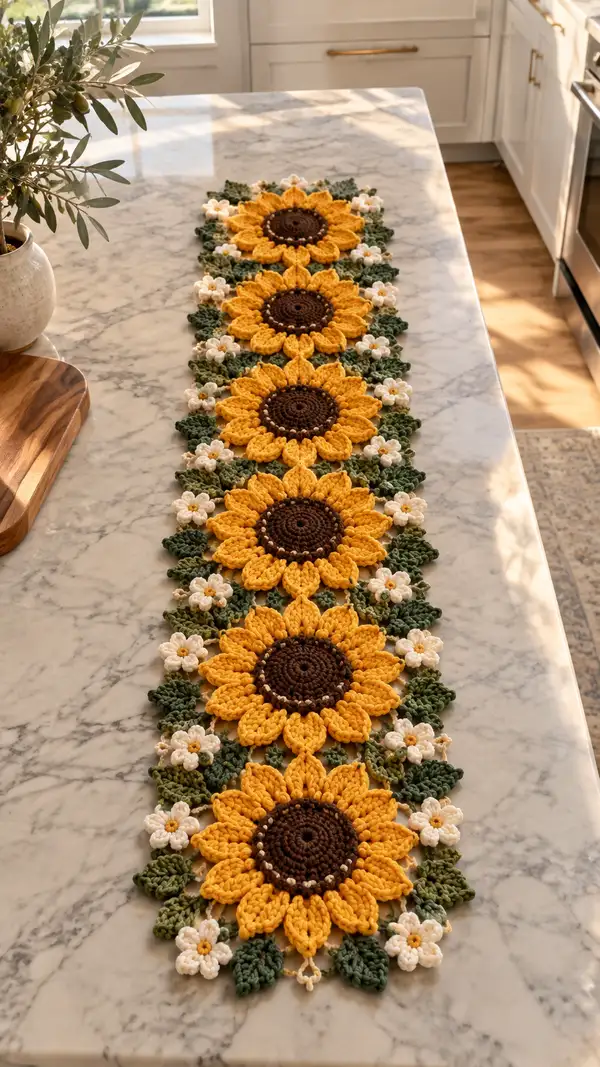
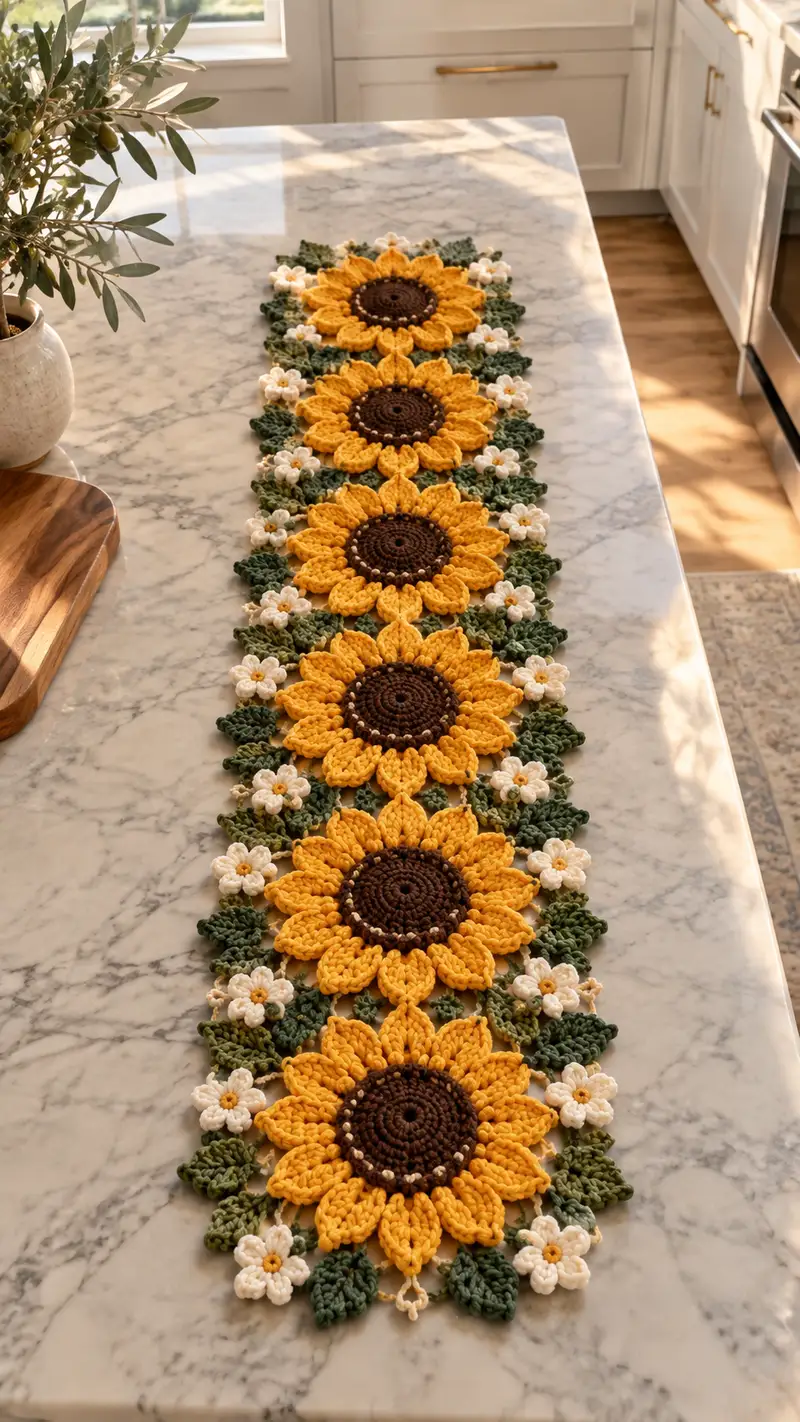
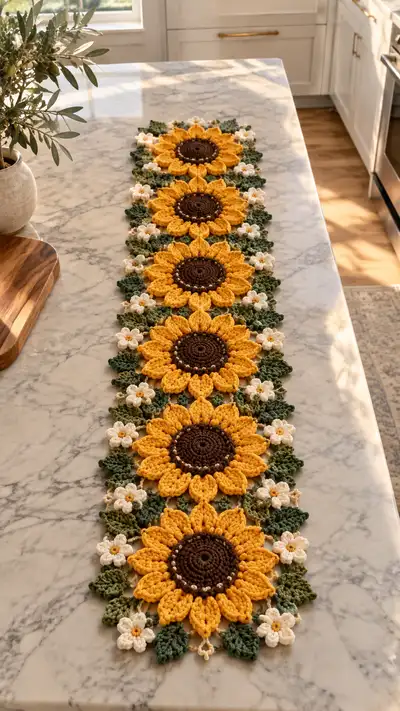
A sunny, handcrafted table runner composed of linked sunflower motifs with textured yellow petals, deep brown centers, soft green leaves and tiny white filler flowers. This pattern guides you through each motif, leaf and join so you can create a long runner just like the photo. The finished runner is decorative, perfect for dining tables, mantels or as a centerpiece runner.
Progress Tracker
0% Complete
— Overview & Construction Method :
Info :
This runner is made of repeat sunflower motifs (one large sunflower motif = center + petal rounds + outer picot/joining ring), paired with leaf clusters and small five-petal filler flowers. Work each motif flat and block before joining. Join motifs side-to-side with a crocheted slip-stitch join and secure leaves/filler flowers in the joining gaps. The runner pictured uses five sunflower motifs linked in a straight line with leaves tucked into the joins. Follow each section carefully for stitch counts and shaping.
Info :
Gauge is not critical for this decorative runner, but consistent tension across motifs will keep spacing uniform. Use a slightly smaller hook for the small white flowers if you prefer tighter, neater petals.
— Sunflower Center (Make 1 per motif) :
Round 1 :
Using deep brown yarn. mr, 6 sc in ring (6)
Round 2 :
Inc in each st around (12)
Round 3 :
(1 sc, inc) x 6 (18)
Round 4 :
(2 sc, inc) x 6 (24)
Round 5 :
(3 sc, inc) x 6 (30)
Round 6 :
(4 sc, inc) x 6 (36)
Round 7 :
1 sc in each st (36)
Round 8 :
1 sc in each st BLO (36)
Info :
The BLO round creates a subtle ridge that helps the seed ring sit slightly raised from the base; keep tension even. Use a stitch marker to mark the start of each round.
Round 9 :
(5 sc, inc) x 6 (42)
Round 10 :
1 sc in each st (42)
Round 11 :
1 sc in each st (42)
Round 12 :
1 sc in each st (42). Fasten off with long tail for joining to petal base if desired
Info :
Optionally embroider small 'seed' dots with a contrasting beige yarn using French knots or tiny surface sl st. If adding a bead ring or decorative dots, sew them after motifs are blocked.
— Seed Contrast Ring (Optional Decorative Round) :
Info :
Optional contrasting beige seeds form a single round of decorative stitches worked into Round 10/11 of the center. This creates a dotted ring between center and petals.
Round 1 :
Attach beige yarn with a sl st to any stitch on Round 9 edge. ch1, *(sl st in next st, ch1) repeat around placing a sl st every other stitch* to create a beaded offset (42 sl st placements). Fasten off and weave ends (42 visible beads)
Info :
If you prefer embroidered beads, leave the beige yarn to embroider later. Ensure beads are evenly spaced by folding the circle visually into quarters and marking four anchor points before adding dots.
— Petal Base Round (Attach petals base to center) :
Info :
Switch to golden yellow yarn to build the petal foundation. You will create 12 primary petal anchors around the center. Count 42 stitches on the outermost round—space anchors every 3-4 stitches to form 12 petals.
Round 1 :
Attach golden yellow with a sl st at a chosen stitch on the center edge. ch1, *ch4, skip 2 sts, sl st in next st* repeat around to make 12 ch-4 loops (12 ch-4 loops)
Round 2 :
Work into each ch-4 loop: (sc, hdc, 3 dc, hdc, sc) in each loop to form a petal base (12 petals) — do not fasten off after final petal
Info :
Make sure each petal base sits flat on the brown center; gently pull loops to even size before completing Row 2. Keep petals aligned by laying the motif flat as you work.
Round 3 :
Slip stitch evenly around base edge to tidy join: sl st in each stitch around the petal base edge (approximately 84 sl st depending on counts). Fasten off and weave in ends
— Textured Petal Layer (Puff/Cluster Petals) :
Info :
To achieve the volumetric petals shown, each petal will receive a puff/cluster layer worked in front of the petal base. We will work 2 rounds of cluster stitches into each petal area to build height and texture. Use same golden yellow yarn.
Round 1 :
Join yarn in the center top of a petal base with a sl st. ch2 (counts as first hdc), *(3-tr cluster: yo, insert in stitch at petal tip, yo pull up loop) x3, yo, draw through 7 loops, ch1, sl st into base at petal center to anchor* Repeat for each petal (12 clusters). End with sl st to secure
Round 2 :
Work a round of sc around the outer edge of the clusters to even the perimeter: 3 sc between clusters as needed for spacing. Adjust to have a final even count approximately 72 sc
Info :
Work each petal's cluster stitches with the same tension; lightly tug loops before finishing each cluster to set the shape. If your puff clusters are too loose, use a smaller hook just for this round.
Round 3 :
Optional: make a decorative picot edge between clusters. *ch3, sl st into 3rd ch from hook (picot), sl st to next cluster anchor* around for a delicate pointy edge. Fasten off and weave ends
— Petal Finishing & Shaping :
Round 1 :
Using surface slip stitch with same yellow, outline each petal top with 6-8 evenly spaced surface sl sts for definition. This adds a ridge and helps petals stand slightly off the center.
Info :
If you want double-layer petals (as pictured with a slightly raised petal) work a second set of smaller petals in front: chain 3 anchors between primary petals and work (sc, 3 dc, sc) into each—this is optional and adds volume.
Round 2 :
Fasten off and block the entire flower flat using light steaming or wet blocking—pin petals evenly spaced and flat.
— Small Five-Petal Flower (Make multiple for filler) :
Round 1 :
Using cream/white yarn. mr, 6 sc in ring (6)
Round 2 :
Ch3 (counts as first dc), *ch2, sl st in next st* repeat around to create 6 small loops for petals (6 loops)
Round 3 :
Into each ch-2 loop: (sc, 3 dc, sc) to form a small five-lobed petal. Join with sl st to starting st. Fasten off leaving a long tail for sewing (approximately 6 small flowers per motif recommended)
Info :
Sew a tiny French knot or a small crochet picot center in a contrasting beige to mimic the tiny seed in each small flower. Block lightly if petals curl.
— Leaf Motif (Make multiple per motif) :
Round 1 :
Using darker green yarn. ch6, sc in 2nd ch from hook, hdc in next, dc in next, hdc in next, 3 sc in last ch; Rotate and work along opposite side: hdc in next, dc in next, hdc in next, sc in last (leaf is worked as a flat crochet leaf from chain) — leave long tail for joining
Info :
This leaf is a long, pointed shape with a textured center. Work all leaves with the same side facing up so that veins are consistent. Make 8 leaves per sunflower motif for the look in the photo (4 per side around the flower).
Round 2 :
Optional: Work a row of surface sl st down the center to create a vein: join yarn at leaf base, sl st along center to tip. Fasten off and weave in end
Round 3 :
Alternate leaves: for variety, also create smaller leaves by starting ch4 and using a reduced pattern: ch4, sc, hdc, sc, 3 sc in top, sc back down opposite side (use for tight spaces). Make approximately 4-6 small leaves per motif
— Outer Joining Loops and Decorative Chains :
Info :
To join motifs seamlessly, we create small loops at the petal tips to crochet into when joining adjacent sunflowers. This establishes consistent spacing and provides attachment points for leaves and small flowers.
Round 1 :
With golden yellow, attach yarn at a petal tip. ch6, sl st at petal tip to anchor, sl st to next petal base stitch. Repeat to create 12 small ch-6 loops around the perimeter (12 loops)
Round 2 :
Chain connectors: Using beige or light yellow, work sl st joins across every other loop so that joining points are offset slightly. This will produce a small decorative chain between flowers when joining rows.
Info :
Ensure you make the same number of connector loops on each motif and place them symmetrically. This prevents a skewed join when assembling the runner.
— Motif Blocking :
Info :
Block each completed sunflower motif flat. Pin to a circular template approximately 8-9 inches across (measured tip to tip) to match photo proportion. Let dry completely before joining to lock shape in place.
— Joining Motifs into a Runner (Join 5 motifs in line shown) :
Info :
Arrange motifs on blocking mat in desired order. Alternate leaf clusters in the junction spaces. The pictured runner uses five sunflower motifs placed with their petal tips nearly touching, joined by slip-stitching through petal tip loops and secure cross-joins at three points per join. Use stitch markers to align loops before joining.
Round 1 :
Place two motifs right sides up, align corresponding ch-6 petal tip loops. Using yarn color that matches petal (golden yellow or beige for a seam that blends), work sl st through one loop of motif A and corresponding loop of motif B across each paired loop you choose to join. Repeat for three evenly spaced joins around the overlapping petal region (approximately 3 sl st joins per adjacent petal group). Continue down entire side to join motifs in a straight line
Round 2 :
For stronger joins, work a second pass: sc in the same joined stitches through both motifs to create a neat, slightly raised seam. This should be done where the runner needs stability (bottom and top joins of each overlap). Fasten off and weave ends
Info :
When joining, keep tension loose enough that motifs lie flat but tight enough to pull them snug. Pin before sewing to check alignment. Add leaves and small flowers into any gaps by sewing them to both motifs at overlapping points.
— Leaf & Filler Placement (per joined gap) :
Info :
Each side of a sunflower join has triangular negative space—use 3-4 leaf pieces and 1-2 small five-petal filler flowers to fill each gap. Sew each leaf at its base to the motif using the long tail left earlier, tucking leaf edges under petals to create an integrated look.
Step :
Arrange 2 large leaves and 2 small leaves alternating around the join, then place a small white flower centrally over the leaf cluster. Sew through the center of the small flower and into both motifs to anchor it tightly. Repeat for each gap between motifs along both sides.
— Outer Edge Decorative Border (Optional) :
Info :
To create the subtle scalloped edge that mirrors the photo, work an edging around the entire outside perimeter after all motifs are joined. This gives a finished look and conceals join tails.
Round 1 :
Using a contrasting light green or beige, attach at any outermost petal tip. ch1, *3 sc in gap between petal clusters, picot (ch3 sl st in 3rd ch), skip small spacing, sl st in next visible stitch* repeat around entire runner perimeter. Aim for an even scallop count. Fasten off and weave ends
Round 2 :
Optional: Work a final row of sc around the back for neatness. Join color to back side and sc evenly around to hide tails and create a tidy border that lifts the runner slightly from the table surface.
— Finishing Touches & Starching/Blocking :
Info :
After assembly, press lightly with steam or spray starch and pin flat if you want a stiffer runner that holds shape. If you prefer a softer runner, only lightly block and avoid starch. Trim all ends carefully and weave inside the seam allowances to hide them.
Info :
For an extra professional touch, sew tiny beige seed knots in the centers of the large brown circles using an embroidery needle and contrasting yarn—this mimics the natural seed texture in the photo.
— Quantity & Layout Notes :
Info :
The photo shows five sunflower motifs joined in a straight line to form a runner approx. 40-50 inches long depending on motif size. Adjust motif count to lengthen or shorten runner. A single motif makes a beautiful centerpiece mat or trivet.
Info :
If you wish to create a wider runner, create two parallel rows of motifs and join together with a decorative lattice of chains and small filler flowers.
— Troubleshooting & Tension Adjustments :
Info :
If petals curl upward, steam-block them gently and pin flat until dry. If petals flop, consider working the petal cluster rounds with a slightly smaller hook to tighten the puff stitches. If joins look sparse, add an extra sc pass through join points.
Info :
When counting petal anchors, ensure each motif has the same number of ch-loops and that loops are evenly spaced. Rework any motif with irregular petal spacing before joining.
This sunflower table runner brings sunshine to your home with textured petals, rich centers and delicate leaf accents — a perfect project for warm-season decor. Each motif is lovingly crafted and the modular construction lets you make it any length you want. Finish with a soft block or gentle starch to suit your table style. 🧶🌻✨