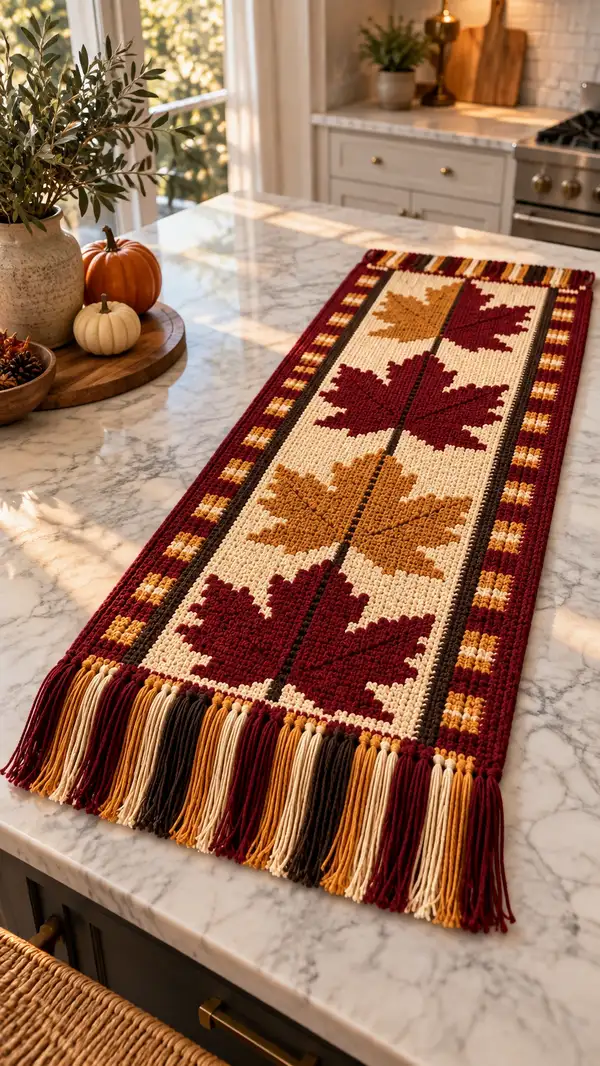
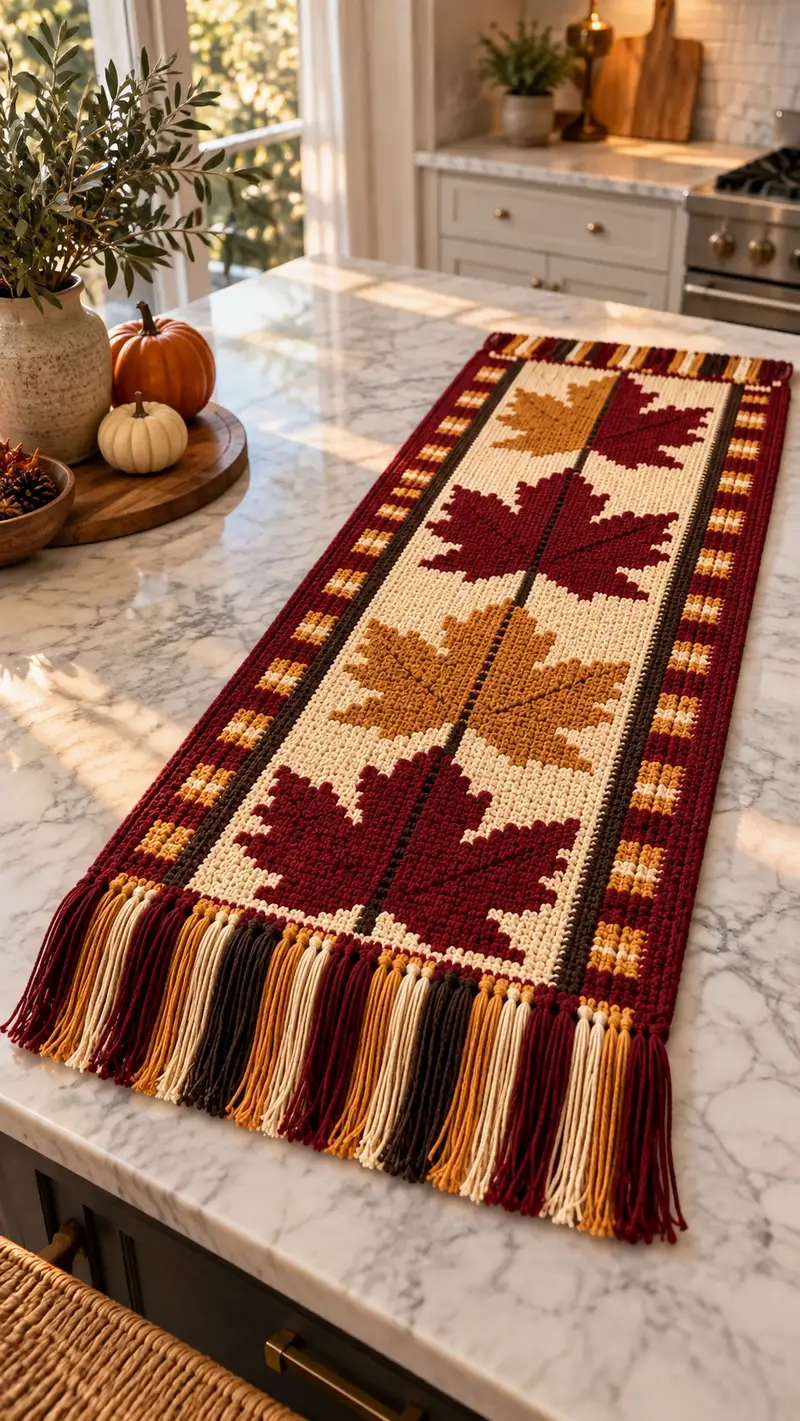
Create a warm, autumn-inspired table runner featuring bold maple leaf motifs, rich burgundy and golden hues, and a textured checkerboard border. This flat tapestry-style crochet project uses single crochet colorwork and carried floats for clean motifs. Finished with a full-length multi-color fringe, it makes a beautiful seasonal centerpiece.
Progress Tracker
0% Complete
— Materials & Gauge :
Info :
Gauge (tapestry single crochet): 16 sc x 18 rows = 10 cm (4 in) using 4.0mm hook in single crochet tapestry. Gauge is important for motif proportions; adjust hook if needed to match fabric density. Runner pattern is written for a foundation chain of 81 stitches across and worked in rows. Finished width using recommended yarn and hook is approximately 12.5 - 13.5 inches; length will depend on number of row repeats—pattern below builds a runner approximately 46-48 inches long before fringe.
— Foundation Chain & Setup :
Row 1 :
Chain 82 (this gives 81 foundation stitches plus 1 turning chain). If you prefer a less stretched starting edge, chain 83 and skip last chain when turning; pattern assumes 81 working stitches across.
Info :
Foundation chain note: Place a stitch marker in the first foundation stitch you work into so it's easier to identify your starting point when tracking columns across each row. The fabric is dense; avoid chaining extra loosely—maintain even tension.
Row 2 :
Working into second chain from hook, sc in each chain across (81 sc). Turn. (81)
Row 3-12 :
Work 1 sc in each stitch across for 10 rows more to create lower border (81) each row. Use A (burgundy) for rows 2-6 to create a solid lower border, then begin the checker reading on row 7 as noted below.
Info :
Lower border: Work the first 6 rows in Outer Border color (A) for a rich anchor. On row 7 you will begin the vertical checker columns on each side—this is worked as color changes in the 6-stitch checker column and should be carried as floats across the back.
— Layout & Column Mapping (81 stitches wide) :
Info :
Column mapping left to right (total 81 stitches): Outer border (8 sts, color A) + Side checker column (6 sts alternating C & MC) + Thin brown column (2 sts, color B) + Left leaf panel (24 sts) + Center divider (1 st, color B) + Right leaf panel (24 sts) + Thin brown column (2 sts, color B) + Side checker column (6 sts) + Outer border (8 sts, color A) = 81 sts total. Keep this map visible while working rows to maintain correct color placement.
— Pattern Charted Approach (Center Panel Detailed Rows) :
Info :
We will work the runner from the lower edge upward. There are four leaf motifs stacked vertically. Each leaf motif uses 19 tapestry rows across the 24-st leaf panel. Between each leaf motif work one spacer row in MC (cream). Leaf colors alternate as you progress up the runner: Leaf 1 (bottom) = M (burgundy), Leaf 2 = C (mustard), Leaf 3 = M (burgundy), Leaf 4 = C (mustard). Center divider column (single B stitch) remains constant every row. The side checker columns are worked using the small 6-st stripe pattern provided at the start of each leaf block; counts shown per row below.
— Lower Border & Transition Rows (Rows 1-12) :
Row 1 :
Chain 82. (foundation)
Row 2 :
Sc in each chain across using A (burgundy). Turn. (81)
Row 3 :
1 sc in each st with A. Turn. (81)
Row 4 :
1 sc in each st with A. Turn. (81)
Row 5 :
1 sc in each st with A. Turn. (81)
Row 6 :
1 sc in each st with A. Turn. (81)
Info :
Rows 2-6 create a sturdy lower border using the burgundy color. Check tension each row and keep edges straight by counting the first and last few stitches periodically.
Row 7 :
Start checker stripe: Work the following across: 8 sc A, 6 sc alternately C/MC (see note below for checker start row: for row 7, work checker as C,C,MC,MC,C,C left to right), 2 sc B, 24 sc MC (start left leaf panel blank), 1 sc B, 24 sc MC (right leaf blank), 2 sc B, 6 sc checker mirrored, 8 sc A. Turn. (81)
Row 8 :
8 sc A, 6 sc checker (alternate pattern for row 8: MC,C,MC,C,MC,C), 2 sc B, 24 sc MC, 1 sc B, 24 sc MC, 2 sc B, 6 sc checker mirrored, 8 sc A. Turn. (81)
Row 9-12 :
Repeat row 7 and 8 patterning so the checker creates a subtle alternating stripe. Keep these 4 rows as the final transition rows before the first leaf motif begins. Each row remains 81 sc.
Info :
For the checker columns: treat the 6-stitch column as its own small tapestry chart; carry both C and MC across where floats are less than 6 stitches. Use small yarn bobbins or clips to manage strands. Keep floats snug behind the work for clean edges.
— Leaf Motif Block 1 (Leaf 1 - Rows 13-31 ; 19 tapestry rows) :
Info :
Leaf 1 is maroon (M). Each of the 19 rows below lists the complete 81-stitch row. Column order: [8 A][6 checker][2 B][24 left leaf panel][1 B center][24 right leaf panel][2 B][6 checker][8 A] — verify sums each row = 81.
Row 13 :
8 sc A, 6 sc checker (pattern row: C,C,MC,MC,C,C), 2 sc B, left leaf: 11 sc MC, 2 sc M, 11 sc MC, 1 sc B, right leaf (symmetrical) 11 sc MC, 2 sc M, 11 sc MC, 2 sc B, 6 sc checker mirrored, 8 sc A. (81)
Row 14 :
8 sc A, 6 sc checker (pattern row), 2 sc B, left leaf: 10 sc MC, 4 sc M, 10 sc MC, 1 sc B, right leaf 10 sc MC, 4 sc M, 10 sc MC, 2 sc B, 6 sc checker, 8 sc A. (81)
Row 15 :
8 sc A, 6 sc checker, 2 sc B, left leaf: 9 sc MC, 6 sc M, 9 sc MC, 1 sc B, right leaf 9 sc MC, 6 sc M, 9 sc MC, 2 sc B, 6 sc checker, 8 sc A. (81)
Row 16 :
8 sc A, 6 sc checker, 2 sc B, left leaf: 8 sc MC, 8 sc M, 8 sc MC, 1 sc B, right leaf 8 sc MC, 8 sc M, 8 sc MC, 2 sc B, 6 sc checker, 8 sc A. (81)
Info :
Continue carrying unused colors on the wrong side as floats. For stretches under 6 stitches consider carrying the color; for longer floats or color changes beyond 6 stitches, twist the yarns to anchor floats to avoid long floats on the back. Keep floats even across rows.
Row 17 :
8 sc A, 6 sc checker, 2 sc B, left leaf: 7 sc MC, 10 sc M, 7 sc MC, 1 sc B, right leaf 7 sc MC, 10 sc M, 7 sc MC, 2 sc B, 6 sc checker, 8 sc A. (81)
Row 18 :
8 sc A, 6 sc checker, 2 sc B, left leaf: 6 sc MC, 12 sc M, 6 sc MC, 1 sc B, right leaf 6 sc MC, 12 sc M, 6 sc MC, 2 sc B, 6 sc checker, 8 sc A. (81)
Row 19 :
8 sc A, 6 sc checker, 2 sc B, left leaf: 5 sc MC, 14 sc M, 5 sc MC, 1 sc B, right leaf 5 sc MC, 14 sc M, 5 sc MC, 2 sc B, 6 sc checker, 8 sc A. (81)
Row 20 :
8 sc A, 6 sc checker, 2 sc B, left leaf: 4 sc MC, 16 sc M, 4 sc MC, 1 sc B, right leaf 4 sc MC, 16 sc M, 4 sc MC, 2 sc B, 6 sc checker, 8 sc A. (81)
Info :
Rows 13-20 expand the leaf horizontally. Keep tension consistent; if motif looks too wide or narrow, adjust by changing hook size on a gauge swatch before continuing. The center brown stitch (B) is a consistent vertical seam—switch to B for that single stitch each row for a crisp divider.
Row 21 :
8 sc A, 6 sc checker, 2 sc B, left leaf: 3 sc MC, 18 sc M, 3 sc MC, 1 sc B, right leaf 3 sc MC, 18 sc M, 3 sc MC, 2 sc B, 6 sc checker, 8 sc A. (81)
Row 22 :
8 sc A, 6 sc checker, 2 sc B, left leaf: 2 sc MC, 20 sc M, 2 sc MC, 1 sc B, right leaf 2 sc MC, 20 sc M, 2 sc MC, 2 sc B, 6 sc checker, 8 sc A. (81)
Row 23 :
8 sc A, 6 sc checker, 2 sc B, left leaf: 3 sc MC, 18 sc M, 3 sc MC, 1 sc B, right leaf 3 sc MC, 18 sc M, 3 sc MC, 2 sc B, 6 sc checker, 8 sc A. (81)
Row 24 :
8 sc A, 6 sc checker, 2 sc B, left leaf: 4 sc MC, 16 sc M, 4 sc MC, 1 sc B, right leaf 4 sc MC, 16 sc M, 4 sc MC, 2 sc B, 6 sc checker, 8 sc A. (81)
Info :
Rows 21-24 begin the contraction of the leaf towards the top tip. Maintain clear separation of panels and always carry/divert yarns behind the B column to avoid tangles. Use stitch markers at column boundaries every 8-12 rows to confirm placement.
Row 25 :
8 sc A, 6 sc checker, 2 sc B, left leaf: 5 sc MC, 14 sc M, 5 sc MC, 1 sc B, right leaf 5 sc MC, 14 sc M, 5 sc MC, 2 sc B, 6 sc checker, 8 sc A. (81)
Row 26 :
8 sc A, 6 sc checker, 2 sc B, left leaf: 6 sc MC, 12 sc M, 6 sc MC, 1 sc B, right leaf 6 sc MC, 12 sc M, 6 sc MC, 2 sc B, 6 sc checker, 8 sc A. (81)
Row 27 :
8 sc A, 6 sc checker, 2 sc B, left leaf: 7 sc MC, 10 sc M, 7 sc MC, 1 sc B, right leaf 7 sc MC, 10 sc M, 7 sc MC, 2 sc B, 6 sc checker, 8 sc A. (81)
Row 28 :
8 sc A, 6 sc checker, 2 sc B, left leaf: 8 sc MC, 8 sc M, 8 sc MC, 1 sc B, right leaf 8 sc MC, 8 sc M, 8 sc MC, 2 sc B, 6 sc checker, 8 sc A. (81)
Row 29 :
8 sc A, 6 sc checker, 2 sc B, left leaf: 9 sc MC, 6 sc M, 9 sc MC, 1 sc B, right leaf 9 sc MC, 6 sc M, 9 sc MC, 2 sc B, 6 sc checker, 8 sc A. (81)
Row 30 :
8 sc A, 6 sc checker, 2 sc B, left leaf: 10 sc MC, 4 sc M, 10 sc MC, 1 sc B, right leaf 10 sc MC, 4 sc M, 10 sc MC, 2 sc B, 6 sc checker, 8 sc A. (81)
Row 31 :
8 sc A, 6 sc checker, 2 sc B, left leaf: 11 sc MC, 2 sc M, 11 sc MC, 1 sc B, right leaf 11 sc MC, 2 sc M, 11 sc MC, 2 sc B, 6 sc checker, 8 sc A. (81)
Info :
Leaf 1 complete (rows 13-31). After row 31, work one spacer row in MC (Row 32) before starting Leaf 2 block with the alternate color. Weave or twist the yarn ends of the motif colors behind the work every 6-8 rows to anchor floats if necessary.
— Spacer Row Between Leaves :
Row 32 :
8 sc A, 6 sc checker (follow checker color order), 2 sc B, 24 sc MC, 1 sc B, 24 sc MC, 2 sc B, 6 sc checker, 8 sc A. (81)
Info :
This single cream spacer row gives breathing room between motifs and resets carried yarn positions. Make sure motifs are centered and that floats are tidy behind the B divider stitch.
— Leaf Motif Block 2 (Leaf 2 - Rows 33-51 ; 19 rows ; mustard tone) :
Info :
Leaf 2 uses C (mustard) as the motif color in the left and right leaf panels for this block. Repeat the sequence used for Leaf 1 but substitute M color with C. Rows are the same structure and counts, only the motif color differs. Below rows 33-51 replicate rows 13-31 counts but with motif color = C.
Row 33 :
8 sc A, 6 sc checker, 2 sc B, left leaf 11 MC, 2 sc C, 11 MC, 1 sc B, right leaf 11 MC, 2 sc C, 11 MC, 2 sc B, 6 sc checker, 8 sc A. (81)
Row 34 :
8 sc A, 6 sc checker, 2 sc B, left leaf 10 MC, 4 sc C, 10 MC, 1 sc B, right leaf 10 MC, 4 sc C, 10 MC, 2 sc B, 6 sc checker, 8 sc A. (81)
Row 35 :
8 sc A, 6 sc checker, 2 sc B, left leaf 9 MC, 6 sc C, 9 MC, 1 sc B, right leaf 9 MC, 6 sc C, 9 MC, 2 sc B, 6 sc checker, 8 sc A. (81)
Row 36 :
8 sc A, 6 sc checker, 2 sc B, left leaf 8 MC, 8 sc C, 8 MC, 1 sc B, right leaf 8 MC, 8 sc C, 8 MC, 2 sc B, 6 sc checker, 8 sc A. (81)
Info :
Repeat pattern expansion rows as in Block 1: rows 33-41 expand to the broadest width, then 42-51 contract symmetrically. Track your row numbers carefully and use a marker or tally to keep leaf stacks aligned.
Row 37 :
8 sc A, 6 sc checker, 2 sc B, left leaf 7 MC, 10 sc C, 7 MC, 1 sc B, right leaf 7 MC, 10 sc C, 7 MC, 2 sc B, 6 sc checker, 8 sc A. (81)
Row 38 :
8 sc A, 6 sc checker, 2 sc B, left leaf 6 MC, 12 sc C, 6 MC, 1 sc B, right leaf 6 MC, 12 sc C, 6 MC, 2 sc B, 6 sc checker, 8 sc A. (81)
Row 39 :
8 sc A, 6 sc checker, 2 sc B, left leaf 5 MC, 14 sc C, 5 MC, 1 sc B, right leaf 5 MC, 14 sc C, 5 MC, 2 sc B, 6 sc checker, 8 sc A. (81)
Row 40 :
8 sc A, 6 sc checker, 2 sc B, left leaf 4 MC, 16 sc C, 4 MC, 1 sc B, right leaf 4 MC, 16 sc C, 4 MC, 2 sc B, 6 sc checker, 8 sc A. (81)
Row 41 :
8 sc A, 6 sc checker, 2 sc B, left leaf 3 MC, 18 sc C, 3 MC, 1 sc B, right leaf 3 MC, 18 sc C, 3 MC, 2 sc B, 6 sc checker, 8 sc A. (81)
Row 42 :
8 sc A, 6 sc checker, 2 sc B, left leaf 2 MC, 20 sc C, 2 MC, 1 sc B, right leaf 2 MC, 20 sc C, 2 MC, 2 sc B, 6 sc checker, 8 sc A. (81)
Row 43 :
8 sc A, 6 sc checker, 2 sc B, left leaf 3 MC, 18 sc C, 3 MC, 1 sc B, right leaf 3 MC, 18 sc C, 3 MC, 2 sc B, 6 sc checker, 8 sc A. (81)
Row 44 :
8 sc A, 6 sc checker, 2 sc B, left leaf 4 MC, 16 sc C, 4 MC, 1 sc B, right leaf 4 MC, 16 sc C, 4 MC, 2 sc B, 6 sc checker, 8 sc A. (81)
Row 45 :
8 sc A, 6 sc checker, 2 sc B, left leaf 5 MC, 14 sc C, 5 MC, 1 sc B, right leaf 5 MC, 14 sc C, 5 MC, 2 sc B, 6 sc checker, 8 sc A. (81)
Row 46 :
8 sc A, 6 sc checker, 2 sc B, left leaf 6 MC, 12 sc C, 6 MC, 1 sc B, right leaf 6 MC, 12 sc C, 6 MC, 2 sc B, 6 sc checker, 8 sc A. (81)
Row 47 :
8 sc A, 6 sc checker, 2 sc B, left leaf 7 MC, 10 sc C, 7 MC, 1 sc B, right leaf 7 MC, 10 sc C, 7 MC, 2 sc B, 6 sc checker, 8 sc A. (81)
Row 48 :
8 sc A, 6 sc checker, 2 sc B, left leaf 8 MC, 8 sc C, 8 MC, 1 sc B, right leaf 8 MC, 8 sc C, 8 MC, 2 sc B, 6 sc checker, 8 sc A. (81)
Row 49 :
8 sc A, 6 sc checker, 2 sc B, left leaf 9 MC, 6 sc C, 9 MC, 1 sc B, right leaf 9 MC, 6 sc C, 9 MC, 2 sc B, 6 sc checker, 8 sc A. (81)
Row 50 :
8 sc A, 6 sc checker, 2 sc B, left leaf 10 MC, 4 sc C, 10 MC, 1 sc B, right leaf 10 MC, 4 sc C, 10 MC, 2 sc B, 6 sc checker, 8 sc A. (81)
Row 51 :
8 sc A, 6 sc checker, 2 sc B, left leaf 11 MC, 2 sc C, 11 MC, 1 sc B, right leaf 11 MC, 2 sc C, 11 MC, 2 sc B, 6 sc checker, 8 sc A. (81)
Info :
Leaf 2 complete. Row 52 will be a spacer row in cream before Leaf 3 starts. Use this spacer to tidy floats and swap which yarns are carried across the inside so you are ready to work the next leaf color without excess tangling.
— Spacer Row (Row 52) :
Row 52 :
8 sc A, 6 sc checker, 2 sc B, 24 sc MC, 1 sc B, 24 sc MC, 2 sc B, 6 sc checker, 8 sc A. (81)
— Leaf Motif Block 3 (Leaf 3 - Rows 53-71 ; 19 rows ; maroon) :
Info :
Leaf 3 repeats the counts of Leaf 1 but with M (maroon) as the motif color. Rows 53-71 mirror rows 13-31 exactly with motif = M. Work rows 53-71 as below.
Row 53 :
8 sc A, 6 sc checker, 2 sc B, left leaf 11 MC, 2 sc M, 11 MC, 1 sc B, right leaf 11 MC, 2 sc M, 11 MC, 2 sc B, 6 sc checker, 8 sc A. (81)
Row 54 :
8 sc A, 6 sc checker, 2 sc B, left leaf 10 MC, 4 sc M, 10 MC, 1 sc B, right leaf 10 MC, 4 sc M, 10 MC, 2 sc B, 6 sc checker, 8 sc A. (81)
Row 55 :
8 sc A, 6 sc checker, 2 sc B, left leaf 9 MC, 6 sc M, 9 MC, 1 sc B, right leaf 9 MC, 6 sc M, 9 MC, 2 sc B, 6 sc checker, 8 sc A. (81)
Row 56 :
8 sc A, 6 sc checker, 2 sc B, left leaf 8 MC, 8 sc M, 8 MC, 1 sc B, right leaf 8 MC, 8 sc M, 8 MC, 2 sc B, 6 sc checker, 8 sc A. (81)
Info :
Rows 53-60 expand the leaf; remember that the right leaf panel always mirrors the left in counts. You can choose to invert the color order in the checker columns at the far right to create symmetry or keep them mirrored as described.
Row 57 :
8 sc A, 6 sc checker, 2 sc B, left leaf 7 MC, 10 sc M, 7 MC, 1 sc B, right leaf 7 MC, 10 sc M, 7 MC, 2 sc B, 6 sc checker, 8 sc A. (81)
Row 58 :
8 sc A, 6 sc checker, 2 sc B, left leaf 6 MC, 12 sc M, 6 MC, 1 sc B, right leaf 6 MC, 12 sc M, 6 MC, 2 sc B, 6 sc checker, 8 sc A. (81)
Row 59 :
8 sc A, 6 sc checker, 2 sc B, left leaf 5 MC, 14 sc M, 5 MC, 1 sc B, right leaf 5 MC, 14 sc M, 5 MC, 2 sc B, 6 sc checker, 8 sc A. (81)
Row 60 :
8 sc A, 6 sc checker, 2 sc B, left leaf 4 MC, 16 sc M, 4 MC, 1 sc B, right leaf 4 MC, 16 sc M, 4 MC, 2 sc B, 6 sc checker, 8 sc A. (81)
Row 61 :
8 sc A, 6 sc checker, 2 sc B, left leaf 3 MC, 18 sc M, 3 MC, 1 sc B, right leaf 3 MC, 18 sc M, 3 MC, 2 sc B, 6 sc checker, 8 sc A. (81)
Row 62 :
8 sc A, 6 sc checker, 2 sc B, left leaf 2 MC, 20 sc M, 2 MC, 1 sc B, right leaf 2 MC, 20 sc M, 2 MC, 2 sc B, 6 sc checker, 8 sc A. (81)
Row 63 :
8 sc A, 6 sc checker, 2 sc B, left leaf 3 MC, 18 sc M, 3 MC, 1 sc B, right leaf 3 MC, 18 sc M, 3 MC, 2 sc B, 6 sc checker, 8 sc A. (81)
Row 64 :
8 sc A, 6 sc checker, 2 sc B, left leaf 4 MC, 16 sc M, 4 MC, 1 sc B, right leaf 4 MC, 16 sc M, 4 MC, 2 sc B, 6 sc checker, 8 sc A. (81)
Row 65 :
8 sc A, 6 sc checker, 2 sc B, left leaf 5 MC, 14 sc M, 5 MC, 1 sc B, right leaf 5 MC, 14 sc M, 5 MC, 2 sc B, 6 sc checker, 8 sc A. (81)
Row 66 :
8 sc A, 6 sc checker, 2 sc B, left leaf 6 MC, 12 sc M, 6 MC, 1 sc B, right leaf 6 MC, 12 sc M, 6 MC, 2 sc B, 6 sc checker, 8 sc A. (81)
Row 67 :
8 sc A, 6 sc checker, 2 sc B, left leaf 7 MC, 10 sc M, 7 MC, 1 sc B, right leaf 7 MC, 10 sc M, 7 MC, 2 sc B, 6 sc checker, 8 sc A. (81)
Row 68 :
8 sc A, 6 sc checker, 2 sc B, left leaf 8 MC, 8 sc M, 8 MC, 1 sc B, right leaf 8 MC, 8 sc M, 8 MC, 2 sc B, 6 sc checker, 8 sc A. (81)
Row 69 :
8 sc A, 6 sc checker, 2 sc B, left leaf 9 MC, 6 sc M, 9 MC, 1 sc B, right leaf 9 MC, 6 sc M, 9 MC, 2 sc B, 6 sc checker, 8 sc A. (81)
Row 70 :
8 sc A, 6 sc checker, 2 sc B, left leaf 10 MC, 4 sc M, 10 MC, 1 sc B, right leaf 10 MC, 4 sc M, 10 MC, 2 sc B, 6 sc checker, 8 sc A. (81)
Row 71 :
8 sc A, 6 sc checker, 2 sc B, left leaf 11 MC, 2 sc M, 11 MC, 1 sc B, right leaf 11 MC, 2 sc M, 11 MC, 2 sc B, 6 sc checker, 8 sc A. (81)
Info :
Leaf 3 complete. Prepare Row 72 as a spacer row in MC to transition to the final leaf block. Check for any pulled floats or twisted yarns as you near the top of the runner.
— Spacer Row (Row 72) :
Row 72 :
8 sc A, 6 sc checker, 2 sc B, 24 sc MC, 1 sc B, 24 sc MC, 2 sc B, 6 sc checker, 8 sc A. (81)
— Leaf Motif Block 4 (Leaf 4 - Rows 73-91 ; 19 rows ; mustard) :
Info :
Leaf 4 uses mustard C again. Rows 73-91 mirror the structure of Leaf 2 (rows 33-51) with motif color = C. Follow the same counts and pattern repeats as before.
Row 73 :
8 sc A, 6 sc checker, 2 sc B, left leaf 11 MC, 2 sc C, 11 MC, 1 sc B, right leaf 11 MC, 2 sc C, 11 MC, 2 sc B, 6 sc checker, 8 sc A. (81)
Row 74 :
8 sc A, 6 sc checker, 2 sc B, left leaf 10 MC, 4 sc C, 10 MC, 1 sc B, right leaf 10 MC, 4 sc C, 10 MC, 2 sc B, 6 sc checker, 8 sc A. (81)
Row 75 :
8 sc A, 6 sc checker, 2 sc B, left leaf 9 MC, 6 sc C, 9 MC, 1 sc B, right leaf 9 MC, 6 sc C, 9 MC, 2 sc B, 6 sc checker, 8 sc A. (81)
Row 76 :
8 sc A, 6 sc checker, 2 sc B, left leaf 8 MC, 8 sc C, 8 MC, 1 sc B, right leaf 8 MC, 8 sc C, 8 MC, 2 sc B, 6 sc checker, 8 sc A. (81)
Info :
Rows 73-80 expand the final leaf, rows 81-91 contract it. Keep your yarn tidy and use bobbins for the mustard and maroon colors to avoid entangling with the cream background.
Row 77 :
8 sc A, 6 sc checker, 2 sc B, left leaf 7 MC, 10 sc C, 7 MC, 1 sc B, right leaf 7 MC, 10 sc C, 7 MC, 2 sc B, 6 sc checker, 8 sc A. (81)
Row 78 :
8 sc A, 6 sc checker, 2 sc B, left leaf 6 MC, 12 sc C, 6 MC, 1 sc B, right leaf 6 MC, 12 sc C, 6 MC, 2 sc B, 6 sc checker, 8 sc A. (81)
Row 79 :
8 sc A, 6 sc checker, 2 sc B, left leaf 5 MC, 14 sc C, 5 MC, 1 sc B, right leaf 5 MC, 14 sc C, 5 MC, 2 sc B, 6 sc checker, 8 sc A. (81)
Row 80 :
8 sc A, 6 sc checker, 2 sc B, left leaf 4 MC, 16 sc C, 4 MC, 1 sc B, right leaf 4 MC, 16 sc C, 4 MC, 2 sc B, 6 sc checker, 8 sc A. (81)
Row 81 :
8 sc A, 6 sc checker, 2 sc B, left leaf 3 MC, 18 sc C, 3 MC, 1 sc B, right leaf 3 MC, 18 sc C, 3 MC, 2 sc B, 6 sc checker, 8 sc A. (81)
Row 82 :
8 sc A, 6 sc checker, 2 sc B, left leaf 2 MC, 20 sc C, 2 MC, 1 sc B, right leaf 2 MC, 20 sc C, 2 MC, 2 sc B, 6 sc checker, 8 sc A. (81)
Row 83 :
8 sc A, 6 sc checker, 2 sc B, left leaf 3 MC, 18 sc C, 3 MC, 1 sc B, right leaf 3 MC, 18 sc C, 3 MC, 2 sc B, 6 sc checker, 8 sc A. (81)
Row 84 :
8 sc A, 6 sc checker, 2 sc B, left leaf 4 MC, 16 sc C, 4 MC, 1 sc B, right leaf 4 MC, 16 sc C, 4 MC, 2 sc B, 6 sc checker, 8 sc A. (81)
Row 85 :
8 sc A, 6 sc checker, 2 sc B, left leaf 5 MC, 14 sc C, 5 MC, 1 sc B, right leaf 5 MC, 14 sc C, 5 MC, 2 sc B, 6 sc checker, 8 sc A. (81)
Row 86 :
8 sc A, 6 sc checker, 2 sc B, left leaf 6 MC, 12 sc C, 6 MC, 1 sc B, right leaf 6 MC, 12 sc C, 6 MC, 2 sc B, 6 sc checker, 8 sc A. (81)
Row 87 :
8 sc A, 6 sc checker, 2 sc B, left leaf 7 MC, 10 sc C, 7 MC, 1 sc B, right leaf 7 MC, 10 sc C, 7 MC, 2 sc B, 6 sc checker, 8 sc A. (81)
Row 88 :
8 sc A, 6 sc checker, 2 sc B, left leaf 8 MC, 8 sc C, 8 MC, 1 sc B, right leaf 8 MC, 8 sc C, 8 MC, 2 sc B, 6 sc checker, 8 sc A. (81)
Row 89 :
8 sc A, 6 sc checker, 2 sc B, left leaf 9 MC, 6 sc C, 9 MC, 1 sc B, right leaf 9 MC, 6 sc C, 9 MC, 2 sc B, 6 sc checker, 8 sc A. (81)
Row 90 :
8 sc A, 6 sc checker, 2 sc B, left leaf 10 MC, 4 sc C, 10 MC, 1 sc B, right leaf 10 MC, 4 sc C, 10 MC, 2 sc B, 6 sc checker, 8 sc A. (81)
Row 91 :
8 sc A, 6 sc checker, 2 sc B, left leaf 11 MC, 2 sc C, 11 MC, 1 sc B, right leaf 11 MC, 2 sc C, 11 MC, 2 sc B, 6 sc checker, 8 sc A. (81)
Info :
Leaf 4 (rows 73-91) complete. After row 91, we will begin the top transition and border rows to match the bottom and create a balanced runner. Make sure all floats are tidy; weave in short floats as you go if necessary. Now work the top transition rows.
— Top Transition & Upper Border Rows (Rows 92-104) :
Row 92 :
8 sc A, 6 sc checker, 2 sc B, 24 sc MC, 1 sc B, 24 sc MC, 2 sc B, 6 sc checker, 8 sc A. (81)
Row 93 :
8 sc A, 6 sc checker (work the checker columns as alternating rows for visual balance), 2 sc B, 24 sc MC, 1 sc B, 24 sc MC, 2 sc B, 6 sc checker, 8 sc A. (81)
Row 94-98 :
Repeat 92-93 alternation for five rows to build a balanced top panel that mirrors the lower transitional area. Keep using MC for the center 24-st panels so the leaves are framed evenly. (81)
Info :
If you prefer a slightly wider top border, add additional rows of A (burgundy) after completing the checker alternation. The pattern here uses sufficient rows to balance the runner visually with the lower border.
Row 99 :
Work 1 sc in each st with A for a solid top border row. (81)
Row 100 :
Repeat Row 99 with A. (81)
Row 101 :
Repeat Row 99 with A. (81)
Row 102 :
Repeat Row 99 with A. (81)
Row 103 :
Repeat Row 99 with A. (81)
Row 104 :
Repeat Row 99 with A. (81)
Info :
Top border complete. Fasten off and weave in any long tail ends if you will be adding assembled fringe next. If you want a longer runner, you can add more motif repeats here before finishing border rows.
— Finishing Edge — Reverse Single Crochet (Optional) :
Info :
For a neat raised edge, pick up your hook at the top right corner and work 1 rnd reverse single crochet (crab stitch) along the top edge, then down the sides and across the bottom. For this flat runner, you may prefer to keep the simple sc edge as worked. If working crab stitch: join A, sl st to corner, ch 1, crab st in each row-end loop across. Secure and weave in ends.
— Fringe Preparation & Attachment :
Info :
Fringe in the photo uses five colors: A (burgundy), C (mustard), MC (cream), B (brown), plus another accent if desired. Fringe length when folded ~5.5-6 inches (total strand length double = 11-12 inches). Cut multiple strands folded in half and attach using a lark's head knot into each stitch along the lower edge. Space fringe bundles into every stitch across the bottom edge or every other stitch depending on desired density.
Row 105 :
Prepare fringe: Cut 6-8 strands of each color to 11.5" length per bundle for a full, dense fringe. Each bundle will be folded in half to form a loop. You will attach bundles across 81 edge positions—if attaching to every stitch use one bundle per stitch; for slightly lighter fringe attach to every other stitch using about 40 bundles evenly spaced.
Row 106 :
Attach Fringe: Insert hook into first stitch at edge, fold bundle loop over hook, pull through to form a loop, pull ends through loop and tighten to form a secure lark's head knot. Repeat across chosen spacing. Alternate colors as desired to echo checker/border colors—e.g., sequence (A, C, MC, B, A) per bundle repeated to create the pictured multi-color look.
Info :
For the pictured look: group 6 strands per color by bundle, attach in sequence: A, MC, C, B, A across each group of 5 stitches and repeat. Trim ends straight and block the fringe if necessary to tidy the lengths.
— Weaving In & Blocking :
Info :
Weave in all floating yarn tails from colorwork on the wrong side using a yarn needle, following the floats for 2-3 cm to secure. Lightly steam or wet block the runner to square up edges: pin to blocking mat and spray or steam lightly, smoothing motifs and fringe. Allow to dry completely before trimming fringe edges even.
Finishing :
Trim fringe to desired even length and give one last press/steam if needed. Your runner is now ready for display.
Info :
Storage tip: Store flat or rolled to preserve fringe and avoid creasing. Spot clean with a gentle detergent; avoid machine washing if yarns are delicate—test a sample if unsure.
This autumn leaf runner is a satisfying tapestry colorwork project that brings cozy seasonal style to your home. Each leaf motif is crisp and bold, framed by a classic checker and rich burgundy borders, finished with a playful multicolor fringe. It's both decorative and durable—perfect for festive tables or everyday warmth. Enjoy every stitch and the peaceful rhythm of colorwork as the runner comes to life. 🍂🧶