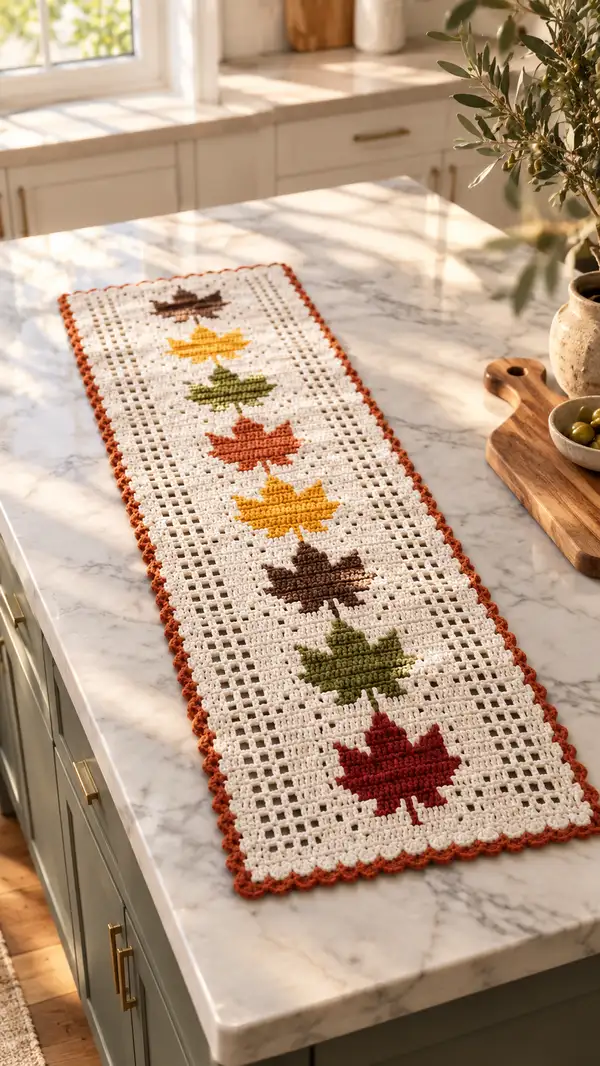
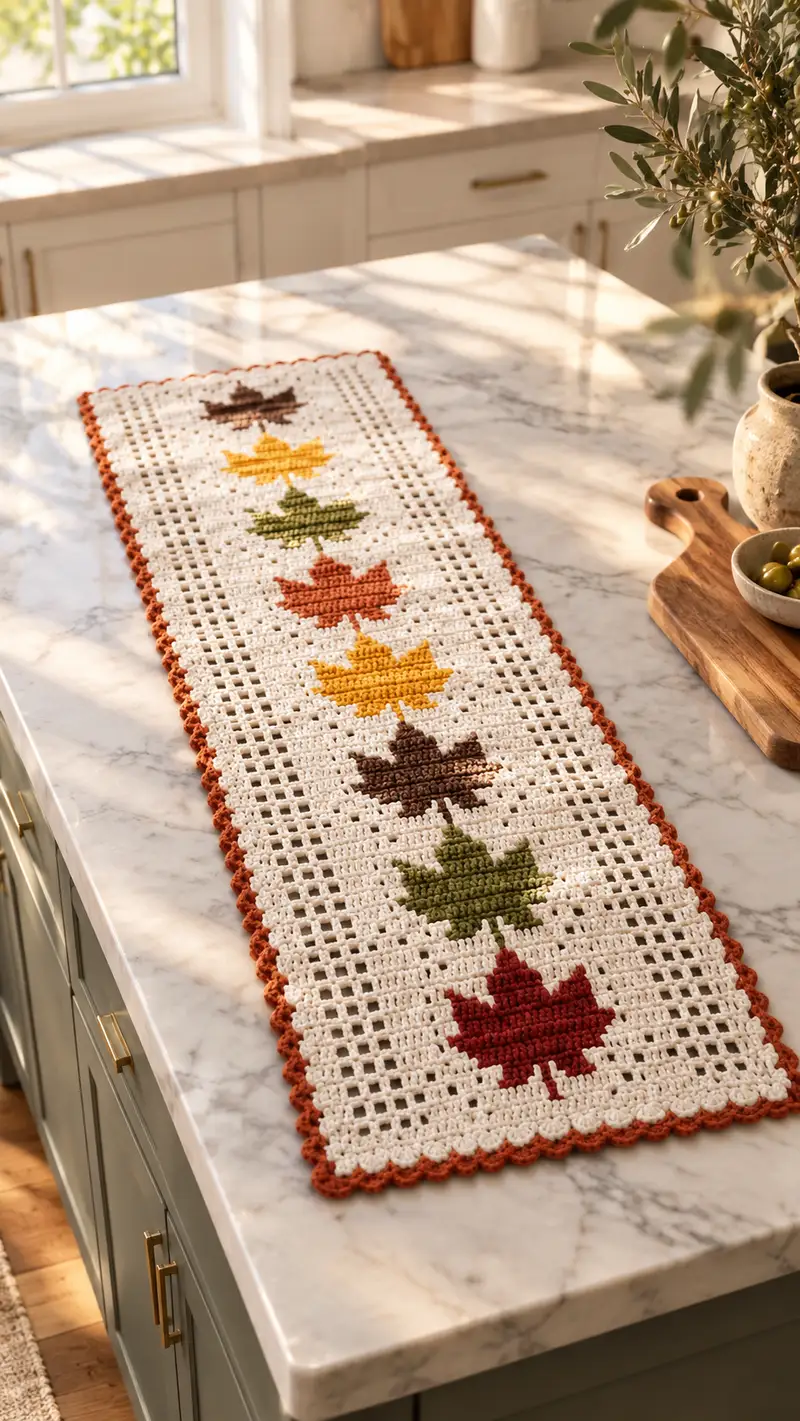
This elegant rectangular table runner features a classic filet crochet grid in a warm cream background with seven stylized maple leaves stacked down the center in autumn hues. A rust-colored scalloped edge frames the runner for a finished, cozy look—perfect for fall tabletops, sideboards, or holiday displays. The pattern uses simple filet techniques and colorwork (tapestry) to place the leaves precisely while keeping the overall construction flat and neat. Suitable for making multiple sizes by adjusting mesh repeats.
Progress Tracker
0% Complete
— Foundation :
Row 1 :
Ch 83 (3 x 27 meshes + 2). This foundation chain creates 27 meshes across the width of the runner. Work a marker at chain 1 side and chain 83 side to keep edges straight.
Info :
The pattern is worked in filet crochet: each "mesh" equals 3 chain units in the foundation. An open mesh is made of 1 dc + ch2 (occupies 3 base chains). A solid mesh is made of 3 dc in successive spaces (also occupies 3 base chains). Use the base formula: foundation chains = 3 x number_of_meshes + 2.
Row 2 :
Turn, ch 3 (counts as first dc), dc in 4th ch from hook, *ch2, skip 2 ch, dc in next ch*; rep across to end. End with dc in top of turning ch-3. (27 open meshes — 27 dc total)
Row 3 :
Ch 3, turn. Repeat Row 2: 27 open meshes. (27 dc total)
Row 4 :
Ch 3, turn. Repeat Row 2. (27 dc total)
Row 5 :
Ch 3, turn. Repeat Row 2. (27 dc total)
Info :
Work these first 6 open rows to create a balanced top margin. Keep stitches even and count meshes: there should be 27 meshes each row. Place a stitch marker in the center mesh (mesh 14) to help align maple leaves vertically later.
Row 6 :
Ch 3, turn. Repeat Row 2. (27 dc total)
Row 7 :
Ch 3, turn. Repeat Row 2. (27 dc total)
Info :
We will begin the first maple leaf on Row 8. Each leaf is worked as a set of 11 consecutive rows of solid meshes arranged symmetrically across the center meshes. Leaf colors change per leaf; I'll indicate color change info before the row where the leaf starts.
Row 8 (Leaf 1, Row 1) :
Info: Change to deep red yarn for Leaf 1. Carry cream background along WS or work tapestry technique, catching floats neatly every 6–8 meshes. Ch 3, turn. Work 13 open meshes (dc, ch2) across first 13 meshes, then 1 solid mesh (3 dc) in central mesh, then 13 open meshes to edge. (solid=1 -> 29 dc total)
Row 9 (Leaf 1, Row 2) :
Ch 3, turn. Work 12 open meshes, 3 solid meshes (3 dc x 3 = 9 dc across those 3 meshes), 12 open meshes. (solid=3 -> 33 dc total)
Row 10 (Leaf 1, Row 3) :
Ch 3, turn. Work 10 open meshes, 7 solid meshes (3 dc x 7), 10 open meshes. (solid=7 -> 41 dc total)
Row 11 (Leaf 1, Row 4) :
Ch 3, turn. Work 8 open meshes, 11 solid meshes (3 dc x 11), 8 open meshes. (solid=11 -> 49 dc total)
Row 12 (Leaf 1, Row 5) :
Ch 3, turn. Work 6 open meshes, 15 solid meshes (3 dc x 15), 6 open meshes. (solid=15 -> 57 dc total)
Info :
If you prefer to work each solid mesh in background color with an overlay, you can alternatively surface-slip-stitch the leaf after completing the background. The tapestry method (changing colors and carrying the unused yarn) makes the leaf part of the fabric for cleaner edges.
Row 13 (Leaf 1, Row 6) :
Ch 3, turn. Work 8 open meshes, 11 solid meshes, 8 open meshes. (solid=11 -> 49 dc total)
Row 14 (Leaf 1, Row 7) :
Ch 3, turn. Work 9 open meshes, 9 solid meshes, 9 open meshes. (solid=9 -> 45 dc total)
Row 15 (Leaf 1, Row 8) :
Ch 3, turn. Work 10 open meshes, 7 solid meshes, 10 open meshes. (solid=7 -> 41 dc total)
Row 16 (Leaf 1, Row 9) :
Ch 3, turn. Work 11 open meshes, 5 solid meshes, 11 open meshes. (solid=5 -> 37 dc total)
Row 17 (Leaf 1, Row 10) :
Ch 3, turn. Work 12 open meshes, 3 solid meshes, 12 open meshes. (solid=3 -> 33 dc total)
Row 18 (Leaf 1, Row 11) :
Ch 3, turn. Work 13 open meshes, 1 solid mesh, 13 open meshes. (solid=1 -> 29 dc total)
Row 19 :
Info: Change back to Cream for spacer rows. Ch 3, turn. Work 27 open meshes across. (27 dc total) - Begin a 3-row open spacer between leaves.
Row 20 :
Ch 3, turn. Repeat Row 19: 27 open meshes. (27 dc total)
Row 21 :
Ch 3, turn. Repeat Row 19: 27 open meshes. (27 dc total)
Info :
Between leaves use 3 fully open rows to readably separate motifs. Continue carrying background color (Cream) when not working leaf color; catch floats every 6–8 meshes to keep back tidy.
Row 22 (Leaf 2, Row 1) :
Info: Change to golden yellow yarn for Leaf 2. Ch 3, turn. Work 13 open, 1 solid (center), 13 open. (solid=1 -> 29 dc total)
Row 23 (Leaf 2, Row 2) :
Ch 3, turn. Work 12 open, 3 solid, 12 open. (solid=3 -> 33 dc total)
Row 24 (Leaf 2, Row 3) :
Ch 3, turn. Work 10 open, 7 solid, 10 open. (solid=7 -> 41 dc total)
Row 25 (Leaf 2, Row 4) :
Ch 3, turn. Work 8 open, 11 solid, 8 open. (solid=11 -> 49 dc total)
Row 26 (Leaf 2, Row 5) :
Ch 3, turn. Work 6 open, 15 solid, 6 open. (solid=15 -> 57 dc total)
Info :
If you find color changes mid-row fiddly, consider doing the leaf color in small separate bobbins or join new color at the first dc of a solid group and switch back to background at the final dc of that group. Weave or tie off ends neatly on the WS as you go.
Row 27 (Leaf 2, Row 6) :
Ch 3, turn. Work 8 open, 11 solid, 8 open. (solid=11 -> 49 dc total)
Row 28 (Leaf 2, Row 7) :
Ch 3, turn. Work 9 open, 9 solid, 9 open. (solid=9 -> 45 dc total)
Row 29 (Leaf 2, Row 8) :
Ch 3, turn. Work 10 open, 7 solid, 10 open. (solid=7 -> 41 dc total)
Row 30 (Leaf 2, Row 9) :
Ch 3, turn. Work 11 open, 5 solid, 11 open. (solid=5 -> 37 dc total)
Row 31 (Leaf 2, Row 10) :
Ch 3, turn. Work 12 open, 3 solid, 12 open. (solid=3 -> 33 dc total)
Row 32 (Leaf 2, Row 11) :
Ch 3, turn. Work 13 open, 1 solid, 13 open. (solid=1 -> 29 dc total)
Row 33 :
Info: Change to Cream for spacer rows. Ch 3, turn. Work 27 open meshes. (27 dc total)
Row 34 :
Ch 3, turn. Repeat Row 33: 27 open meshes. (27 dc total)
Row 35 :
Ch 3, turn. Repeat Row 33: 27 open meshes. (27 dc total)
Info :
Leaf 3 will be rust orange; note that some leaves may be darker or lighter based on yarn dye lot. Keep track of which color you used for each leaf if repeating the runner.
Row 36 (Leaf 3, Row 1) :
Info: Join rust orange for Leaf 3. Ch 3, turn. Work 13 open, 1 solid, 13 open. (solid=1 -> 29 dc total)
Row 37 (Leaf 3, Row 2) :
Ch 3, turn. Work 12 open, 3 solid, 12 open. (solid=3 -> 33 dc total)
Row 38 (Leaf 3, Row 3) :
Ch 3, turn. Work 10 open, 7 solid, 10 open. (solid=7 -> 41 dc total)
Row 39 (Leaf 3, Row 4) :
Ch 3, turn. Work 8 open, 11 solid, 8 open. (solid=11 -> 49 dc total)
Row 40 (Leaf 3, Row 5) :
Ch 3, turn. Work 6 open, 15 solid, 6 open. (solid=15 -> 57 dc total)
Info :
As you change leaf colors, always finish the last dc in the previous color and start the first dc of the new color with the new yarn on the last yarn-over of the previous stitch for a clean join. This avoids loose loops and visible knots in the front.
Row 41 (Leaf 3, Row 6) :
Ch 3, turn. Work 8 open, 11 solid, 8 open. (solid=11 -> 49 dc total)
Row 42 (Leaf 3, Row 7) :
Ch 3, turn. Work 9 open, 9 solid, 9 open. (solid=9 -> 45 dc total)
Row 43 (Leaf 3, Row 8) :
Ch 3, turn. Work 10 open, 7 solid, 10 open. (solid=7 -> 41 dc total)
Row 44 (Leaf 3, Row 9) :
Ch 3, turn. Work 11 open, 5 solid, 11 open. (solid=5 -> 37 dc total)
Row 45 (Leaf 3, Row 10) :
Ch 3, turn. Work 12 open, 3 solid, 12 open. (solid=3 -> 33 dc total)
Row 46 (Leaf 3, Row 11) :
Ch 3, turn. Work 13 open, 1 solid, 13 open. (solid=1 -> 29 dc total)
Row 47 :
Info: Change to Cream for spacer. Ch 3, turn. Work 27 open meshes. (27 dc total)
Row 48 :
Ch 3, turn. Repeat Row 47: 27 open. (27 dc)
Row 49 :
Ch 3, turn. Repeat Row 47: 27 open. (27 dc)
Info :
Leaf 4 will be olive green; if you want mirrored or offset leaves, you can shift the solid block positions by one mesh left or right—this pattern keeps all leaves centered for a classic stacked look.
Row 50 (Leaf 4, Row 1) :
Info: Join olive green for Leaf 4. Ch 3, turn. Work 13 open, 1 solid, 13 open. (solid=1 -> 29 dc total)
Row 51 (Leaf 4, Row 2) :
Ch 3, turn. Work 12 open, 3 solid, 12 open. (solid=3 -> 33 dc total)
Row 52 (Leaf 4, Row 3) :
Ch 3, turn. Work 10 open, 7 solid, 10 open. (solid=7 -> 41 dc total)
Row 53 (Leaf 4, Row 4) :
Ch 3, turn. Work 8 open, 11 solid, 8 open. (solid=11 -> 49 dc total)
Row 54 (Leaf 4, Row 5) :
Ch 3, turn. Work 6 open, 15 solid, 6 open. (solid=15 -> 57 dc total)
Info :
When working solid meshes, crochet 3 dc into successive spaces (or into successive dc tops on rows above). Be mindful of tension when switching between many dc in a row and open meshes with ch2; keep a steady rhythm to avoid pulling fabric in.
Row 55 (Leaf 4, Row 6) :
Ch 3, turn. Work 8 open, 11 solid, 8 open. (solid=11 -> 49 dc total)
Row 56 (Leaf 4, Row 7) :
Ch 3, turn. Work 9 open, 9 solid, 9 open. (solid=9 -> 45 dc total)
Row 57 (Leaf 4, Row 8) :
Ch 3, turn. Work 10 open, 7 solid, 10 open. (solid=7 -> 41 dc total)
Row 58 (Leaf 4, Row 9) :
Ch 3, turn. Work 11 open, 5 solid, 11 open. (solid=5 -> 37 dc total)
Row 59 (Leaf 4, Row 10) :
Ch 3, turn. Work 12 open, 3 solid, 12 open. (solid=3 -> 33 dc total)
Row 60 (Leaf 4, Row 11) :
Ch 3, turn. Work 13 open, 1 solid, 13 open. (solid=1 -> 29 dc total)
Row 61 :
Info: Change to Cream for spacer rows. Ch 3, turn. Work 27 open meshes. (27 dc total)
Row 62 :
Ch 3, turn. Repeat Row 61: 27 open meshes. (27 dc total)
Row 63 :
Ch 3, turn. Repeat Row 61: 27 open meshes. (27 dc total)
Info :
Leaf 5 will be chocolate brown. Use the same 11-row leaf block pattern as earlier leaves. Keep track of which yarn ball you use to maintain consistent dye lot look if you plan to make multiple runners.
Row 64 (Leaf 5, Row 1) :
Info: Join chocolate brown. Ch 3, turn. Work 13 open, 1 solid, 13 open. (solid=1 -> 29 dc total)
Row 65 (Leaf 5, Row 2) :
Ch 3, turn. Work 12 open, 3 solid, 12 open. (solid=3 -> 33 dc total)
Row 66 (Leaf 5, Row 3) :
Ch 3, turn. Work 10 open, 7 solid, 10 open. (solid=7 -> 41 dc total)
Row 67 (Leaf 5, Row 4) :
Ch 3, turn. Work 8 open, 11 solid, 8 open. (solid=11 -> 49 dc total)
Row 68 (Leaf 5, Row 5) :
Ch 3, turn. Work 6 open, 15 solid, 6 open. (solid=15 -> 57 dc total)
Info :
At the widest rows (solid=15), you will be working long sequences of dc. Maintain a relaxed hand and keep stitches even; use a slightly smaller hook if your dc look too loose compared with open mesh rows.
Row 69 (Leaf 5, Row 6) :
Ch 3, turn. Work 8 open, 11 solid, 8 open. (solid=11 -> 49 dc total)
Row 70 (Leaf 5, Row 7) :
Ch 3, turn. Work 9 open, 9 solid, 9 open. (solid=9 -> 45 dc total)
Row 71 (Leaf 5, Row 8) :
Ch 3, turn. Work 10 open, 7 solid, 10 open. (solid=7 -> 41 dc total)
Row 72 (Leaf 5, Row 9) :
Ch 3, turn. Work 11 open, 5 solid, 11 open. (solid=5 -> 37 dc total)
Row 73 (Leaf 5, Row 10) :
Ch 3, turn. Work 12 open, 3 solid, 12 open. (solid=3 -> 33 dc total)
Row 74 (Leaf 5, Row 11) :
Ch 3, turn. Work 13 open, 1 solid, 13 open. (solid=1 -> 29 dc total)
Row 75 :
Info: Change to Cream for spacer. Ch 3, turn. Work 27 open meshes. (27 dc total)
Row 76 :
Ch 3, turn. Repeat Row 75: 27 open. (27 dc)
Row 77 :
Ch 3, turn. Repeat Row 75: 27 open. (27 dc)
Info :
Leaf 6 will be a rust orange (warmer than the earlier rust used for leaf 3 if you want tonal variety). Continue to mark the center mesh if helpful for visual alignment.
Row 78 (Leaf 6, Row 1) :
Info: Join rust-orange (or alternate rust) yarn. Ch 3, turn. Work 13 open, 1 solid, 13 open. (solid=1 -> 29 dc total)
Row 79 (Leaf 6, Row 2) :
Ch 3, turn. Work 12 open, 3 solid, 12 open. (solid=3 -> 33 dc total)
Row 80 (Leaf 6, Row 3) :
Ch 3, turn. Work 10 open, 7 solid, 10 open. (solid=7 -> 41 dc total)
Row 81 (Leaf 6, Row 4) :
Ch 3, turn. Work 8 open, 11 solid, 8 open. (solid=11 -> 49 dc total)
Row 82 (Leaf 6, Row 5) :
Ch 3, turn. Work 6 open, 15 solid, 6 open. (solid=15 -> 57 dc total)
Info :
As you approach the bottom half of the runner, keep a straight edge by ensuring the same number of open border rows exist at the bottom as at the top (we used 6 top border rows at the beginning). You can add more if a longer runner is desired.
Row 83 (Leaf 6, Row 6) :
Ch 3, turn. Work 8 open, 11 solid, 8 open. (solid=11 -> 49 dc total)
Row 84 (Leaf 6, Row 7) :
Ch 3, turn. Work 9 open, 9 solid, 9 open. (solid=9 -> 45 dc total)
Row 85 (Leaf 6, Row 8) :
Ch 3, turn. Work 10 open, 7 solid, 10 open. (solid=7 -> 41 dc total)
Row 86 (Leaf 6, Row 9) :
Ch 3, turn. Work 11 open, 5 solid, 11 open. (solid=5 -> 37 dc total)
Row 87 (Leaf 6, Row 10) :
Ch 3, turn. Work 12 open, 3 solid, 12 open. (solid=3 -> 33 dc total)
Row 88 (Leaf 6, Row 11) :
Ch 3, turn. Work 13 open, 1 solid, 13 open. (solid=1 -> 29 dc total)
Row 89 :
Info: Change to Cream for spacer rows. Ch 3, turn. Work 27 open meshes. (27 dc total)
Row 90 :
Ch 3, turn. Repeat Row 89: 27 open. (27 dc)
Row 91 :
Ch 3, turn. Repeat Row 89: 27 open. (27 dc)
Info :
Final leaf (Leaf 7) will be deep red again for visual balance. After Leaf 7 we will work the bottom open rows to match the top then add the rust scalloped border rounds.
Row 92 (Leaf 7, Row 1) :
Info: Join deep red again for Leaf 7. Ch 3, turn. Work 13 open, 1 solid, 13 open. (solid=1 -> 29 dc total)
Row 93 (Leaf 7, Row 2) :
Ch 3, turn. Work 12 open, 3 solid, 12 open. (solid=3 -> 33 dc total)
Row 94 (Leaf 7, Row 3) :
Ch 3, turn. Work 10 open, 7 solid, 10 open. (solid=7 -> 41 dc total)
Row 95 (Leaf 7, Row 4) :
Ch 3, turn. Work 8 open, 11 solid, 8 open. (solid=11 -> 49 dc total)
Row 96 (Leaf 7, Row 5) :
Ch 3, turn. Work 6 open, 15 solid, 6 open. (solid=15 -> 57 dc total)
Info :
At the widest solid rows you may notice the fabric is denser; if you prefer an even drape, try a lighter worsted yarn for the solid colors or a slightly larger hook for all colors so the fabric relaxes uniformly when blocked.
Row 97 (Leaf 7, Row 6) :
Ch 3, turn. Work 8 open, 11 solid, 8 open. (solid=11 -> 49 dc total)
Row 98 (Leaf 7, Row 7) :
Ch 3, turn. Work 9 open, 9 solid, 9 open. (solid=9 -> 45 dc total)
Row 99 (Leaf 7, Row 8) :
Ch 3, turn. Work 10 open, 7 solid, 10 open. (solid=7 -> 41 dc total)
Row 100 (Leaf 7, Row 9) :
Ch 3, turn. Work 11 open, 5 solid, 11 open. (solid=5 -> 37 dc total)
Row 101 (Leaf 7, Row 10) :
Ch 3, turn. Work 12 open, 3 solid, 12 open. (solid=3 -> 33 dc total)
Row 102 (Leaf 7, Row 11) :
Ch 3, turn. Work 13 open, 1 solid, 13 open. (solid=1 -> 29 dc total)
Row 103 :
Info: Change to Cream for bottom open rows. Ch 3, turn. Work 27 open meshes. (27 dc total)
Row 104 :
Ch 3, turn. Repeat Row 103: 27 open meshes. (27 dc total)
Row 105 :
Ch 3, turn. Repeat Row 103: 27 open meshes. (27 dc total)
Row 106 :
Ch 3, turn. Repeat Row 103: 27 open meshes. (27 dc total)
Row 107 :
Ch 3, turn. Repeat Row 103: 27 open meshes. (27 dc total)
Row 108 :
Ch 3, turn. Repeat Row 103: 27 open meshes. (27 dc total)
Info :
These 6 bottom open rows match the 6 top open rows for a balanced margin. Check overall length now and add or remove full open rows if you want a shorter/longer runner before working the border.
Border Prep (Row 109) :
Ch 1, turn to WS. Work 1 sc in each dc across the row to make a neat base for edging (approx. 27 sc across each row of meshes; because dc count varies, simply work 1 sc in the top of each dc and 2 sc in wide clusters if needed to keep edges straight). Fasten off and turn the piece so RS faces up.
Info :
For a scalloped shell border you can work a rust-orange contrast color now. Join rust orange at any corner and work shells evenly; the following rounds assume joining rust-orange and working a shell edging along both long sides and short ends.
Round 110 (Border base) :
With rust orange, join with sl st at one short end corner. Ch 1, work 1 sc evenly around end and long edge working 1 sc in each end-row dc top and 2 sc in corner spaces; when you reach the next short end, work 1 sc in each dc top across. Slip stitch to join. (This creates an even base for scallops.)
Round 111 (Shells round 1) :
Ch 1, *skip 2 sc, work (5 dc) into next sc, skip 2 sc, sl st into next sc*; rep along long edge and mirror on opposite side; work shells evenly along short ends with 3-dc shells if space is tight. Slip stitch to join. (Evenly spaced scallops)
Round 112 (Shells round 2) :
Ch 1, sl st into center of each 5-dc shell, work (sc, ch 2, sc) into shell center for a picot-like finish or simply sl st for a clean look. Fasten off and weave in ends. Block the runner flat to open the filet mesh and set scallops neatly.
Info :
Blocking: Soak runner lightly, press between towels, pin to blocking mat to desired rectangular dimensions, and allow to dry thoroughly. Gently steam the scallops if you need sharper edges. Weave all tails to the wrong side and trim close.
Finishing Notes (Row 113 onward) :
Weave in all ends from color changes on the WS. For a neat back, weave short tails under a few stitches near joins rather than knotting. If you carried yarn across long distances, secure floats every 6–8 meshes by wrapping the carried yarn behind sts.
Info :
Optional variation: Instead of changing yarn mid-row, you can complete the entire runner in Cream and surface-embroider the leaves afterward using duplicate stitch or chain stitch to add bold, raised leaf shapes. This will create a slightly different texture but is beginner-friendly.
This cozy table runner brings the warmth of autumn to any space with an elegant filet grid and rich maple leaf motifs. Each leaf and scalloped edge is a small celebration of color and texture—perfect for seasonal centerpieces or thoughtful handmade gifts. I hope you enjoyed each row of relaxing filet crochet and that this runner finds a special place on your table this fall. 🍁🧶