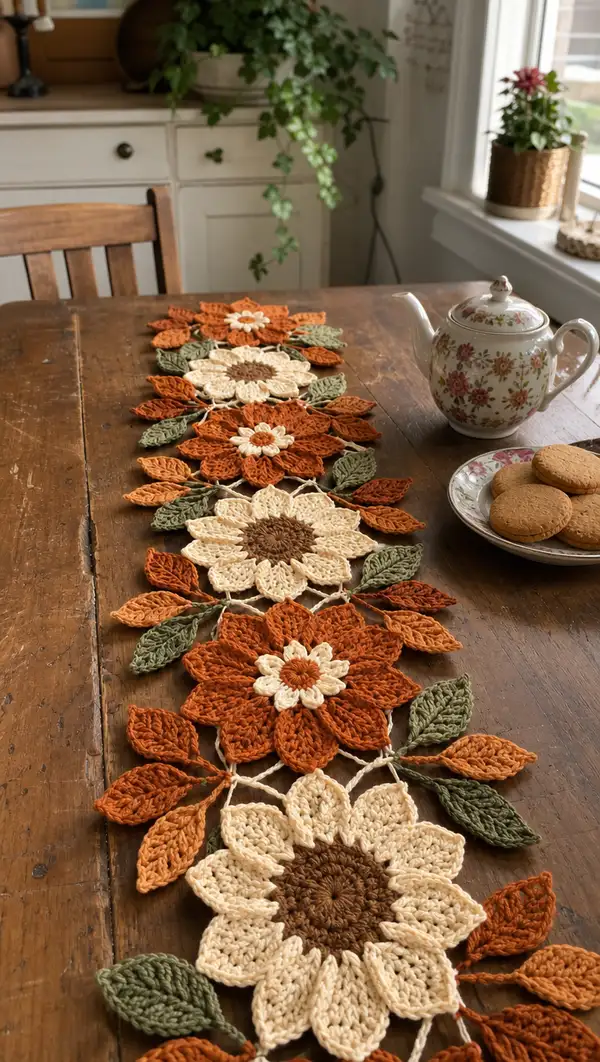
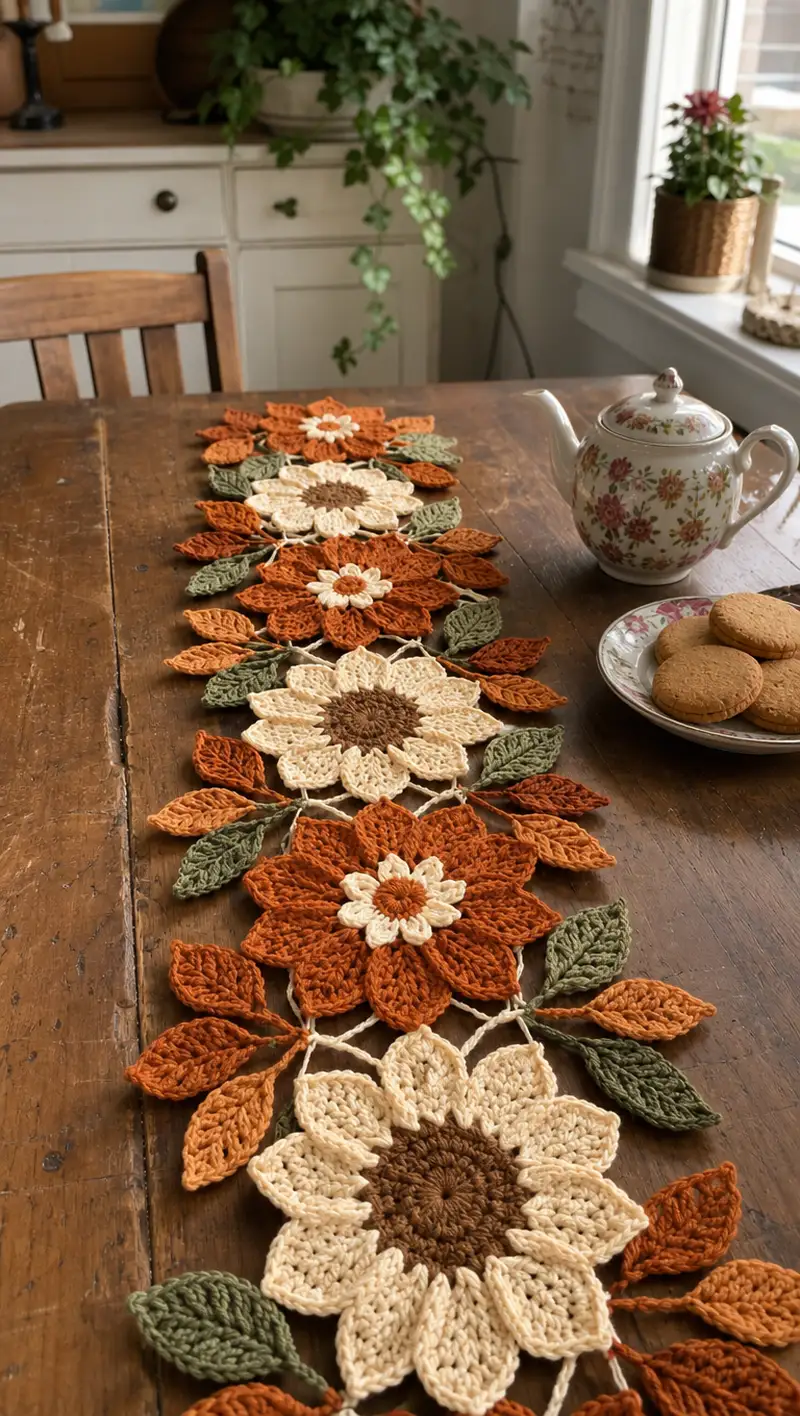
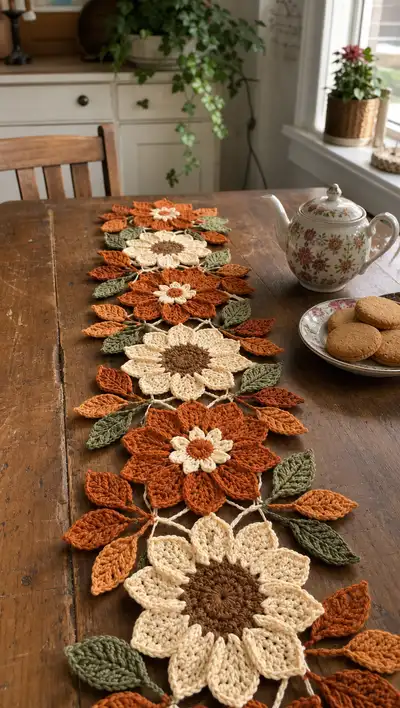
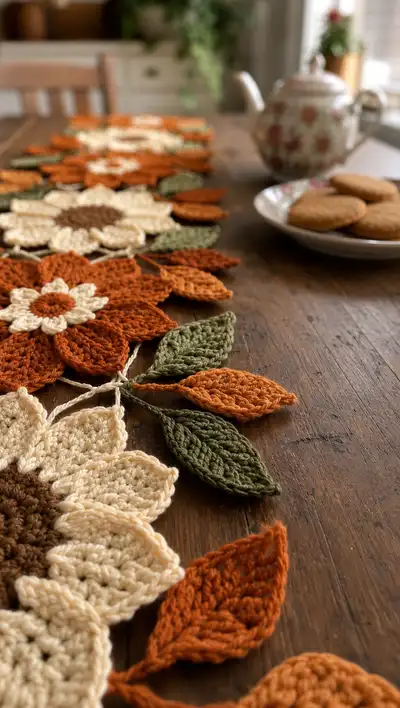
Create a warm, rustic table runner made of joined sunflower motifs and leafy connectors in autumn tones. This pattern uses layered sunflower motifs, delicate leaf elements, and join-as-you-go techniques to form a long, decorative runner. Finished runner shown with rich rust, burnt orange, cream, brown, and olive tones and a subtle openwork join. Ideal for seasonal decor or a thoughtful handmade gift.
Progress Tracker
0% Complete
— Notes & Gauge :
Info :
Gauge is not critical for this decorative runner, but for consistent motif size: 10 cm (4 in) across the center disc worked through round 10 using recommended yarn and 4.0mm hook. Work tightly enough so petal edges are defined. Use blocking to open petals and flatten leaves before assembly.
Info :
Throughout this pattern: when a motif or leaf says 'make X' you will repeat all rounds for that element X times. Use stitch markers to mark round starts. Color names used: 'Rust' (medium rust/orange), 'Burnt Orange' (darker copper orange), 'Cream' (soft ivory), 'Brown' (center), 'Olive' (leaf green), 'Natural' (neutral beige).
— Large Sunflower Motif (Make 5) :
Round 1 :
With Brown, mr, 6 sc into ring (6)
Round 3 :
(1 sc, inc) x6 (18)
Round 4 :
(2 sc, inc) x6 (24)
Round 5 :
(3 sc, inc) x6 (30)
Info :
Start center increases to reach a flat disc about 6-7 rounds in depending on yarn. If your center bowls, stop increasing one round earlier. Count stitches frequently.
Round 6 :
(4 sc, inc) x6 (36)
Round 7 :
(5 sc, inc) x6 (42)
Round 8 :
(6 sc, inc) x6 (48)
Round 9 :
1 sc in each st (48)
Round 10 :
1 sc in each st (48)
Info :
Change to Petal Color (Rust or Cream depending on your motif) at the end of Round 10. Fasten off Brown or leave a short tail to weave into back. Place marker at the last sc of Round 10 to maintain orientation.
Round 11 :
With Petal Color, *sc in next 3 sts, ch5, sk next 1 st* rep around to make 12 ch5 loops (48 sc remain); sl st to first sc to join
Round 12 :
Work petals into ch5 loops: *(sc, hdc, 3 dc, hdc, sc) into next ch5 loop; sl st into next sc on base* rep 12 petals (work anchors into base scs; the base will still have 48 sts around)
Info :
Each petal is worked entirely in the round of Round 12 as a shell anchored into base. Keep petals flat by not pulling loops too tight; you may want to block petals flat before next round.
Round 13 :
Ch1, sc around base between petals (48)
Round 14 :
To add a second petal layer: *ch3, sl st into base sc between petals to create 12 small loops; sl st to next base sc* rep around (creates 12 loops positioned between main petals)
Round 15 :
Into each ch3 loop: (sc, hdc, 3 dc, hdc, sc) to form inner decorative petals (12 petals)
Info :
This round creates a layered effect with smaller inner petals. If you prefer single-layer sunflower, skip Rounds 14-15 and proceed to Round 16.
Round 16 :
Ch1, sc evenly around entire motif in FLO to create a subtle ridge and improved join surface (count will be approximately 48+12 anchors ≈ 60, adjust as needed to place 1 sc between petals)
Round 17 :
Edging round: *[sl st in next 2, ch4, sl st in next sc]* rep around to create small decorative picot loops spaced between petals. Fasten off and weave ends. (Spacing adjust to maintain symmetry)
Info :
Block each motif lightly by pinning to a flat surface and spritzing water, arranging petals flat. This will help them sit evenly when joined. Make 5 large sunflower motifs in alternating colors (3 Cream-centered with Rust petals and 2 Rust-centered with Burnt Orange petals, or as preferred).
— Small Center Flower Motif (Accent, Make 4) :
Round 1 :
With Rust or Cream, mr, 6 sc (6)
Round 3 :
(1 sc, inc) x6 (18)
Round 4 :
Ch3, *2 dc in next st, ch1, sl st into next st* rep until you have a ring of small petals (18 anchors) Fasten off (creates a decorative small motif to place between large flowers)
Info :
These smaller motifs are used as fillers in the runner and sit between large sunflowers. Make 4 and block flat before assembly.
— Leaf (Make 30-36 total; mix Olive and Burnt Orange) :
Round 1 :
With Olive (or Burnt Orange), ch6, sc in 2nd ch from hook, hdc in next, dc in next, tr in next, dc in next, hdc in next, sc in next (create a tapered tip), sl st to last ch to turn (this begins leaf foundation)
Round 2 :
Work along one side of the chain: sc in first base st, hdc, dc, (2 dc) in center top, dc, hdc, sc; continue working along other side mirroring the increases to form leaf thickness. End with sl st into base to complete one side (approx 12 sts total)
Round 3 :
Turn and work into the FLO of the leaf: sc in each st to create a ridge: sc across (12) Fasten off or continue to Round 4 for more texture.
Info :
If you want more pronounced veins, use BLO on Round 3 so the ridge stands up. Make leaves in two sizes by varying starting chain length: ch6 (small), ch8 (medium), ch10 (large). Block leaves with a little steam or mist for definition.
Round 4 :
For larger leaf: after Round 2 add an extra round: *sc in each st BLO around (approx 16-20) to add body to leaf* Fasten off and weave ends.
Info :
Make approximately 30-36 leaves total to match runner layout—mix Olive and Burnt Orange colors. Leaves will be joined between sunflower motifs creating clusters of 2-4 leaves each.
— Connector Chain & Join-As-You-Go Motifs :
Round 1 :
With Natural, ch40 (or a length between motifs to space motifs as desired), sl st to form a loose loop that lays flat between motifs. Fasten off leaving long tail for sewing. Repeat chain connectors between each sunflower motif and small filler motif.
Info :
Join-as-you-go: you can choose to either sew motifs together after blocking or create connector chains while crocheting the final edging of each motif. To j-a-y-g, when working petals' edging round (Round 17 of Large Sunflower), instead of sl st to join, sl st into corresponding loop on adjacent blocked motif where pinned in place.
Round 2 :
Alternative join method: Use Natural to create small picot chains (ch5, sl st into motif edge, ch5) that form the open lattice seen in the photo. Make 3-4 picot chains between each adjacent petal tip on neighboring motifs.
Info :
When positioning connectors, lay out motifs in final order on table and pin connectors to check spacing. The photo shows motifs arranged with about 1.5-2 cm gaps filled by leaf clusters and picot chains; adjust ch length accordingly.
— Border Edging (Final Unifying Round, Work After All Motifs Are Joined) :
Round 1 :
With Natural, working around the entire assembled runner, sc evenly around all outer edges and leaf tips to create a unified edge. When working around petal clusters, place 2 sc in outermost tip stitches to keep edge flat. Continue around entire runner.
Round 2 :
Work a decorative scallop: *skip 2 sc, (5 dc) in next sc, skip 2 sc, sl st in next sc* rep around edges and leaf tips to create small scallops. Fasten off and weave in ends.
Info :
This edging brings motifs together visually and gives the runner a finished look. If you prefer a more minimal look, a single round of sc in BLO around the assembly is enough.
— Alternate Embellishments (Optional) :
Round 1 :
For a raised center, you can add a 2-round textured disc: With Brown, mr, 8 sc (8); Round 2: (1 sc, inc) x4 (12). Then use a short embroidery stitch to produce center rays. Attach to motif center with slip stitches and sew securely.
Round 2 :
To add tiny seeds effect, embroider small French knots or bullion knots in center with a darker brown yarn after motifs are joined and blocked. This adds three-dimensional texture representative of sunflower seeds.
Info :
If gifting to households with small children, avoid sewing on beads or small embellishments; keep centers embroidered or crocheted for safety.
— Putting It All Together (Assembly Sequence) :
Info :
Layout: Arrange motifs in an alternating color pattern along the runner length: Large Sunflower, Large Sunflower, Small Accent Flower between; adjust until satisfied. Place leaf clusters (2-4 leaves) around petal junctions. Pin everything to the blocking mat before final joining.
Round 1 :
Sewing joins: Using Natural and a yarn needle, whip stitch or mattress stitch the connector loops and picot chains into place, securing petals and leaf bases. Use small, evenly spaced stitches to avoid visible seams.
Round 2 :
After initial sew joins, check runner on a flat table and add additional picot chains or short ch loops to fill any visible gaps between petals and leaves. Secure ends and weave into adjacent motifs.
Info :
For the most seamless look, join two motifs by matching 3-4 picot points along petal edges and using slip stitches with corresponding motifs pinned together, then secure with yarn needle for durability.
Round 3 :
Once fully joined, work the Border Edging rounds described earlier to unify and tidy all outer edges and leaf tips. After edging, give the entire runner a final light blocking and allow to dry fully.
— Detailed Stitch Math and Examples (Reference) :
Info :
Large motif stitch counts: Center rounds expand 6->12->18->24->30->36->42->48. Petal anchors assume 48 base stitches and produce 12 large petals (anchor every 4 base sts). Inner small petal ring anchors at 12 spaces created by groupings when you form ch5 loops in Round 11.
Info :
Leaf sizing: ch6 base yields about 10-14 total stitches in finished leaf; ch8 yields 14-18; ch10 yields 18-24 depending on amount of increases and whether you add extra outer rounds. Plan leaf cluster sizes to fit petal spacing between motifs.
Info :
Spacing summary: Leave roughly 1.5-2 cm between large motifs when pinned; use leaf clusters and connector picot chains to bridge the gap into a continuous runner. If you want a denser runner, reduce chain connector length to ch25-30 per gap.
— Troubleshooting and Tips :
Info :
If petals curl up, steam block them flat or add a small beading of glue under petal tip while flattening on a pinboard. If center bulges, reduce increases in the final increasing round by stopping one round earlier or adding an even round of sc to flatten center.
Info :
To change runner length: Add or remove large sunflower motifs and adjust number of small filler motifs and leaves accordingly. Each additional large motif adds roughly 18-25 cm to final runner length depending on spacing.
Info :
Color swapping: Use Cream as the lightest petal color and Rust/Burnt Orange alternately for contrast. Place Olive leaves mostly adjacent to Rust petals and Burnt Orange leaves adjacent to Cream petals for balanced contrast similar to the photo.
Info :
Final care: Hand wash gently or machine wash on delicate inside a delicates bag, reshape and lay flat to dry. Cotton yarns are great for table linens but will soften with wash; keep out of very hot dishwasher-style exposure.
This sunflower table runner blends rustic charm with crochet technique, creating a beautiful seasonal accent for any table. The layered petals and leafy connectors bring depth and warmth to a room, and the modular pattern makes it easy to customize length and color palette. Enjoy the meditative process of making each motif, then watch them come together into a striking display. 🧶🍁 Your handmade runner will become a treasured centerpiece for autumn gatherings. Happy stitching! ✨